
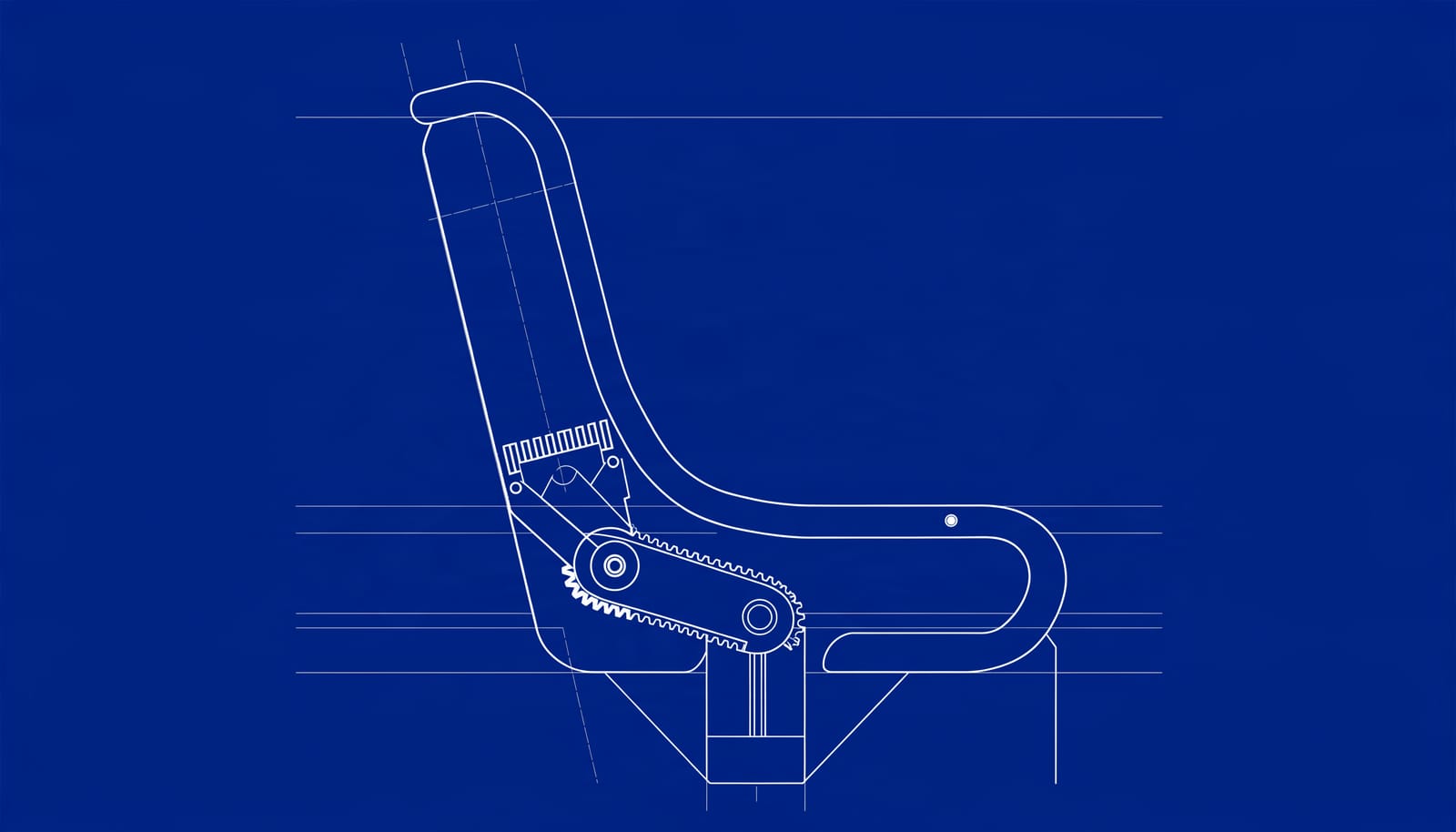
You pull the bar down, it clicks a few times, a green light comes on somewhere near your knee, and a stranger tugs on it before the train moves an inch. None of that looks like it could survive an upside-down loop at 100 km/h (62 mph). And yet it does, every day, on machines that carry millions of people without the restraint ever being the thing that fails.
The short answer: a coaster restraint is really two devices in one — a locking mechanism (ratchet-and-pawl or hydraulic) that can only tighten, never loosen, on its own, and a containment shape (lap bar, vest, or full over-the-shoulder harness) sized to the specific forces that ride’s layout produces. The shape looks scarier as the ride gets wilder; the lock underneath is doing most of the actual work regardless of shape.
Here’s how both halves are engineered, why the industry is quietly retiring its bulkiest restraints, and why the ones that remain still occasionally bruise your ears.
Three families, one job
Every coaster restraint on Earth is a variation on three basic shapes. A lap bar is a padded bar that swings down across the hips and thighs, leaving the torso free — the minimum viable restraint, used wherever the forces stay gentle and mostly vertical. A vest or T-bar restraint adds a soft harness or raised handlebar across the chest, containing the upper body without rigid shoulder contact. And an over-the-shoulder restraint (OTSR) is the heavy artillery: a rigid U-shaped yoke that comes down over both shoulders and locks at the lap, built for rides that turn riders properly upside down.
None of these is a style choice. Each is sized to the worst moment the ride’s layout produces, which is why the second half of this article spends so long on forces rather than padding. The same three shapes turn up well beyond coasters, too — a drop tower’s OTSR is holding you in against several seconds of genuine weightlessness, not a curve.
Locking without holding
Whatever shape the restraint takes, it has to lock by the same basic trick: a mechanism that will only move in the closing direction. The older method is a ratchet and pawl — a toothed quadrant on the bar’s pivot, with a spring-loaded pawl that drops into each tooth as you pull the bar down. It can slide forward one tooth at a time, but the pawl physically blocks it moving back, which is where the reassuring clicking comes from.
The modern default is a hydraulic piston: pulling the bar down forces fluid through a one-way valve into a reservoir, and because the valve won’t let fluid flow back, the bar can’t loosen either. It has no teeth, so it locks at literally any position rather than the nearest notch — which is why hydraulic restraints tend to feel snugger and stop clicking altogether.
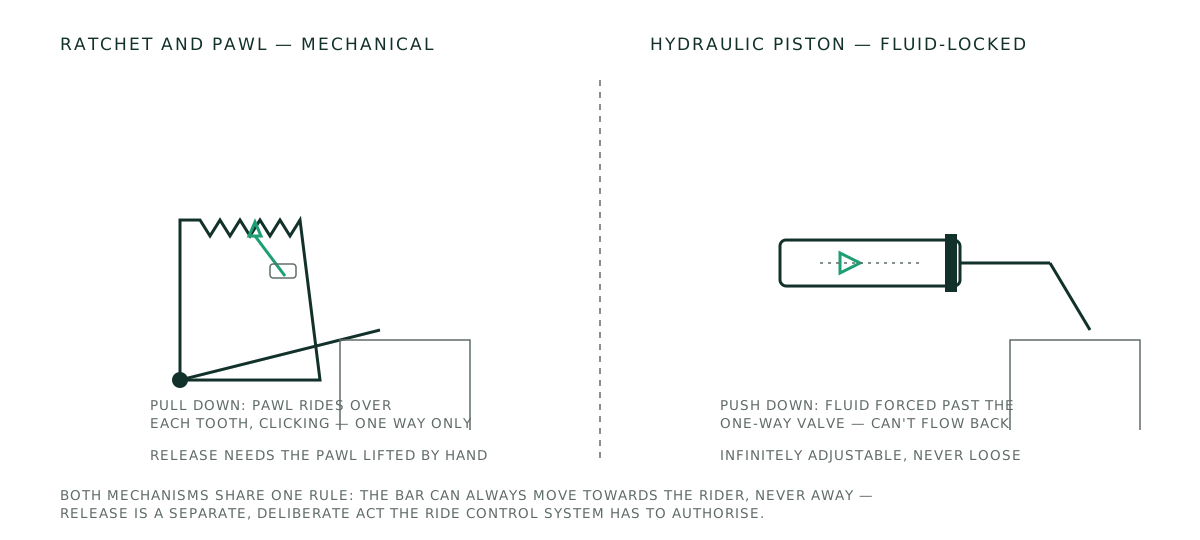
Both designs share the same fail-safe logic as coaster brakes — closing is passive and automatic, opening needs a deliberate, powered release. A restraint that has locked cannot un-lock itself, whatever else on the ride goes wrong.
Normally closed, on purpose
That “release needs power” property is the whole safety case, and it’s worth stating plainly because it’s counter-intuitive: the restraint you can’t easily loosen is the one you should trust. A restraint that could work itself loose under vibration, or that a rider could reopen mid-ride by leaning the wrong way, would be a liability regardless of how padded it looked.
The release side is deliberately harder. A ride operator’s console sends an electrical signal that energises a solenoid, which either releases hydraulic pressure back to a reservoir or lifts every pawl clear of its ratchet simultaneously. Cut the power, and the restraints do nothing at all — which, as with brakes, is the entire point. An unpowered restraint stays locked; only a powered one can open.
Restraints are a dispatch input, not an afterthought
This is where restraints stop being a personal-comfort story and become part of the ride’s actual safety architecture. Before a coaster can leave the station, the control system checks a list of conditions, and “every restraint reads locked” sits on that list alongside “the block ahead is empty” — the same one-train-per-block rule that keeps trains from colliding.
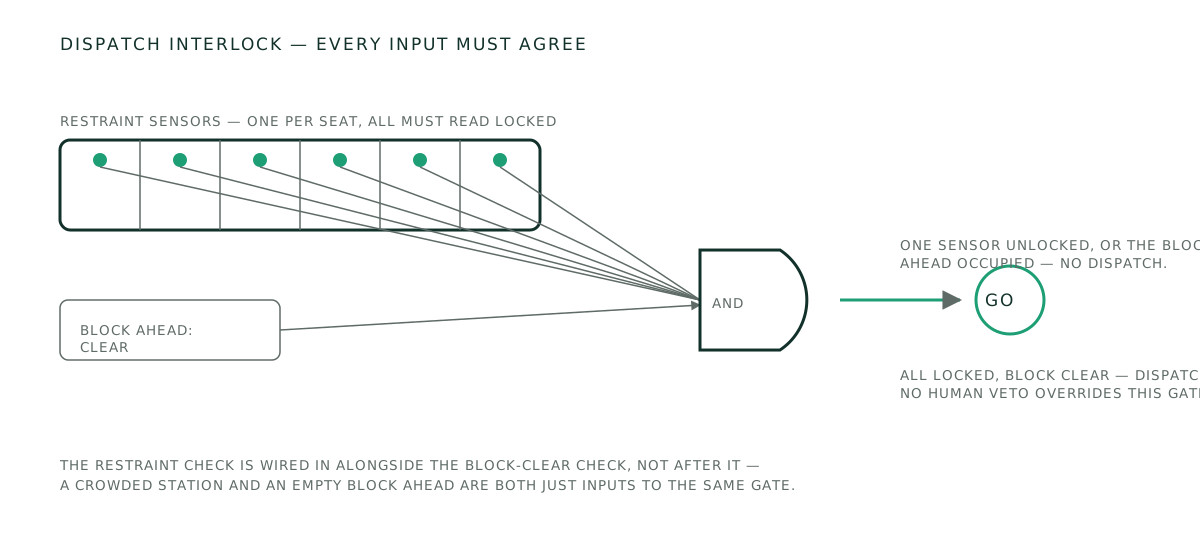
Each restraint carries a proximity sensor — often the little light you’ll spot near the seat — that reports locked or unlocked to the ride’s programmable logic controller. That controller is deliberately indifferent to why an input is unhappy: a restraint that hasn’t clicked shut behaves, as far as the dispatch logic is concerned, exactly like a train still sitting in the block ahead. Neither gets a train moving. The operator manually checking and tugging every bar before waving the train off isn’t theatre laid on top of the sensors — it’s a second, human-run check of the same fact the electronics already tested.
That same unforgiving logic is why a rider’s own unsecured belongings, or even a loose limb, are treated as a genuine hazard rather than a formality — Efteling’s new SafeStrap, launched in September 2026 to let riders with leg prostheses keep them on, exists precisely because a restraint system has no way to certify “mostly secure.”
Matching the restraint to the forces
The reason a hyper coaster with 67 m (220 ft) of airtime hills can get away with a lap bar, while a looping coaster needs a full harness, comes down to which direction the forces actually push.
Airtime — the floating sensation over a hill’s crest — is negative vertical g, and it lifts you up out of your seat, which a lap bar resists perfectly well by pressing down across your hips. B&M’s Silver Star at Europa-Park is 73 m (239 ft) tall and hits 127 km/h (79 mph) across a string of camelback hills with zero inversions, and it carries nothing but a lap bar — because nothing on that layout ever tries to throw a rider sideways or upside down. Intamin’s Taron at Phantasialand, a 117 km/h (73 mph) launch coaster with sharp negative-g airtime moments of its own, uses the same logic: a lap bar with soft shoulder pads for comfort, deliberately built without rigid OTSR arms so even larger riders keep freedom of movement.
Push, twist, or invert the layout and the maths changes. A loop turns you fully upside down, briefly relying on the restraint alone against your own weight; a corkscrew adds lateral forces a lap bar was never shaped to catch. That’s the point at which engineering reaches for the OTSR — though not always: Intamin’s single-rail Hot Racer trains, confirmed for Djurs Sommerland’s Midgårdsormen with three inversions, hold riders on an over-the-shoulder lap bar rather than a full harness, betting on inline single-seat trains and a lighter chassis to keep the forces centred enough that Taron’s logic still applies.
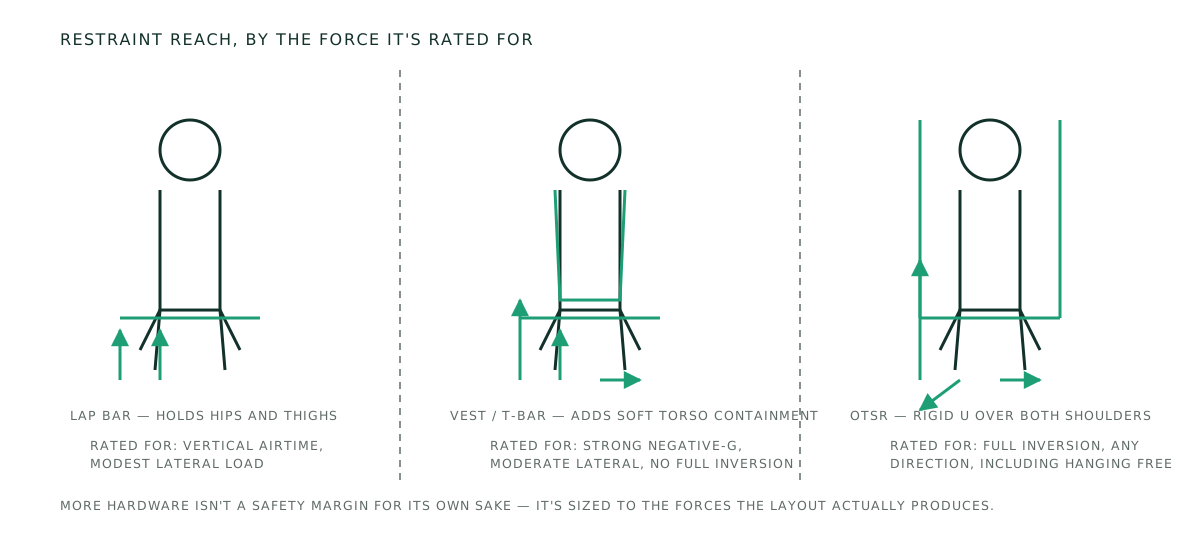
The interesting exception is Rocky Mountain Construction’s I-Box hybrids, which routinely put riders through inversions with a lap bar alone — Zadra at Energylandia is 62.8 m (206 ft) tall, hits 121 km/h (75 mph) and carries three inversions on nothing but a lap bar. RMC’s trick is shaping the inversions so the combined force stays pressed through the seat along the rider’s centreline throughout — the same heartlining principle used across its track designs — rather than letting it swing sideways or try to lift the rider clear. Get the g-forces to behave and the restraint requirement drops with them.
When it goes wrong: the headbanging problem
None of this means OTSRs are beloved. Vekoma’s Suspended Looping Coaster (SLC) model carries one of the industry’s worst reputations, and the restraint is a large part of why: a rigid, relatively bulky OTSR combined with rough tracking on ageing examples produces the phenomenon enthusiasts call headbanging — the restraint’s own hard edges knocking against the rider’s head and ears on every direction change, because there’s nothing soft between skull and steel. Riders have developed an actual brace position for it, which is not a sentence that should exist about a safety device.
The restraint isn’t unsafe in the sense that matters — it locks, it holds, it does its one job. It’s simply a first-generation shape that never accounted for how much a worn track would shove riders around inside it, and three decades of tightening tolerances haven’t fully solved a problem baked into the geometry.
The industry’s fix: softening the harness
The fix the industry landed on is the vest restraint, and it’s a genuine engineering response rather than a comfort upgrade dressed up as one. B&M introduced its first vest harness on Banshee at Kings Island in 2014 — 51 m (167 ft) tall, 109 km/h (68 mph), with 7 inversions — pairing a rigid lap bar with a soft mesh panel across the chest instead of a hard shoulder yoke. It still contains the rider through a full inversion; it just does it without a steel edge anywhere near the head.
Vekoma has run the same idea in reverse, retrofitting vest-harness trains onto existing SLCs rather than designing them in from new. Energylandia’s Mayan, an SLC that opened in September 2015, is one of only a handful worldwide to receive this treatment, alongside Walibi Holland’s Condor — enthusiast trackers who catalogue these retrofits count them in single digits globally, which tells you how expensive and rare a fix it is for a ride already built. Energylandia may be about to get a vest restraint the easy way, too: construction photos spotted in September 2026 point to an unannounced B&M wing coaster, a format that has carried nothing but a vest since its very first installation.
Where you’ll find it
| Ride | Park | Manufacturer | Restraint | What it’s rated for |
|---|---|---|---|---|
| Silver Star | Europa-Park, Germany | B&M | Lap bar | 73 m (239 ft), 127 km/h (79 mph), zero inversions |
| Taron | Phantasialand, Germany | Intamin | Lap bar, shoulder pads | 117 km/h (73 mph) launch, no OTSR needed |
| Zadra | Energylandia, Poland | RMC | Lap bar | 121 km/h (75 mph), 3 inversions, heartlined track |
| Banshee | Kings Island, USA | B&M | Vest / soft harness | First B&M vest restraint, 7 inversions |
| Mayan | Energylandia, Poland | Vekoma | Vest (retrofit) | SLC retrofitted from OTSR to reduce headbanging |
| Nemesis | Alton Towers, UK | B&M | OTSR | Retained on its 2024 retrack — no clearance for a wider vest train |
Nemesis is the instructive case at the strict end. When Alton Towers rebuilt the ride’s track in 2022–2024, the trains kept their original rigid OTSRs rather than switching to B&M’s newer vest harness — reportedly because vest trains are physically wider, and there simply wasn’t clearance to widen the ride envelope through an already-tight ravine. Sometimes the restraint that stays is the one the site allows, not the one the industry would pick today.
The Dispatch verdict
The genuinely clever part of a coaster restraint isn’t the padding riders notice — it’s that the entire system is built to fail towards staying shut. A lock that can only tighten, a release that needs deliberate power, and a dispatch computer that treats one unhappy sensor exactly like a train stuck on the track ahead: three separate pieces of engineering, all pointed the same direction. The vest-harness trend is the industry doing the harder thing well — instead of just declaring the OTSR safe enough and moving on, it went back and re-engineered the shape until the safety case and the comfort case finally agreed.
Next time the bar clicks home and the light goes green, you’re not watching a formality. You’re watching the same interlock logic that keeps two trains apart, applied to you.
Further reading: how block systems keep trains apart, how coaster brakes fail towards stopped, how launch coasters build the forces restraints have to hold, and why log flumes and rapids rides get away with a lap bar alone.