
Two things happen on nearly every water ride, and neither makes obvious sense the first time you think about it. A log flume’s boat climbs a hill with no chain, no motor you can see, and no driver — then somehow stops dead at the bottom without throwing you through the windscreen. And on the ride next door, a perfectly round raft spins a different amount on every single lap, as if the water itself were making it up as it goes.
The short answer: a log flume climbs on a cleated conveyor belt that grips a bar under the boat’s hull, then lets gravity and a carefully shaped trough do the rest, right down to a deliberate upward kick at the bottom that turns your speed into a wave instead of a jolt. A rapids raft never climbs at all — it’s pushed by pumped, gradient-fed current the whole way round, and its “random” spin comes from bumping fixed, unmoving fins in the channel wall at a slightly different angle every single pass.
Here’s the machinery behind both rides, and why they solve the same problem — moving you without an engine — in almost opposite ways.
Two rides, one family, opposite tricks
Log flumes and river rapids rides get lumped together as “water rides” so often that it’s easy to miss how differently they actually work. A flume is fundamentally a gravity ride wearing a wetsuit: it needs height, because height is where the drop — and the thrill — comes from, exactly the way a roller coaster’s lift hill banks the potential energy it spends later. A rapids ride needs none of that. It runs at one level, start to finish, and gets its energy from pumps shoving water around a closed loop rather than from anything falling.
That single difference — one ride climbs, the other doesn’t — explains almost everything else that follows: why a flume needs a lift mechanism at all, why a rapids raft is round instead of boat-shaped, and why the two rides manage their traffic in completely different ways.
The flume’s lift: a conveyor, not a coaster chain
A coaster’s lift hill grips a train with a chain dog — a hinged hook that catches a chain link and clicks past the next one if the train slows, which is the sound that gives the whole mechanism away. A log flume’s lift does the same basic job — haul a vehicle up an incline — with none of the same hardware, because a boat doesn’t have a fixed metal chassis riding a fixed rail the way a coaster train does.
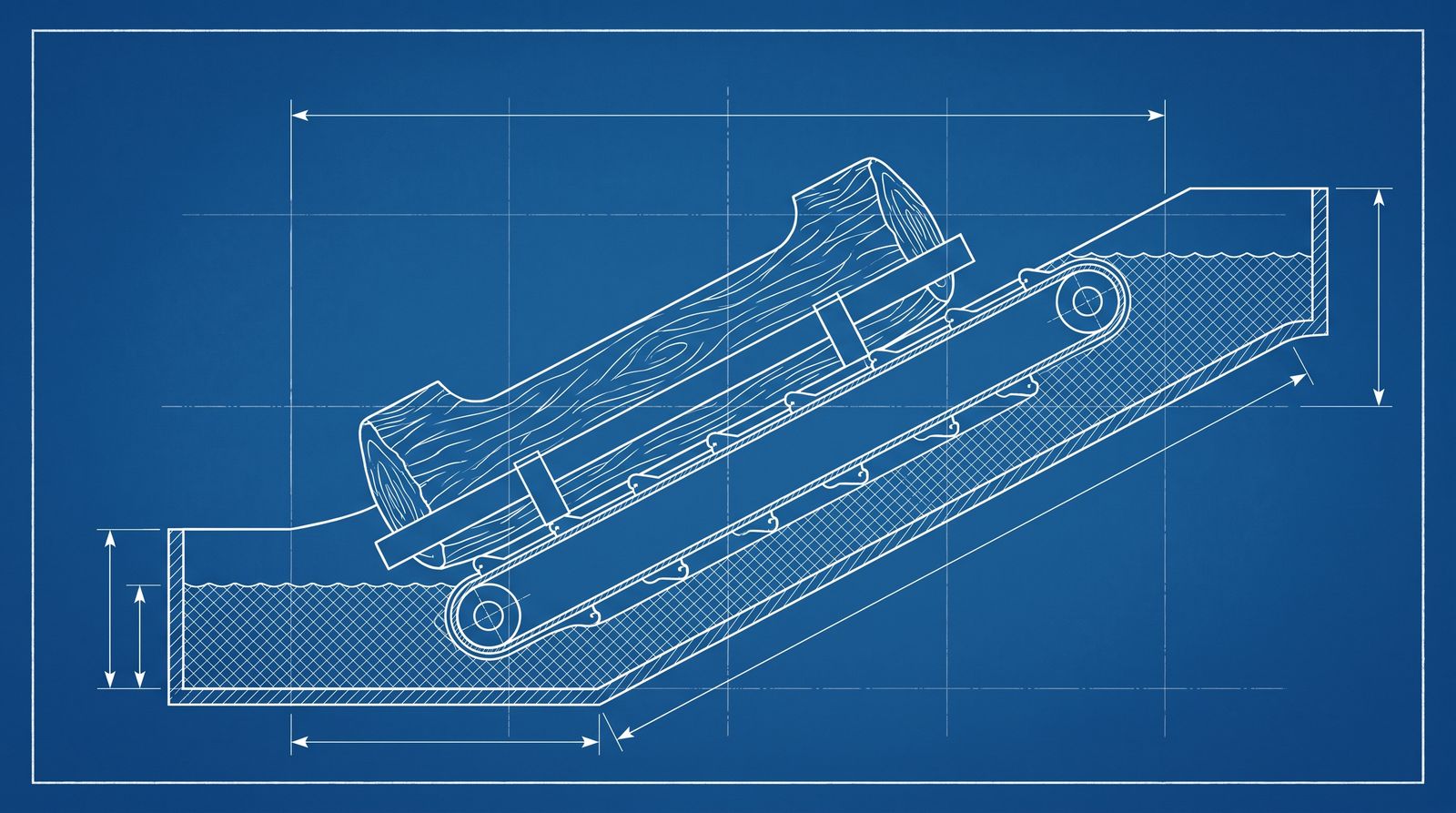
Instead, the base of each fibreglass boat carries a locking bar, a raised rib running across the underside of the hull. The incline itself hides a continuous conveyor — a looped belt or chain fitted with raised cleats — running just beneath the trough. As the boat floats onto the lift, the cleats catch the locking bar from behind and haul the whole boat, water and all, up the slope at a fixed, steady speed. There’s no clicking anti-rollback dog anywhere in this system, and there doesn’t need to be one: a coaster train left to its own devices on an incline will roll backwards under gravity, but a boat that loses its grip on the conveyor simply floats, going nowhere in particular, because it’s buoyant rather than rolling on wheels. Different physics, different safety problem, different solution.
The trough is a river with a script
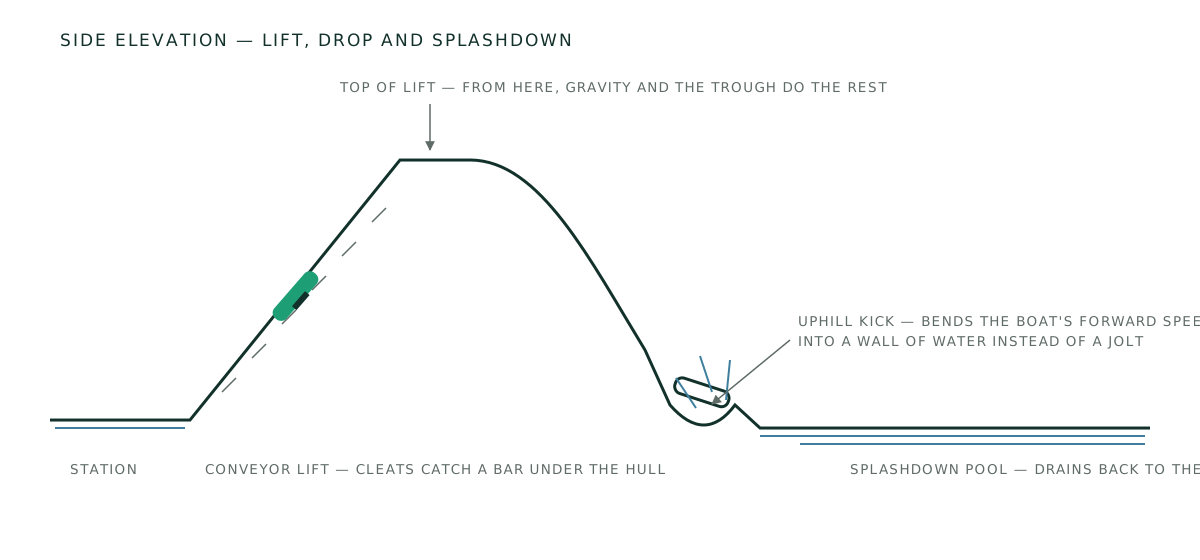
Once a boat crests the lift, the ride’s designer has already decided everything that happens to it. The trough — the fibreglass, concrete or galvanised-steel channel the boat floats through — is shaped to manage speed and depth continuously, without a single moving part doing the work. A long drop needs somewhere for all that speed to go, and simply running the boat into a flat pool at the bottom would stop it the way running into a wall stops a car: hard, and unpleasantly, for everyone in the front row.
The fix is a small, deliberate rise at the very bottom of the drop — an uphill kick — that catches the boat just as it’s moving fastest. Rather than absorbing the impact as a jolt, the upward curve converts the boat’s forward momentum into a burst of vertical motion: the bow lifts, a wall of water sheets up and forward off the hull, and the boat settles gently into the pool having shed most of its speed to the splash rather than to your spine. It’s the same instinct as a block brake’s fail-safe design applied to hydraulics instead of steel — the ride is engineered to fail towards comfort, not against it.
The closed loop of water beneath your feet
None of this works without an enormous amount of water going somewhere and coming back. A flume (and a rapids ride, for that matter) isn’t sitting on a river — it’s sitting on a closed circuit, with a reservoir tucked out of sight and a bank of pumps doing the actual work of physics. Water drains from the splashdown pool back to a low-point reservoir, then gets pumped back up to the top of the lift to refill the trough, over and over, all day.
The scale is genuinely industrial. At Efteling’s Piraña, four pumps circulate roughly ten million litres of water an hour to keep the ride’s current moving — a volume that would fill an Olympic swimming pool in under fifteen minutes, recycled continuously rather than drawn fresh. None of it is decorative; the ride simply stops working the instant the flow does.
Rapids: the raft with no front and no rail
A rapids raft looks nothing like a flume boat, and that’s not a styling choice either. It’s a circular fibreglass hull ringed by a thick rubber tyre, deliberately symmetrical, with no bow, no stern and no fixed orientation — because unlike a coaster’s wheel truck, which grips a rail from three directions at once to stop the vehicle leaving a defined path, a rapids raft has no rail at all. It free-floats in an open channel, at the mercy of the current and every other raft’s wake, and the rubber ring is there to absorb exactly the collisions that arrangement guarantees — with the channel walls, with rocks and obstacles built into the riverbed, and with other rafts.
The current itself comes from the same pump-and-gradient system as a flume’s water supply, minus the lift hill: submerged axial-flow pumps, usually four of them (three running, one on standby), push water through a channel that’s gently sloped and deliberately narrowed or obstructed at points to whip up genuine turbulence. There’s no equivalent of a coaster’s chain or a flume’s conveyor, because there’s nothing to climb — the whole circuit runs at one level, and the “lift” you’ll sometimes see at the loading station isn’t there to gain height at all. It’s usually a turntable or short conveyor that rotates the raft to present a boarding gap at the platform edge, then simply releases it back into the current.
The “random” spin that isn’t random at all
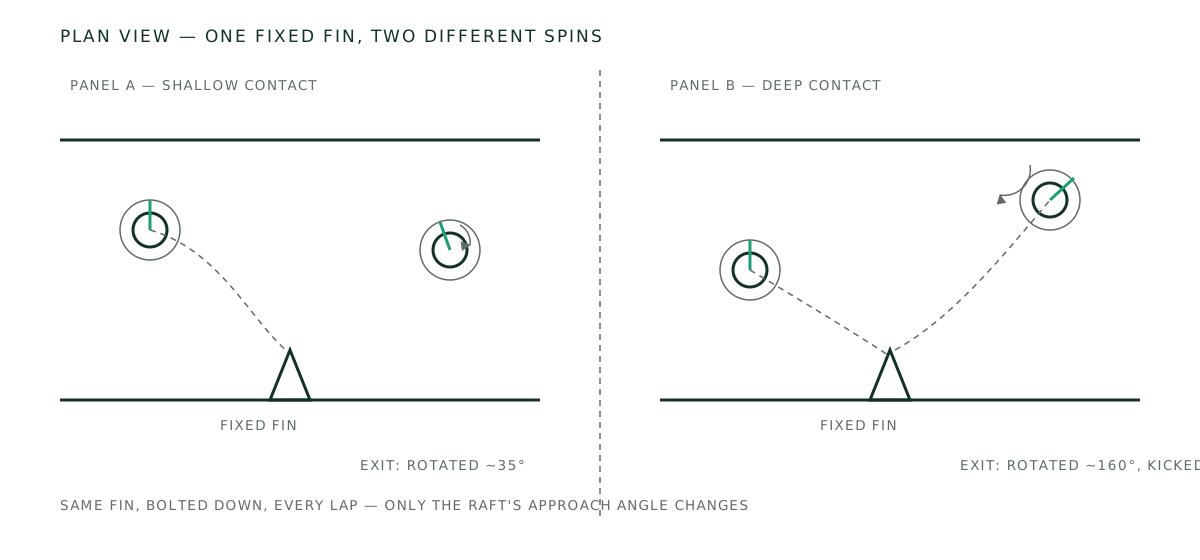
Watch a rapids raft long enough and it looks like the ride is improvising — spinning hard on one lap, barely turning on the next, in a pattern no rider can predict. It isn’t improvising. Manufacturers build fixed spin features — raised fins or ledges bolted permanently to the channel wall or floor — at specific points along the circuit, and it’s contact between those fixed features and matching features moulded into the raft’s rubber ring that causes the rotation, entirely mechanically, every single time.
What makes the spin feel random is that the fin itself never moves, but the raft’s approach to it does. A raft arriving a few centimetres to one side, or nudged a fraction of a degree by an earlier bump with the channel wall or another raft’s wake, meets the same fixed fin at a different angle — and a different angle of contact produces a different amount of spin. It’s the technical definition of chaotic rather than genuinely random: a fixed, entirely deterministic mechanism whose result is so sensitive to tiny upstream variations that predicting it in advance is practically impossible, even though nothing about the fin itself ever changes.
Traffic control without a block system
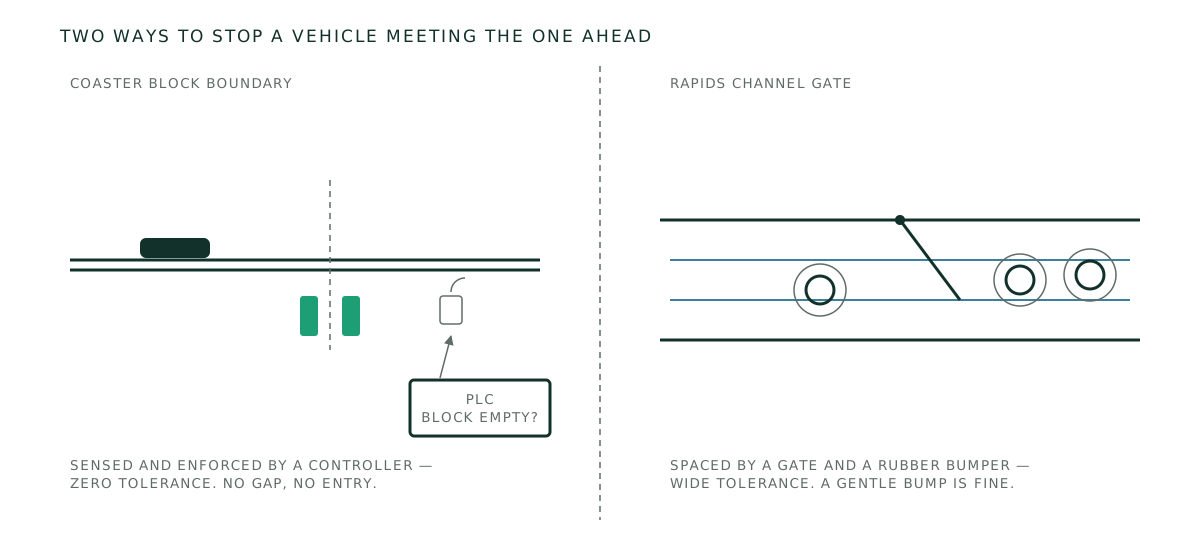
A roller coaster manages multiple trains with a block system: sensors report every train’s position to a PLC, and the controller enforces one absolute rule — no train enters a block until the one ahead has fully left it. Zero tolerance, because a coaster train meeting another coaster train is a disaster, not an inconvenience.
A rapids ride can’t run that system, because there’s no rail to define discrete positions and no chassis-mounted sensor target to detect — just an open channel full of loosely floating rafts. Instead, most rapids rides manage traffic with physical gates: hinged arms set into the channel that hold a raft back until the “reach” of river ahead of it has enough rafts already in it, then swing clear to release it. The tolerance is deliberately wide rather than zero, because the whole vehicle is built to absorb the contact a wider tolerance allows — that thick rubber ring exists precisely so a gentle bump between rafts is a shrug rather than an incident.
Restraints built for a gentler ride
The restraint hardware tells the same story from a different angle. A coaster’s harness is sized to the specific forces its track geometry produces — a rigid over-the-shoulder rig for a ride with real lateral force, a lap bar where the geometry keeps everything centred. Flumes and rapids rides sit at the gentlest end of that whole spectrum: the forces involved are mostly vertical and comparatively low, the real hazard is water entering the boat rather than a rider leaving the seat, and both ride types typically get away with a simple lap bar or lap belt rather than anything more restrictive. It’s the same principle as everywhere else in ride engineering — the restraint matches the force, no more and no less — just applied to a ride whose worst-case scenario is a soaking rather than a slam.
Where you’ll find it
| Ride | Park | What it’s doing |
|---|---|---|
| Chiapas | Phantasialand, Germany | Intamin log flume, opened 2014, 15 m (49 ft) tall with a 20 m (66 ft), 53° drop — the steepest log flume drop in the world, hit at 76 km/h (47 mph) |
| Congo River Rapids | Alton Towers, UK | Intamin river rapids, opened 1986, 725 m (2,379 ft) of channel, 35 rafts, roughly 2,480 riders an hour |
| Piraña | Efteling, Netherlands | Intamin river rapids, opened 1983, four pumps circulating about 10 million litres of water an hour around a 520 m (1,710 ft) circuit |
| Fjord-Rafting | Europa-Park, Germany | Intamin river rapids, opened 1991, 30 rafts carrying six riders each through a four-and-a-half-minute circuit |
Chiapas is the modern extreme of the flume side of the family — that 53-degree final drop exists purely because Intamin’s engineers pushed the uphill kick and trough geometry as far as they’d go without turning “wet” into “dangerous”. The three rapids rides, by contrast, are older designs from the format’s first decade, proof that fixed fins, gates and a rubber ring solved the problem well enough the first time that nobody’s had much reason to redesign it since.
The Dispatch verdict
Neither of these rides has an engine anywhere near the water, and that’s the entire point of both of them. A log flume banks height on a conveyor belt and spends it through a trough engineered down to the last upward kick; a rapids ride never banks anything, running instead on pumped current and a raft built to bounce off whatever it meets. It’s easy to write both off as the ride you queue for on a hot day and forget about by teatime — but a flume’s splashdown and a rapids raft’s spin are both doing exactly what a very specific piece of hydraulic engineering was built to make them do, right down to the fin nobody in the raft ever notices is there.
Next time a rapids raft spins you round for no apparent reason, you’ll know better: there’s a reason, it’s bolted to the wall, and it’s been there since the day the ride opened.
Further reading: how roller coaster block systems keep trains apart, how roller coaster wheels keep trains locked to the track, how restraints are matched to the forces a ride produces, and why the lift hill clicks.