
Here is a fact that unsettles people at exactly the right moment: the roller coaster train you’re sitting in has no brakes. No pedal, no lever, no discs — nothing. If you could somehow uncouple it and roll it down a hill, it would keep going until physics lost interest.
The short answer: on a modern coaster, all the braking lives in the track. Two working principles do everything — friction brakes that physically grip a metal fin under the train, and magnetic brakes that slow the same fin without ever touching it — and they’re deployed in four distinct jobs: ending the ride, separating trains, shaving speed mid-course, and stopping everything when something’s wrong.
That mid-course job is the controversial one. The trim brake may be the most complained-about component in the entire industry, and by the end of this piece you’ll be able to grumble about it accurately.
Brakes moved out of the train — eventually
It wasn’t always this way. The earliest coasters put braking where cars and trains put it: with a human. Copenhagen’s Rutschebanen at Tivoli Gardens — built in 1914 and still running — carries an actual brakeman, a member of staff sitting mid-train, riding every single lap and slowing the descent by hand. It’s one of only a handful of coasters left on Earth operated this way, and riding it is the closest thing coaster history has to a working museum — in a park that is currently rebuilding an entire district around a coaster from the other end of its history.
The industry’s move was to take the human — and eventually all the machinery — out of the train. First came skid brakes: long flat beds in the track that rise and press against the train’s underside, still doing station duty on many classic wooden coasters. Then came the modern standard: the train carries only a dumb metal fin, and the track carries everything clever. It’s the same design philosophy as the block system — keep the moving vehicle simple and passive, keep the intelligence on the ground where it can be powered, monitored and maintained.
Friction: the pinch brake
The workhorse is the pinch brake: pairs of calipers mounted in the track that clamp onto the fin as it passes. What elevates it from a bench vice to a safety system is the energy arrangement, which is worth seeing twice because it’s the industry’s signature move: springs close the brake, air pressure holds it open.
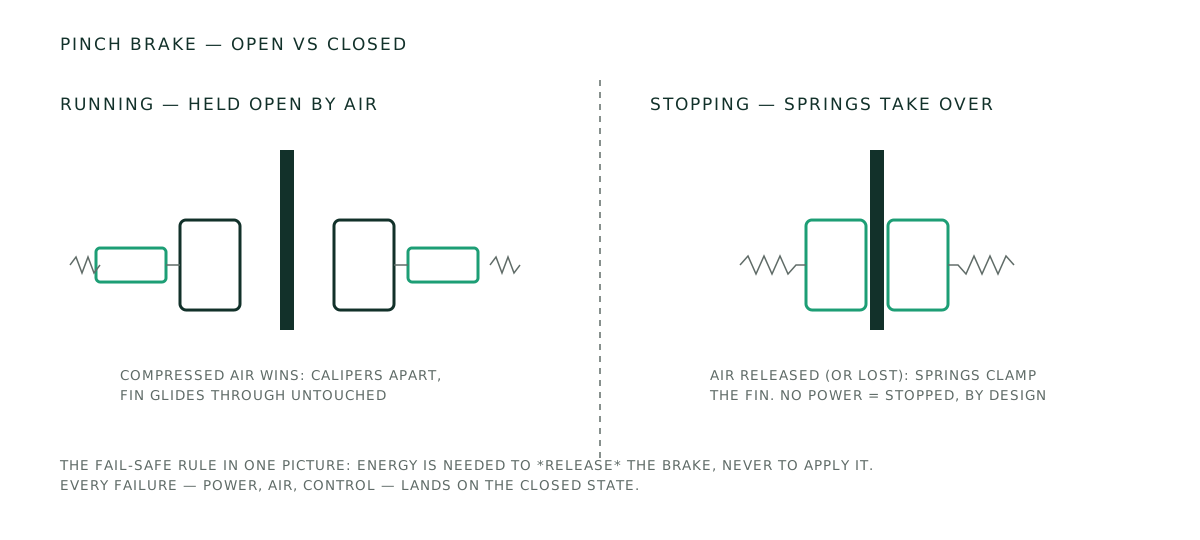
Run the failure cases in your head. Power cut? Brakes close. Air leak? Brakes close. Control system crash? The valves de-energise and the brakes close. There is no sequence of failures that ends with the brakes flopping uselessly open — the ride’s worst day is a park full of trains parked on brake runs, which is an inconvenience, not an incident. The restraint over your lap runs on the same principle: it can only tighten by itself, never loosen.
Magnetism: braking without touching
The second principle is more elegant and more limited. Run a conductive fin between strong permanent magnets and the movement itself induces swirling eddy currents in the metal; those currents create their own magnetic field, which drags against the motion. The result is a brake with no contact, no wear, no noise and — on the safety-critical installations — no power supply: a row of magnets bolted to the track will do its job during a blackout, an earthquake, or the heat-death of the universe.
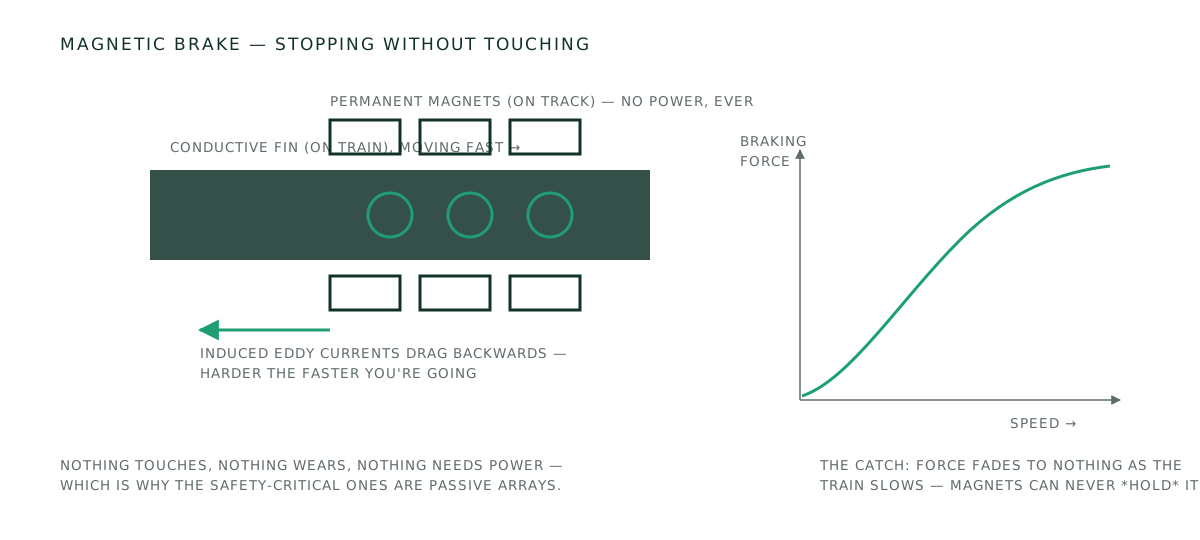
Notice the shape of that force curve, because it explains where magnets can and can’t be used. The drag is fierce at speed and fades to nothing as the train slows — which makes magnetic brakes wonderfully smooth (no jolt, just a firm lean) and completely incapable of holding a stopped train. That’s why a block brake is never magnets alone: magnets shed the speed, then friction calipers catch and hold, and drive tyres send the train on its way. Cedar Point’s Millennium Force introduced magnetic braking to the big leagues in 2000; today the combination package — magnets for the deceleration, pinches for the parking — is simply how brake runs are built. The same physics, in retractable form, catches failed launches on launch coasters, and turned through ninety degrees it’s exactly how a drop tower stops a falling gondola.
The four jobs
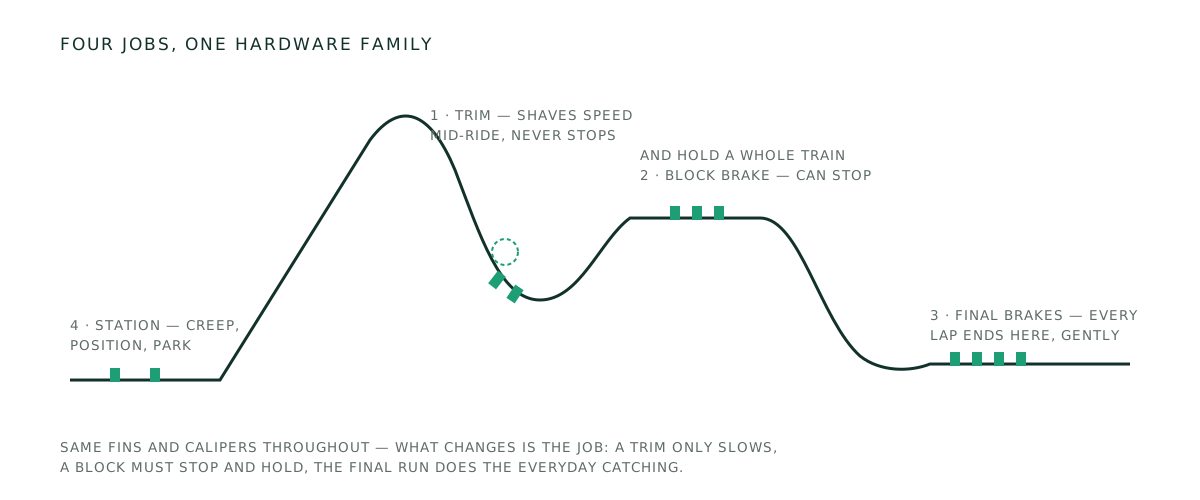
All of this hardware gets deployed in four roles, and telling them apart is most of brake literacy. The final brake run ends every lap, bleeding the train’s remaining speed before the station. Block brakes — the ones that can stop and hold a full train — divide the circuit so multiple trains can run at once. Emergency stops are less a separate brake than a behaviour: cut the power and every brake on the ride closes at once, which is the fail-safe doing its thing. And then there are trims.
The trim brake: a defence, mostly
A trim brake is a short brake section in the middle of the ride — often halfway down a hill or before a big element — that shaves off a few km/h without stopping anything. Enthusiasts speak of trims the way cyclists speak of headwinds. The complaint: the designer drew a ride with a certain violence, and the trim quietly confiscates some of it.
Here’s the engineering case for the defence. A coaster’s forces vary enormously with conditions — a heavy train on a hot day with rain-slick, freshly-lubricated wheels can run far faster than the same train cold and empty. Everything downstream of that variation has to cope: wheel temperatures, structural fatigue loads, rider comfort limits, the entry speed of the next element. A trim is a regulator — it clips the fast outliers so the ride stays inside its designed envelope every single cycle, all season, for thirty years. The alternative to a trim is often a ride that’s magnificent in April and closed by August.
And the honest bit: sometimes the grumblers are right. Trims get added retroactively when a ride proves harder on itself (or its riders) than the models predicted, and occasionally a park dials one in far enough that a signature moment goes missing — the enthusiast lore around certain B&M hypers’ mid-course trims exists for a reason. A trim used well is invisible. A trim used timidly is a refund of thrills nobody asked for. This site’s position: judge each trim on whether you’d rather be riding the untamed version in its second decade — usually, you wouldn’t.
Where you’ll find them
Every coaster’s final brake run is on show from the queue — watch for the row of fins and the soft hiss of the calipers cycling. Magnetic brakes announce themselves by silence: if the train sweeps into the brake run and leans smoothly to a walking pace with no clatter, that’s eddy currents at work. Trims hide in plain sight mid-circuit, usually a short fin-row on a descent; you’ll feel them as a firm, brief hand on your shoulder. And for the full pre-history, Rutschebanen’s brakeman still takes the middle seat in Copenhagen, a hundred and twelve years into the job.
The Dispatch verdict
Coaster braking is the fail-safe principle worn openly: every brake on the ride is trying to close at all times, and the control system’s entire job is politely asking them not to yet. That inversion — energy to release, never to apply — is why the industry’s braking record is so boringly excellent, and boring is the highest compliment a safety system can earn.
As for trims: the least glamorous component on the ride is also the one quietly guaranteeing the ride is still there, still smooth and still open next season. Grumble — it’s tradition — but grumble informed.
Further reading: how block brakes divide the track, why launch tracks brake with magnets, and what a fail-safe stop looked like for real at Legoland Billund in August 2026.