
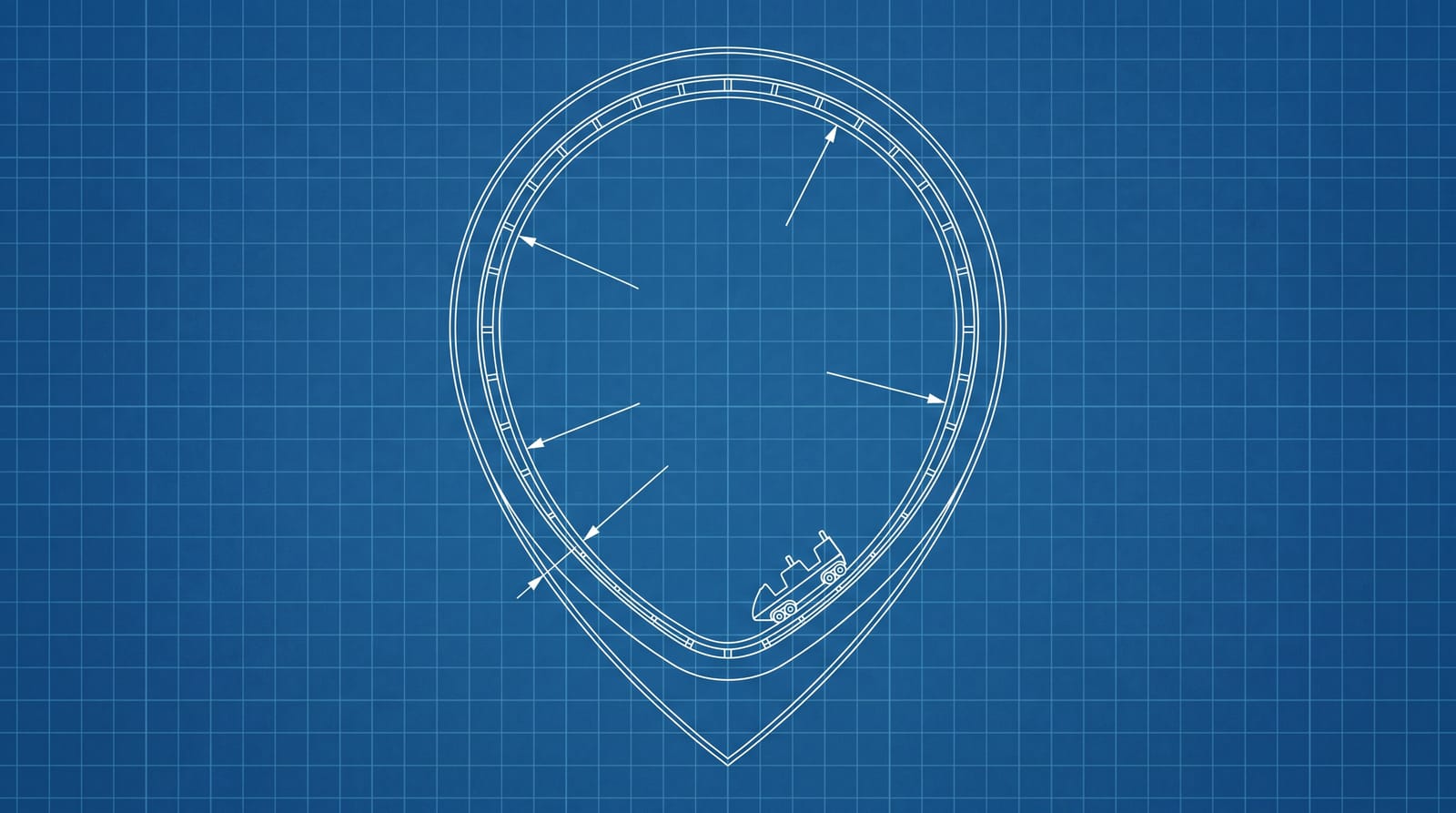
Look at a roller coaster loop from the car park and it reads as a circle — the classic loop-the-loop shape everyone’s drawn as a kid. It isn’t one. If you traced the actual rail with a survey pole, you’d find a curve that’s tight at the top and noticeably wider at the bottom, closer to a teardrop stood on its point than anything a compass could draw. That’s not a styling choice. It’s the entire reason the ride doesn’t hurt you.
The short answer: a true circular loop applies dangerous, spiking forces at its base, because a train’s speed there is at its highest just as the curve is at its tightest. Engineers replaced the circle with a clothoid — a curve whose radius changes continuously along its length — so the track can widen out exactly where the train is going fastest and tighten up exactly where it’s slowest, keeping the force on your body roughly level the whole way round.
Here’s how a single piece of 1970s German maths turned the most dangerous shape in the fairground into the safest inversion on the ride sheet.
The circle that nearly ended the idea
Looping coasters aren’t a modern invention. The Flip Flap Railway, which opened at Coney Island’s Sea Lion Park in 1895, had one — a 7.5 m (25 ft) circular loop, genuinely the first of its kind in North America. It also nearly killed the concept for a generation. Riders went round a perfectly circular loop at a speed that, at the bottom of the circle, produced somewhere between 6 and 12 g of force, all of it arriving in the same direction, all at once. The ride was notorious for whiplash and neck injury, and it closed within a few years — remembered today as a cautionary tale rather than a landmark.
The problem wasn’t the idea of a loop. It was the shape. A circle has one radius, everywhere, by definition. But a train doesn’t travel a loop at one speed — it enters fast, having built up momentum through the approach, and it’s noticeably slower by the time it reaches the top, having spent that momentum fighting gravity on the way up. Force a constant-radius curve to handle wildly different speeds and the maths does something ugly at the point where speed is highest: the bottom.
The clothoid curve: a loop that changes its mind about its own radius
The fix arrived in 1976, on Revolution at Six Flags Magic Mountain in California — the world’s first modern coaster to use a genuinely engineered, computer-calculated loop shape rather than a circle. It was designed by Werner Stengel, a German engineer who’d been working with manufacturer Anton Schwarzkopf since 1963 and founded his own firm, Ingenieurbüro Stengel, in 1965. Stengel’s insight was to stop treating the loop as one curve and start treating it as a spiral with a continuously changing radius — a shape mathematicians call a clothoid.
The logic is straightforward once you see it laid out. The force a curve puts through a train depends on both its speed and the tightness of the bend — a fast train needs a wide curve to keep the force manageable, the same way a motorway slip road is a gentler curve than a roundabout. So Stengel’s clothoid loop is deliberately widest at the bottom, where the train is fastest, spreading that force out over a gentler arc. Climbing the loop, the train sheds speed to gravity the whole way — so the curve can afford to tighten, right up to the loop’s tightest point at the very top, where the train is moving slowest of all and needs a smaller radius just to keep following the track rather than travelling in a straight line off the top of it.
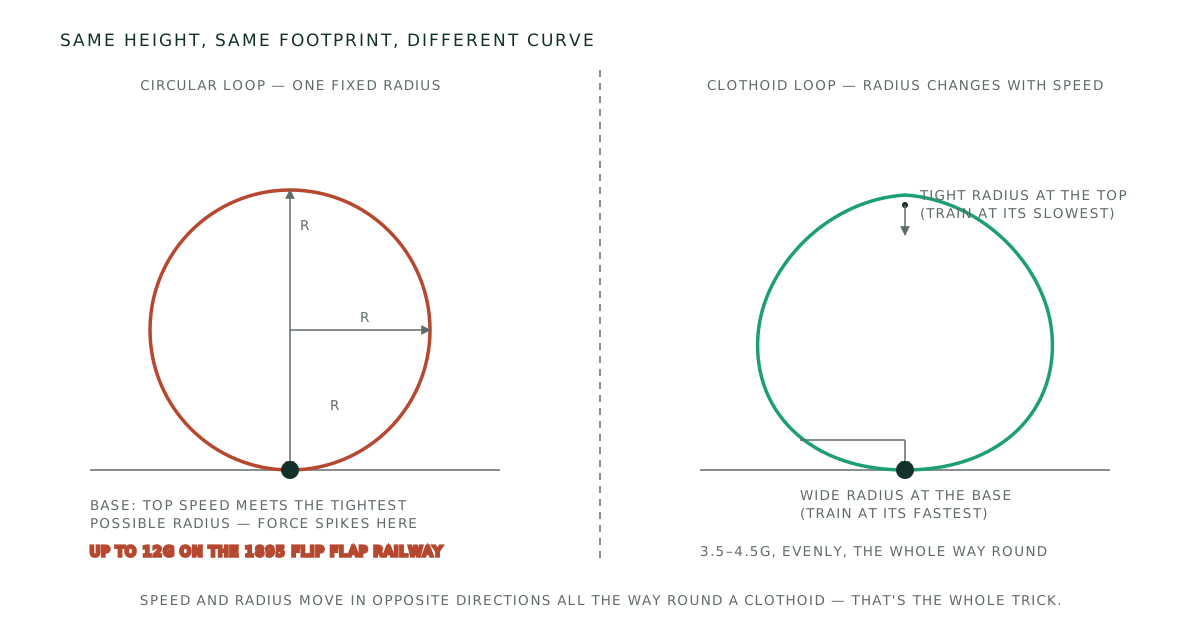
The result looks like a teardrop balanced on its point, and it’s now so completely standard that a modern circular vertical loop essentially doesn’t exist outside museum pieces and history lessons. Nemesis at Alton Towers, which opened in March 1994, carries a full clothoid loop among its four inversions — and was itself designed by Stengel’s firm, working with manufacturer B&M, eighteen years after Revolution proved the idea.
Reading the g-force through a loop
The whole point of the clothoid shape is to keep the ride’s g-force — the multiple of ordinary gravity your body feels pressed into the seat — inside a band the human body tolerates comfortably, rather than letting it spike. On a well-designed modern loop, that band sits around 3.5 to 4.5 g for the whole rotation: noticeably more than your own weight, enough to feel genuinely serious, but a world away from the 6–12 g that closed the Flip Flap Railway.
It helps to walk the loop in stages. At the base, the train is at its fastest — this is where a circular loop would spike hardest, and where the clothoid’s wide radius does its main job, spreading that peak force out rather than letting it slam in over a short arc. Rising up the side, speed bleeds away to gravity and the curve tightens correspondingly, keeping the force roughly level rather than easing off only to demand it back later. At the very top, the train is slowest of all, upside down, and the tightened radius is providing just enough force to keep the train’s path curving rather than letting it fall away from the track in a straight line — riders typically feel close to their own bodyweight here, sometimes a touch of genuine near-weightlessness on a gentler design, never the crushing peak of the bottom. Coming down the far side, the sequence runs in reverse.
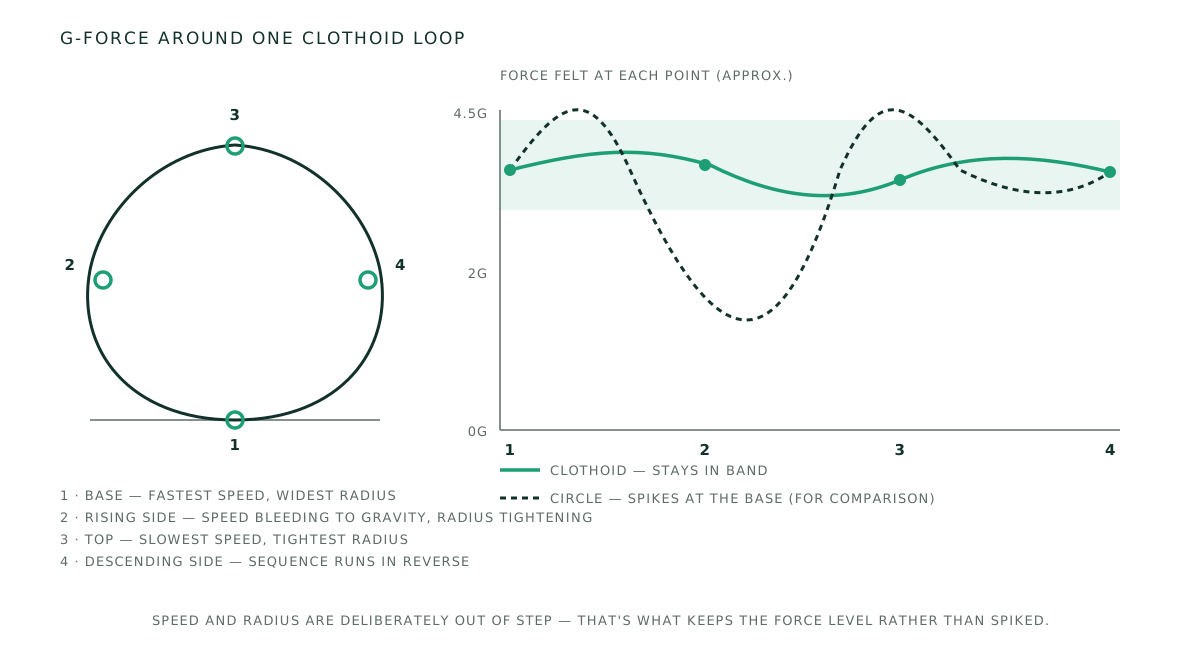
That evenness is the entire engineering achievement. It’s not that a clothoid loop is gentler than a circular one — Blue Fire at Europa-Park, whose 32 m (105 ft) loop is the centrepiece of its four inversions, runs at a genuine 3.8 g — it’s that the force stays roughly where the designer put it, for the whole rotation, instead of arriving as a single unpredictable spike your neck has no time to brace for.
Heartlining: engineering around the rider, not the rail
A loop is only the simplest inversion. Send a train through a corkscrew, a roll, or anything that twists sideways as well as flipping vertically, and a new problem appears: if the track’s centreline is what the designer optimises, a rider sitting a metre or so away from that centreline — at head height in some rotations, at foot height in others — gets flung through a wider, faster arc than the rail itself follows, simply because they’re not sitting on the axis the maths was built around.
Stengel’s second major contribution solves exactly this, and it’s arguably the more elegant of the two ideas. Instead of designing the track around its own physical centreline, heartlining designs it around an imaginary line running through the approximate height of a seated rider’s chest — the “heartline” — wherever that rider happens to sit on any given rotation. The rail itself is then built to twist, bank and corkscrew around that line, so the line the rider’s body actually experiences stays smooth even while the physical steel around them is doing something considerably wilder.
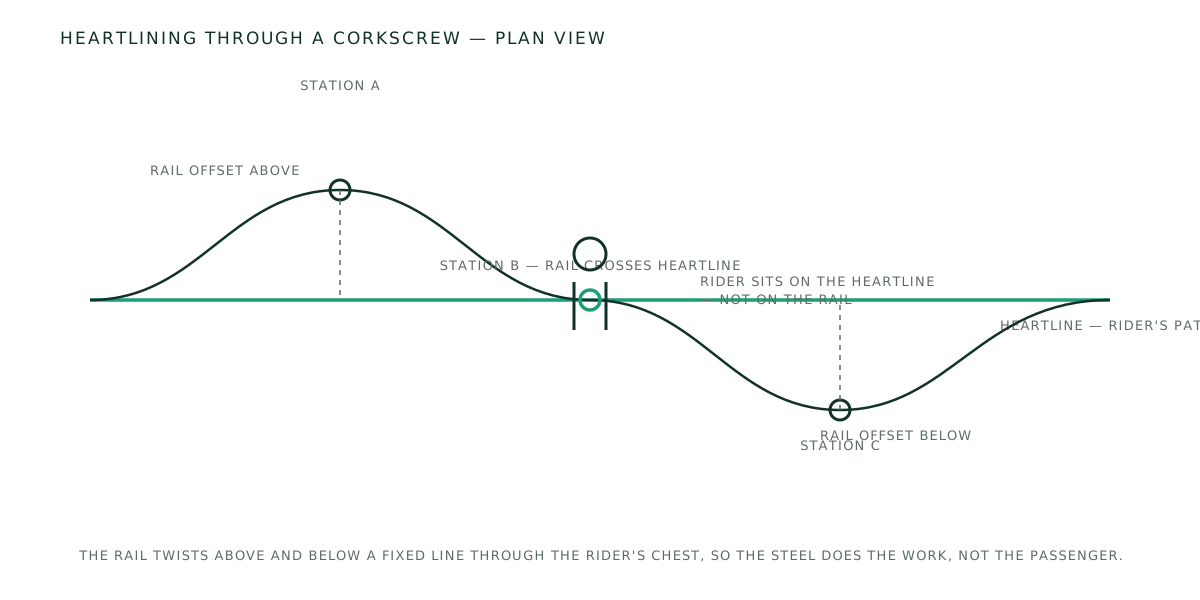
Blue Fire’s finale — a heartline roll, a manoeuvre named directly after the principle — rolls the train a full 360 degrees around an axis that passes through the rider rather than the rail, producing a disorientingly smooth barrel-roll sensation with none of the sideways wrench an off-axis roll would produce. RMC leans on the same principle across its I-Box hybrids: Zadra at Energylandia carries three inversions on nothing heavier than a lap bar, a restraint that would be inadequate on a track designed the old way — heartlining is precisely what lets the forces stay centred enough for a lighter restraint to hold.
The wheels and restraints doing the holding
None of this geometry works in isolation. The three-wheel truck that grips every metre of rail — road wheel on top, guide wheels either side, and the upstop wheel underneath — is what stops a train leaving the track altogether during the loop’s tightest, slowest, most physically demanding moment at the top, where gravity is doing its best to pull the train straight down and away from the rail. And the restraint holding you in your seat is sized specifically to the forces a given loop’s geometry produces: a lap bar where heartlining keeps everything centred, a rigid over-the-shoulder harness where it doesn’t.
Nemesis is the case where all three pieces of engineering are working simultaneously and visibly: a clothoid loop, an upstop wheel carrying the train’s full weight through the inversion, and a rigid harness sized for a design that predates widespread heartlining. Ride it and you can feel the difference against something newer like Blue Fire, where the same three systems are present but tuned by three further decades of refinement.
Not every inversion is a loop
Worth being precise here, because enthusiasts will notice if you’re not: “loop” specifically means a full vertical rotation that returns the train to roughly the same point it entered, tracing something close to that teardrop shape. It’s one of several distinct inversion types, not a catch-all term for “upside down.” A corkscrew rotates the train through 360 degrees while also carrying it forward along the track, like a horizontal spiral rather than a vertical circle. A zero-g roll — one of Nemesis’s four inversions — banks the train through a slow roll timed to a parabolic arc, engineered to produce a genuine moment of weightlessness rather than g-force at all. A cobra roll stacks two rolls back to back in an S-shape. Manufacturers each have their own named variations again — Blue Fire’s “twisted horseshoe roll” is Mack’s own design, distinct from any of the above.
All of them use some version of the clothoid and heartlining principles covered here; a loop is simply the type where those principles are easiest to see, because it’s the one everyone can already picture.
Where you’ll find it
| Ride | Park | What the loop is doing |
|---|---|---|
| Revolution | Six Flags Magic Mountain, USA | The 1976 original — first modern coaster with a computer-calculated clothoid loop, designed by Werner Stengel |
| Nemesis | Alton Towers, UK | B&M inverted coaster, 1994, Stengel-designed clothoid loop among four inversions, rigid OTSR |
| Blue Fire | Europa-Park, Germany | Mack launch coaster, 32 m (105 ft) loop plus a heartline roll finale, 3.8 g |
| Zadra | Energylandia, Poland | RMC I-Box hybrid, three heartlined inversions held on a lap bar alone |
The Dispatch verdict
The clever part of a coaster loop was never the idea of turning riders upside down — fairgrounds tried that in the 1890s and it went badly. It’s the realisation, decades later, that the shape has to change its mind continuously as the train’s speed does, and that the maths deciding that shape should be built around the rider’s body rather than the steel. A circle nearly ended the entire concept in 1895. A clothoid, and the heartlining that followed it, is why nobody’s neck has needed rescuing from a loop in living memory.
Next time a loop swings you upside down without a single jolt, that smoothness isn’t luck. It’s a spiral equation, solved fifty years ago, doing exactly what it was built to do.
Further reading: how roller coaster wheels keep trains locked to the track, how restraints are matched to the forces a ride produces, wood vs steel vs RMC hybrid track, and a guide to the manufacturers building all of this.