
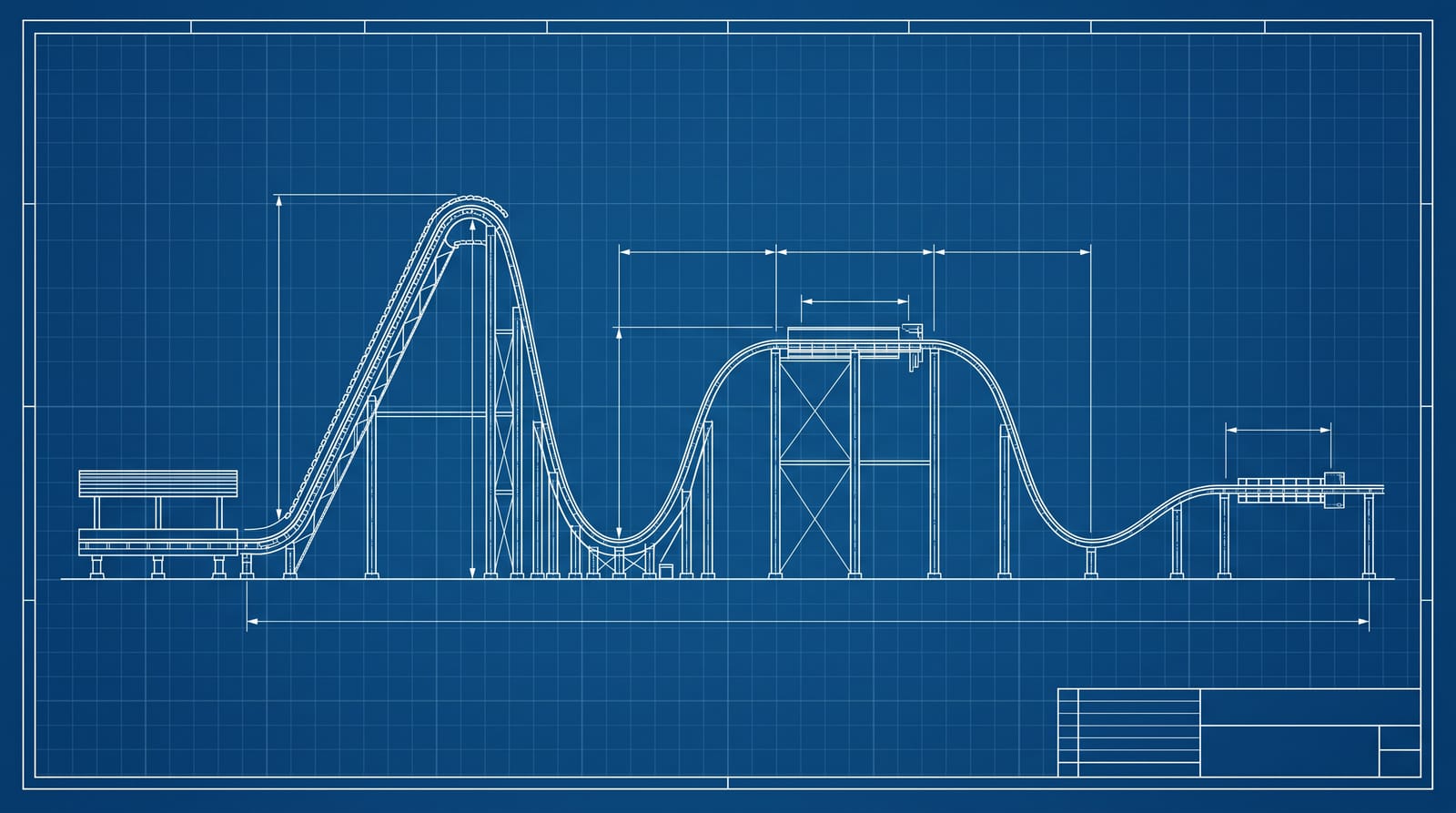
Stand in any coaster queue long enough and the question arrives on its own: there are three trains on this track, none of the drivers exist, and the one in front of you has just paused on the brakes for no obvious reason. What, exactly, is stopping them from meeting?
The short answer: the track is divided into sections called blocks, and the control system enforces one unbreakable rule — only one train may occupy a block at a time. A train is physically prevented from entering the next block until the train ahead has left it, which is why two coaster trains can chase each other all day and never, ever touch.
Everything else in this article is the machinery behind those two sentences. It’s a system borrowed from Victorian railway signalling, refined by a century of amusement engineering, and it is quietly one of the most reliable safety systems ever put in front of the public.
One train per block: the rule that runs everything
A block is simply a stretch of track with a defined start and end. A coaster running one train doesn’t strictly need them — there’s nothing to collide with. The moment a park wants two or more trains running (and it always does; trains in motion are capacity, and capacity is money), the track gets carved up.
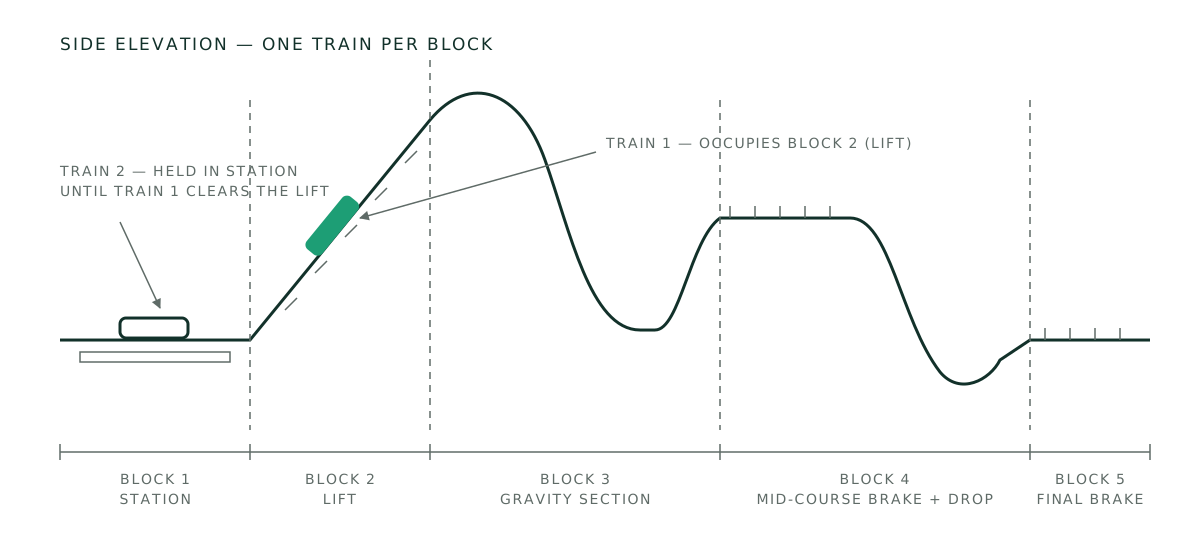
A typical layout breaks down into five or six blocks: the station, the lift hill, one or two long gravity-driven sections, a mid-course brake run — a straight section of elevated track with brakes, usually the flat bit you hit halfway through where the ride briefly loses its nerve — and the final brake run before the station.
The rule is enforced at every boundary between blocks. A train may only cross a boundary if the entire block beyond it is empty. Not “probably empty”. Not “empty in a second once the other train clears”. Empty, confirmed by sensors, right now — or the train waits.
What makes a block a block
Here’s the constraint that shapes the whole design: a coaster train on a gravity section can’t be stopped. There’s no engine, no driver and no brakes on board — the train is a trolley falling with style. Once it leaves the top of the lift, physics is in charge until the track’s own hardware intervenes.
So a block boundary can’t go just anywhere. Every block must end at a place where the track can do two things: stop the train, and start it moving again. That means a lift hill (stop the chain), a launch track, a station, or a brake run with powered wheels. The wild bit in between — the drops, the inversions, the airtime hills — is one indivisible block precisely because nothing in it can stop you.
This is why coasters have mid-course brake runs at all. That anticlimactic flat section halfway round isn’t a designer losing interest; it’s a block boundary, and it exists so the ride can run an extra train. The enthusiast complaint that a mid-course “ruins the pacing” is really a complaint about arithmetic: one more brake run equals one more block equals one more train equals several hundred more riders per hour.
Brakes that fail safely
The hardware at a block boundary is built on a principle worth knowing, because it’s the same principle behind lift evacuations and railway signals: fail-safe means the failure mode is the safe state.
Most modern block brakes are pinch brakes — pairs of calipers mounted on the track that grip a metal fin hanging from the underside of the train. The elegant part is how they’re powered. Springs clamp the calipers shut; compressed air holds them open. If the ride loses power, loses air pressure, or a cable is cut by an over-enthusiastic digger, the brakes don’t fail off — they snap closed. A dead coaster is a stopped coaster.
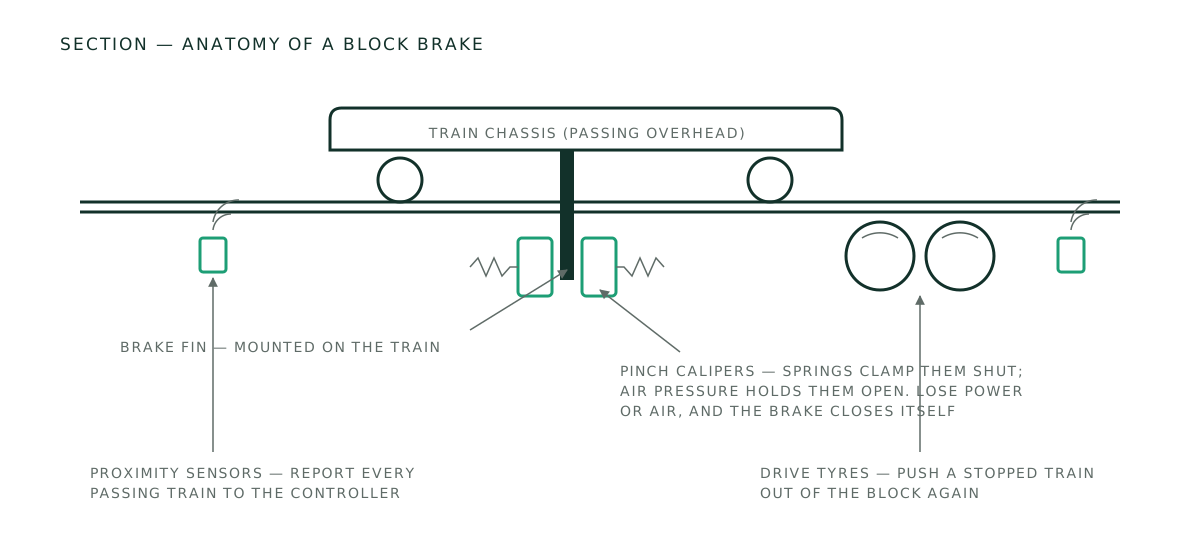
Many rides also carry magnetic brakes — rows of permanent magnets that slow a passing fin by inducing eddy currents, no contact, no wear, no power needed. They’re superb at shedding speed but they have one limitation that matters here: the braking force fades as the train slows, so magnets alone can never hold a train stationary. A block boundary therefore always includes something mechanical — pinch brakes to hold the train, and drive tyres (motorised rubber wheels that grip the train’s underside) to push it on its way again once the block ahead clears.
The lift hill earns its place as a block the same way: stopping the chain stops the train, and the anti-rollback ratchet — the source of the famous clickety-clack on the way up — guarantees it can’t slide backwards while parked. That sound is a safety system announcing itself several times a second.
The brain: sensors and the controller
Spotting the trains is the job of proximity sensors — small inductive detectors mounted along the track that register metal passing overhead. They cluster at block boundaries, so the control system knows when a train has fully entered and fully left each section.
The decisions are made by a PLC — a programmable logic controller, the same breed of hardened industrial computer that runs bottling plants and railway interlockings. It holds a live map of which blocks are occupied and applies the rule with the pedantry only a machine can sustain: boundary brakes stay closed unless the next block reads empty. Safety-critical parks and manufacturers run these controllers with redundancy — duplicated sensors and processors cross-checking each other — so a single failed component degrades the ride to a stop, not to a guess.
The important cultural point: the operator in the station is not driving the ride. They’re loading it, checking restraints and pressing dispatch. Whether that dispatch actually sends the train is the controller’s call, and the controller cannot be sweet-talked.
Stacking: the block system you can watch from the queue
You’ve seen the block system work a hundred times without clocking it. When your train glides onto the final brake run and just… sits there, while the ride ahead unloads at walking pace — that’s called stacking, and it’s the one-train-per-block rule doing its job in public.
The station is a block. If the train in it hasn’t dispatched, the train behind waits on the final brakes. If the final brakes are occupied, the train behind that holds at the mid-course. The holds cascade backwards through the circuit, each train parked at a boundary, each boundary waiting for the block ahead.
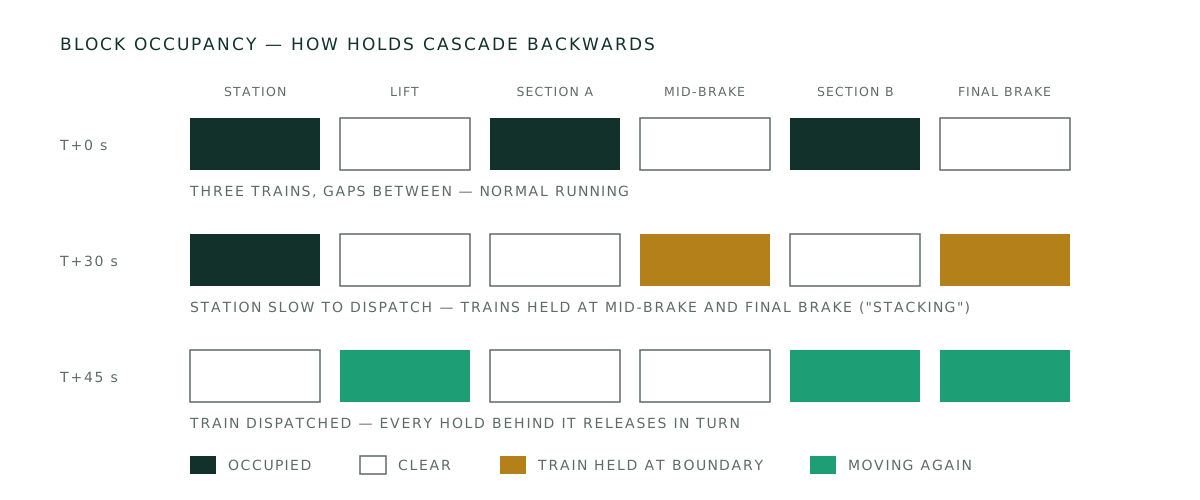
Stacking is also why ride crews obsess over dispatch intervals. A coaster’s real capacity isn’t set by its top speed but by how fast the slowest block — almost always the station — can be cycled. Watch a well-drilled crew at a major park turn a train around in under a minute and you’re watching the block system being fed at its maximum rate. It’s genuinely a sport.
The day the humans overrode it
The block system’s one weakness isn’t mechanical. On 2 June 2015, The Smiler at Alton Towers — a Gerstlauer Infinity coaster with a record fourteen inversions, built to run as many as five trains — put that weakness on public display.
An empty test train had stalled in a valley partway round the circuit. The control system did exactly what it was designed to do: it detected the fault and halted the ride. Engineers, believing the stoppage was a glitch rather than a train genuinely sat on the track, overrode the block stop and released a fully loaded train — without confirming the section ahead was clear. Sixteen people were injured in the collision; two young women each lost a leg. The Health and Safety Executive estimated the impact as equivalent to a 1.5-tonne family car crashing at about 90 mph (145 km/h).
The HSE’s investigation found no fault with the track, the trains or the control system. The block logic had worked; it was human hands, under pressure and without a robust procedure for safety-critical decisions, that unlocked it. Merlin, Alton Towers’ operator, pleaded guilty and was fined £5 million in September 2016 — at the time the largest fine ever imposed on a UK leisure business.
The machine said no. The failure was the process that let people say yes anyway.
It’s a grim story to find in the middle of an explainer, but it makes the point better than any diagram: the block system is not the weak link. On the rare occasions coaster trains have met, the report almost always describes a human reaching around the interlock — which is why modern procedures treat an override not as a fix, but as the most dangerous button in the park.
Where you’ll find it
Every multi-train coaster on Earth runs blocks, but a few make the machinery unusually visible:
| Ride | Park | Trains | What to watch for |
|---|---|---|---|
| The Smiler | Alton Towers, UK | up to 5 | 1,170 m (3,840 ft) of track dense with block brakes — count the flat sections between the 14 inversions |
| Silver Star | Europa-Park, Germany | 3 | A B&M hyper, 73 m (239 ft) tall and 127 km/h (79 mph), with a textbook mid-course brake run at the crest of a hill |
| Taron | Phantasialand, Germany | 4 | An Intamin multi-launch where the launch tracks themselves double as block boundaries — hitting 117 km/h (73 mph) on the second one |
Taron is the modern refinement worth a second look. On a launch coaster there’s no lift hill to act as a natural block, so the launch sections do the job instead — each one can stop a train, hold it, and fire it onwards, which is how the ride cycles four trains through 1,320 m (4,330 ft) of track at roughly 1,200 riders an hour without ever letting two of them share a section.
The Dispatch verdict
The block system is what good safety engineering looks like: a rule simple enough to write on the back of a ticket, enforced by hardware that fails towards stopping, watched by a computer that cannot be argued with. It costs parks capacity when a crew is slow and it flattens the middle of a few ride layouts, and it is worth every second and every trimmed hill.
Next time your train stacks on the final brakes, you’ll know precisely what’s happening: nothing — which, after a century of refinement, is exactly the intended result.
Further reading: what it looks like when a block system stops a train somewhere the track was never built to be walked — Legoland Billund, August 2026, and how rapids rides manage the same collision problem without a rail to sense.