
A lift hill is honest engineering: drag the train up, let it fall, done. A launch coaster skips the honesty. One moment you’re stationary, listening to someone’s safety spiel; the next you’re doing motorway speeds with your cheeks somewhere behind your ears. The obvious question — the one this article answers — is what on earth just pushed you.
The short answer: almost every launch coaster uses one of two systems. A hydraulic launch is a monstrous winch — a cable, wound by hydraulic motors, drags the train up to speed and lets go. An LSM launch is an electric motor unrolled and laid flat — computer-switched electromagnets in the track sweep a magnetic field along it, pulling magnets on the train with it.
For twenty years the hydraulic winch held every speed record that mattered. As of New Year’s Eve 2025, it holds none of them. This is the story of both machines, and of how the magnets won.
Why launch at all
The lift hill has two limitations. It’s slow — a long climb spends queue-swallowing minutes per train — and it can only give the train as much energy as the hill is tall. Marketing departments dislike the second constraint most: if you want a coaster to hit 200 km/h from a lift, you need to build most of a skyscraper first.
A launch spends money on power instead of steel. It also unlocks layouts a lift can’t do: launches out of dark buildings, launches uphill, mid-course boosts, and the rolling multi-launch designs where the train gets several pushes around the circuit. There’s a tidy engineering bonus too — a launch section can stop, hold and re-start a train, which makes it a natural block boundary, exactly like a lift hill but without the queue-side clanking. (A launch also can’t carry an anti-rollback ratchet — a train that doesn’t make the hill must roll back freely, which is why launch tracks catch returning trains with retractable magnetic fins instead.)
The hydraulic sledgehammer
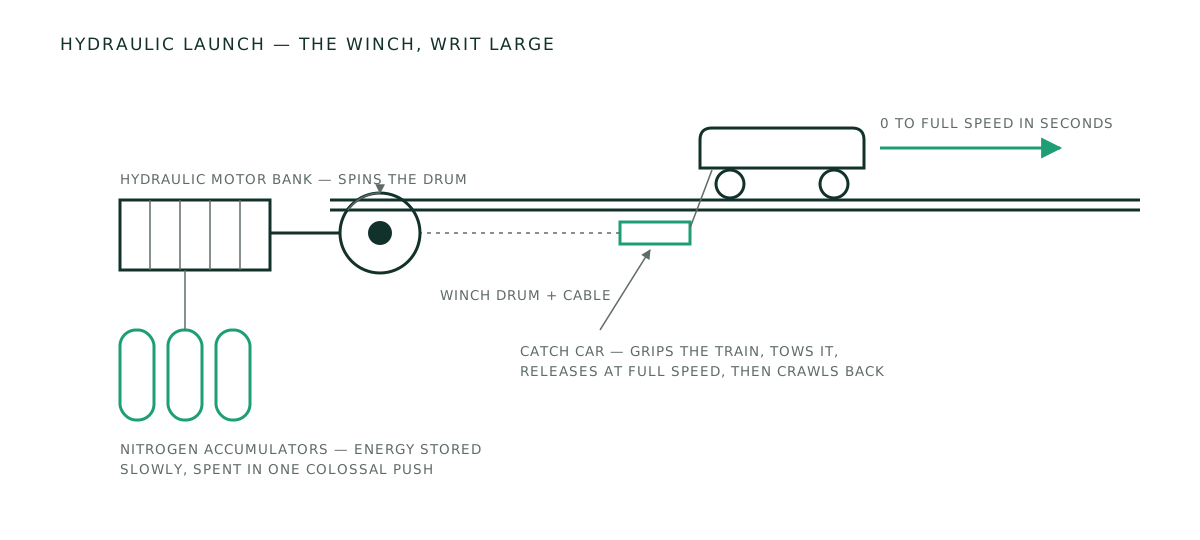
Intamin’s hydraulic launch — the system behind the famous “Accelerator” coasters of the 2000s — is best understood as a fishing reel the size of a house, run in reverse.
Under the launch track sits a catch car that grips the train. A steel cable runs from it to a huge winch drum, spun by a bank of hydraulic motors. The clever part is where the energy comes from: hydraulic fluid is pumped, relatively slowly and cheaply, into nitrogen-charged accumulators — pressure vessels that store the energy like a compressed spring. At launch, the accumulators dump that stored energy through the motors in a few seconds, the drum howls, and the train goes from parked to preposterous.
The results were era-defining. Top Thrill Dragster (2003) reached 193 km/h (120 mph); Kingda Ka (2005) managed 206 km/h (128 mph); and Ferrari World Abu Dhabi’s Formula Rossa (2010) still holds the hydraulic crown at 240 km/h (149 mph) in 4.9 seconds — for fifteen years the fastest roller coaster on Earth. The UK’s example, Stealth at Thorpe Park, is modest by comparison at 129 km/h (80 mph) and remains one of Europe’s hardest-hitting launches.
The drawback was never the physics; it was the housekeeping. One cable, one catch car and one drum handle every single launch, at colossal loads, all day. Cables wear and occasionally shred. The system launches once, then needs winding back. And it’s all-or-nothing: one launch per circuit, no boosts, no second acts.
The electromagnetic answer
The linear synchronous motor takes a rotary electric motor and unrolls it. The rotating part — the bit with permanent magnets — is bolted to the train. The stationary coils are laid along the track as a row of stator modules. Energise the coils in sequence and you create a magnetic field that travels along the track; the train’s magnets are dragged along with it, riding the wave. Sensors track the train’s position precisely so the field stays perfectly in step — that’s the “synchronous” part.
(Its older sibling, the linear induction motor or LIM, works without magnets on the train by inducing currents in a metal fin — it pioneered electromagnetic launches in the 1990s, but LSMs are more efficient and controllable, and have largely taken over.)
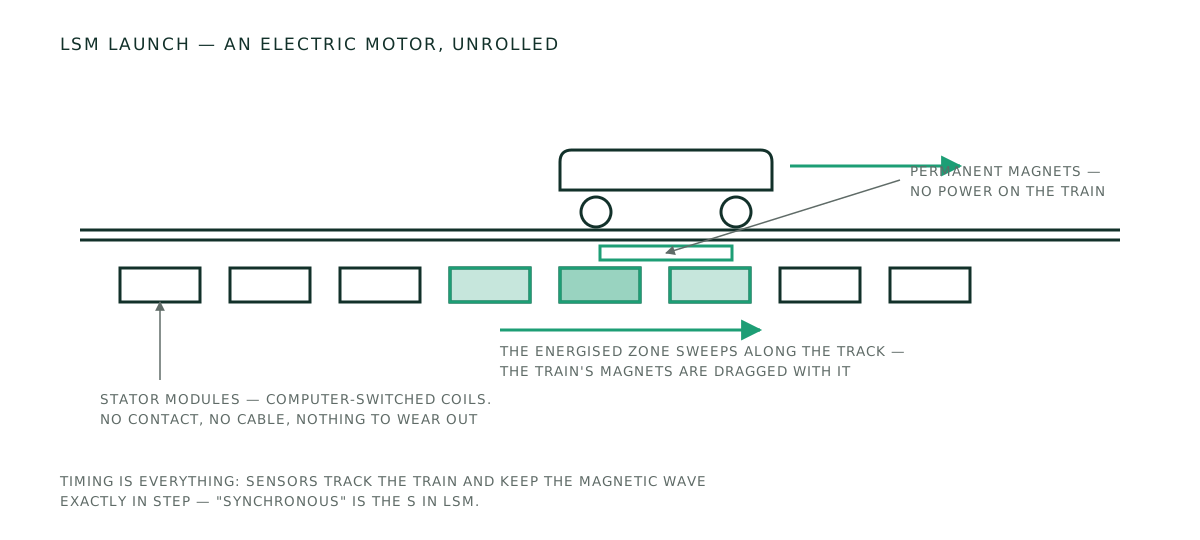
Notice everything that isn’t there: no cable, no catch car, no moving parts in the launch itself. Nothing needs rewinding, so an LSM can launch again the moment the next train arrives — or launch the same train several times around the circuit. It can push uphill, boost out of a mid-course, or swing a train backwards and forwards through the same section to build speed. Taron at Phantasialand cycles four trains through two launches; Universal’s VelociCoaster (2021) hits 113 km/h (70 mph) on its second, rooftop-skimming push.
The one thing LSMs historically couldn’t match was the hydraulic system’s raw, single-hit violence — electromagnets that powerful cost serious money and need serious cooling. That objection has now been dealt with, emphatically.
The scoreboard flipped
On 31 December 2025, Falcons Flight opened at Six Flags Qiddiya City in Saudi Arabia and took the world records for tallest, fastest and longest coaster in one go — 163 m (535 ft), 250 km/h (155 mph), 4,250 m (13,944 ft) of track. It reaches that speed with three LSM launch sections driven by more than 700 water-cooled stator modules — per Intamin, around six times the motor count of VelociCoaster — including a launch that accelerates the train downhill into the record run.
The symbolism is hard to miss. Formula Rossa, the hydraulic king, lost its crown to magnets. Kingda Ka was imploded in 2025. And Top Thrill Dragster’s troubled hydraulic system was ripped out entirely in Zamperla’s 2024 rebuild of the ride as Top Thrill 2 — same tower, LSM launches. The monuments of the hydraulic era aren’t just being outrun; they’re being converted or demolished.
What it means for your ride
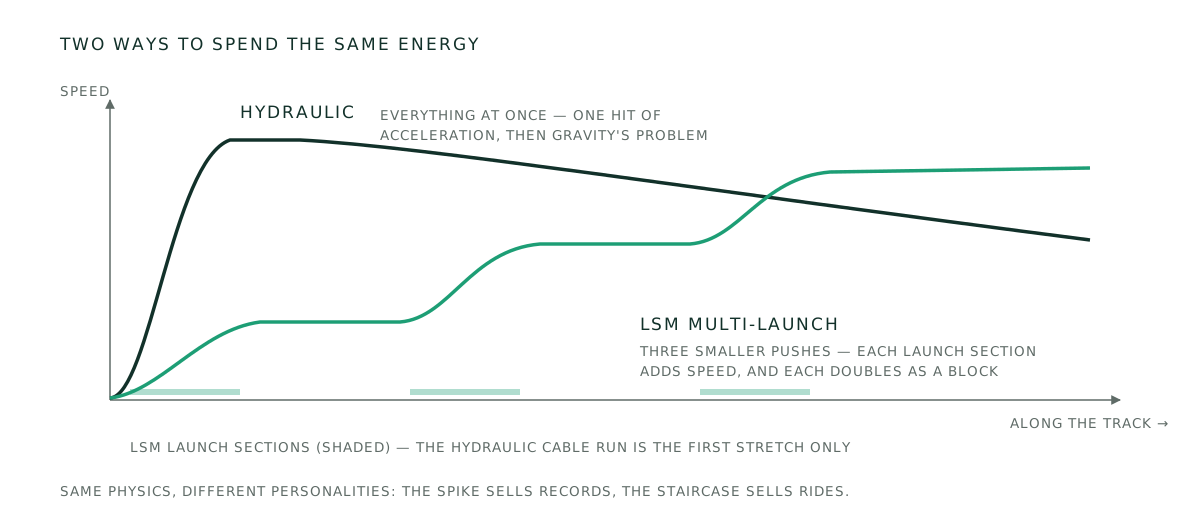
The two systems feel different from the seat, and it’s worth knowing what you’re being sold. A hydraulic launch is a single, brutal, unrelenting shove — acceleration that keeps building in a way that genuinely disorients, which is precisely its appeal. An LSM launch is typically a surging, rising push — often gentler at any instant, but repeatable, so designers spend it several times per lap. The modern enthusiast consensus, roughly: hydraulic for the violence, LSM for the ride. Either way, the restraint holding you in place is doing real work: launch forces are mostly straight backwards into the seat, which is why most launch coasters get away with a lap bar rather than a full harness.
For parks the calculus is simpler. LSMs have almost no launch-specific wear parts, no cable to inspect and replace, and they fail towards a stopped train sitting on a flat section — after which the block system treats it like any other hold. That reliability gap, as much as Falcons Flight’s records, is why new hydraulic launches have quietly stopped being ordered.
Where you’ll find each
| Ride | Park | System | Launch speed |
|---|---|---|---|
| Formula Rossa | Ferrari World Abu Dhabi | Hydraulic | 240 km/h (149 mph) in 4.9 s |
| Stealth | Thorpe Park, UK | Hydraulic | 129 km/h (80 mph) |
| Top Thrill 2 | Cedar Point, USA | LSM (converted from hydraulic, 2024) | 193 km/h (120 mph) |
| VelociCoaster | Universal Orlando, USA | LSM, two launches | 113 km/h (70 mph) |
| Taron | Phantasialand, Germany | LSM, two launches | 117 km/h (73 mph) |
| Falcons Flight | Six Flags Qiddiya City, Saudi Arabia | LSM, three launches | 250 km/h (155 mph) |
There’s a third, humbler method worth flagging: friction-wheel (tyre-drive) launches, which spin rubber tyres against the train’s underside rather than switching magnets or dumping hydraulic pressure. It’s cheaper, lower-maintenance and has a much lower speed ceiling than either system above — which is exactly why it’s the technology behind small family launch coasters, including Denmark’s first single-rail coaster, announced for 2027.
LSMs are also spreading into formats beyond the conventional sit-down train: Efteling’s Missie Luminar, a suspended, motorbike-style Vekoma coaster due in 2029, launches riders hanging beneath the rail rather than sitting on top of it.
The Dispatch verdict
The hydraulic launch was a magnificent piece of brute-force engineering — a fairground winch scaled up until it broke world records — and it deserves its retirement with honours. But the LSM is simply the better machine: no contact, no cable, no rewind, and now no speed argument either. When the same technology can launch a family coaster gently out of a dark ride building and hold the outright world speed record, the debate is over.
The magnets won. The queue at Stealth just hasn’t been told yet.
Further reading: how block systems keep those trains apart, and why lift hills click when launches don’t.