
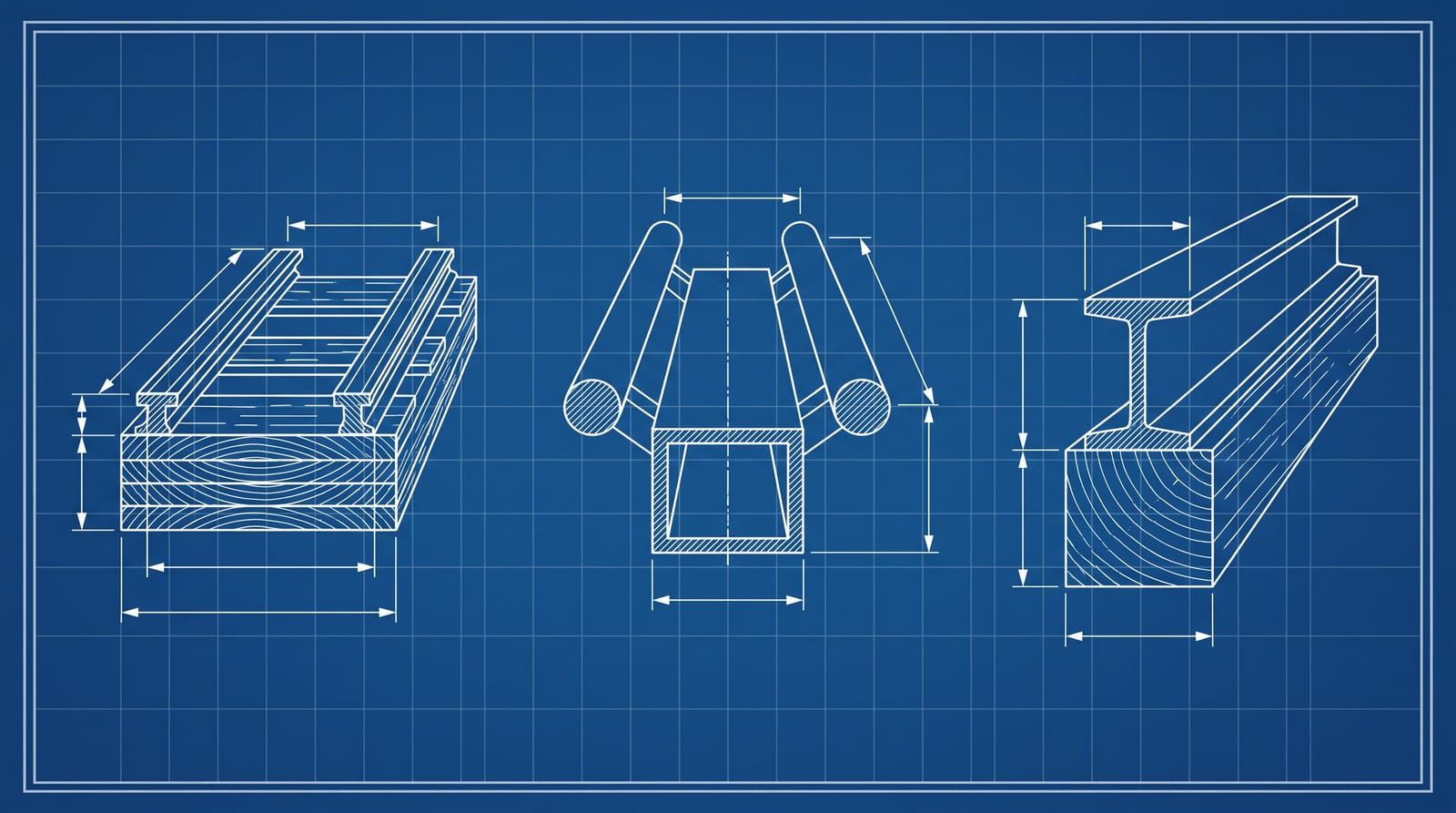
Ask what a coaster is made of and you’ll get a category answer — wood, steel, or that third thing where a wooden coaster comes back from the dead with steel rails and a taste for inversions. What people are really asking is why the three feel so different. The answer isn’t in the supports. It’s in the few centimetres of material directly under the wheels.
The short answer: a wooden coaster’s wheels run on a flat steel strap on top of stacked, laminated timber, which flexes and varies; a steel coaster’s wheels grip precision-bent tubular or box rails, which do exactly what the computer drew; and an RMC hybrid bolts a steel I-Box rail onto a wooden coaster’s timber structure — steel’s precision riding on wood’s bones.
Everything else — the roar, the roughness, the loops, the maintenance bill — falls out of that one difference.
What the wheels actually ride on
Strip away the paint and theming and a coaster is a rail and a wheel. On a traditional woodie, that rail is a steel strap — a flat band — laid over a stack of six-or-so laminated timber layers, all cut, bent and nailed by carpenters, then re-cut and re-nailed for the rest of the ride’s life. The track is built, not manufactured, and no two metres of it are quite identical.
Tubular steel flipped the logic. Round rails can be rolled and welded to any curve a computer can describe, to millimetre tolerances, with wheels gripping above, beside and below the rail — which is what makes inversions, overbanks and glass-smooth transitions possible at all. The idea arrived with Disneyland’s Matterhorn Bobsleds in June 1959, the first tubular steel coaster, and the entire modern steel industry — from B&M’s box-spine giants to Intamin’s launchers — descends from it.
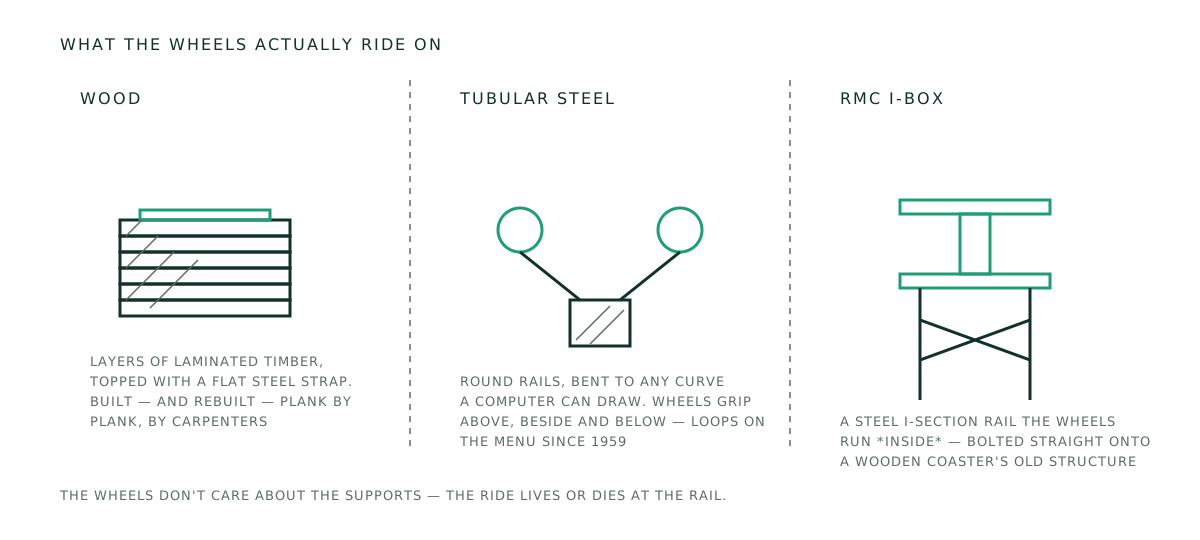
One myth to bin at this point: “wooden supports” versus “steel supports” is not the distinction. Plenty of steel coasters stand on lattice structures, and plenty of woodies use steel bracing. Classification follows the rail, and so does the ride experience.
Why wood feels alive
A wooden coaster’s charm is structural. Timber flexes — the whole structure deflects a few centimetres as the train passes and springs back after it, which is by design: the give spreads loads across the structure and absorbs shocks the rails would otherwise deliver to your spine. It’s also the source of the sound. That rolling thunder a woodie makes is thousands of timber joints working; a steel coaster mostly hums.
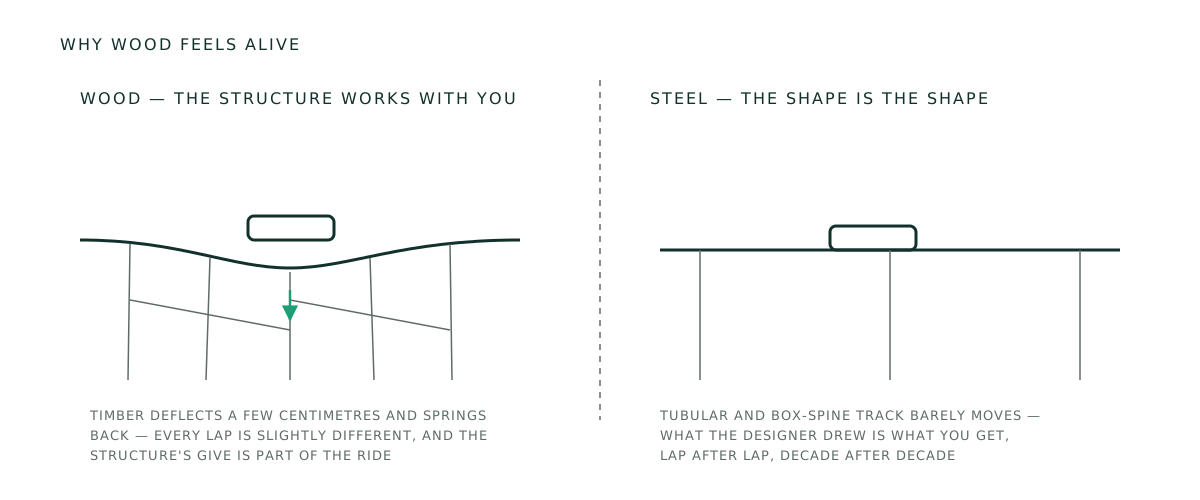
Because the track is hand-built and the structure lives, a woodie is never the same ride twice — faster in the heat, tighter in the cold, subtly reshaped by every off-season re-tracking. Enthusiasts don’t love wood despite the variation; they love it because of it. The cost is literal: wood wears, warps and wanders, and keeping a big woodie smooth is a permanent carpentry programme, which is why so many great ones drifted into roughness when budgets did.
Modern wood builders have narrowed the gap without abandoning the material. GCI’s fast, low-slung twisters are engineered wood at its most agile, and Intamin’s prefabricated laminated track — cut to precision off-site for rides like El Toro (2006) — delivers wooden character with nearly steel smoothness. Wood isn’t a legacy technology; it’s a choice with a personality attached.
Why steel does everything else
Steel’s pitch is control. If the designer can draw it, the factory can roll it and the ride will execute it — identically, every cycle, for decades. Inversions, beyond-vertical drops, launches, 100-metre hills: all fundamentally steel-track privileges. Maintenance shifts from carpentry to inspection; the shape you bought is the shape you keep.
The trade is character for consistency. A steel coaster doesn’t breathe with the weather or evolve between visits, and a mediocre steel layout has nowhere to hide — there’s no structural drama underneath to carry it. Wood forgives a plain layout; steel exposes it.
The RMC hybrid: the third answer
Which brings us to the category that rewrote the 2010s. Rocky Mountain Construction’s insight was that America’s stock of big, rough, expensive-to-maintain wooden coasters had one enormously valuable asset: the structure. The timber lattice was sound; it was the hand-built wooden track on top that was beating riders up and eating budgets.
RMC’s I-Box track replaces that wooden stack with a steel I-section rail the wheels run inside — manufactured to steel tolerances, bolted onto the existing (re-engineered where needed) timber bents. The first conversion, New Texas Giant at Six Flags Over Texas in April 2011, turned a notoriously rough giant into a smooth, wildly overbanked hit — and opened the floodgates. Cedar Point’s Mean Streak, a 49 m (161 ft) woodie few mourned, re-emerged in May 2018 as Steel Vengeance, an inverting monster that has parked itself at the top of enthusiast polls ever since. RMC now also builds hybrids from scratch — Energylandia’s Zadra (2019) skipped the “ageing woodie” stage entirely and went straight to new timber structure, steel rail.
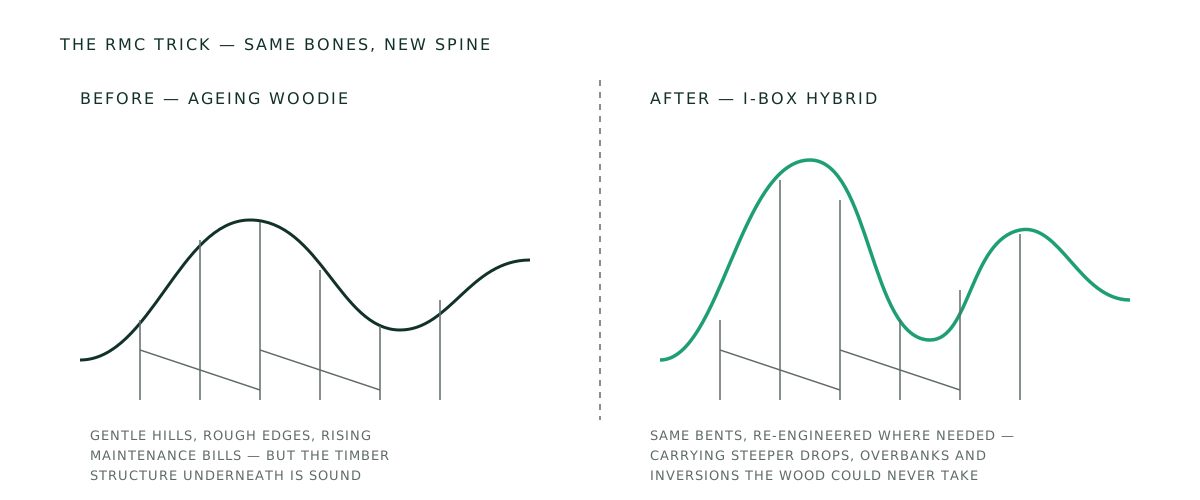
Is a hybrid a wooden coaster? By rail — the honest classification — no: the wheels touch steel. What survives is the wooden structure’s look, some of its flex and all of its looming presence, carrying geometry no carpenter could ever have nailed together. It’s less a compromise between wood and steel than steel wearing wood’s clothes, and the results speak for themselves.
Where you’ll find each
For wood with its character intact, Europe does well: GCI’s twisters at several parks, Wodan at Europa-Park, and the veteran woodies of Blackpool Pleasure Beach at the heritage end. For definitive steel, pick any modern B&M or Intamin flagship. For the hybrid conversion, Steel Vengeance at Cedar Point is the reference; for born-hybrids, Zadra at Energylandia is routinely called Europe’s best coaster with a straight face. Ride one of each in a season and you’ll never need the categories explained again.
The Dispatch verdict
The material argument was settled by realising it wasn’t an argument. Steel won the engineering war decades ago — precision, inversions, longevity — and wood responded by leaning into the one thing steel can’t manufacture: a structure that’s alive. The RMC hybrid didn’t end the debate so much as monetise it, rescuing the atmosphere of wood with the accuracy of steel.
What actually changes between the three? A few centimetres of material under the wheel — and from it, the sound, the feel, the maintenance bill and the poll rankings. Small rail, big consequences.
Further reading: why the lift hill clicks, and how block systems run every multi-train coaster, whatever the track’s made of.