
You’ve driven two hours, the sky is a thoroughly unremarkable grey, and the biggest coaster in the park has a sign on it saying “temporarily closed due to weather”. Twenty metres away, a much faster ride is running happily through what is unmistakably drizzle. Somebody, somewhere, appears to be making this up as they go along.
The short answer: they aren’t. Every ride has a weather envelope, a set of conditions it was designed and certified to operate in, and the ride closes when a sensor or a rule says it has left that envelope. Wind, wet brakes and lightning each break a different part of the safety margin, which is why the closures look so inconsistent from the outside.
Here’s what’s actually being measured, what rain really does to a coaster, and why a ride that has stopped for weather doesn’t simply restart when the sky clears.
Every ride comes with a weather envelope
A ride isn’t “safe” in the abstract; it’s safe within stated conditions. The European standard series for amusement rides, EN 13814, covers the design and manufacture of rides, the minimum requirements for operating, maintaining and testing them, and their inspection, according to the European standards body CEN. Design loads under the standard include wind loads appropriate to where the ride is deployed, as well as the fatigue from repeated cycles.
In practice that means the manufacturer’s operating manual contains the limits, and the park’s job is to stay inside them. This is the same logic as the daily checks and annual inspections: the park isn’t deciding afresh each morning what’s acceptable, it’s confirming the ride still sits inside what was certified.
It also explains the apparent inconsistency. A tall, slim, exposed structure and a low, heavy, enclosed one have entirely different envelopes, so the same weather can legitimately close one and not the other.
Wind: loads, gusts and the sensor on the structure
Wind is the closure that most often catches people out, because it can feel mild at ground level. The structure and the train don’t feel it at ground level, though. Wind speed rises with height, and a big coaster presents a very large area to a sideways push, so engineers have to allow for wind loading: the force wind puts on the track, supports and any train stopped at the top of something.
Most large rides therefore carry an anemometer, a wind-speed sensor (traditionally spinning cups, increasingly an ultrasonic unit with no moving parts), feeding the ride’s control system. The logic is simple, and shown in Fig. 1: the controller compares the signal with limits set by the ride designer and, if one is exceeded, stops accepting new dispatches. Trains already out on the circuit finish their lap and return to the station.
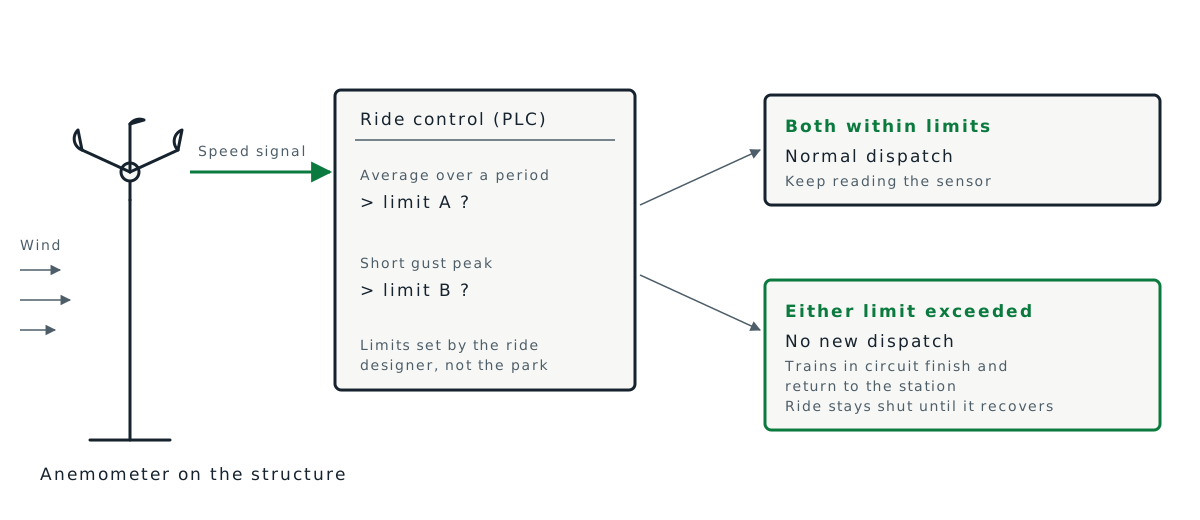
Two limits, because wind does two different kinds of harm. A sustained wind loads the structure continuously, while a short gust can push a stationary or slow train sideways, or swing a lightweight car, harder than the average suggests. That’s why a ride can close on a day that feels merely breezy: the average looks fine and the gusts do not.
Wind direction and funnelling matter too: a gust squeezed between structures can behave nothing like the open-air reading, which is one reason a sensor on the ride tells you more than one on the park office roof.
Rain: it’s mostly about brakes and traction
Rain is stranger, because most rides cope with light rain perfectly well and a few can’t cope with a drop of it. The reason is that water changes friction, and a coaster runs on friction in more places than you’d expect.
Wheels grip a steel rail, friction brakes clamp a metal fin (the plate under the train that the track brakes act on), and many stations use drive tyres, rubber wheels that pinch the train to move it. Put a film of water between any of those surfaces and the grip drops. The clamp force is the same; the force it produces isn’t. As we explained in the brakes guide, trains carry no brakes of their own, so the track’s brakes must stop the train in a known distance every single time, wet or dry.
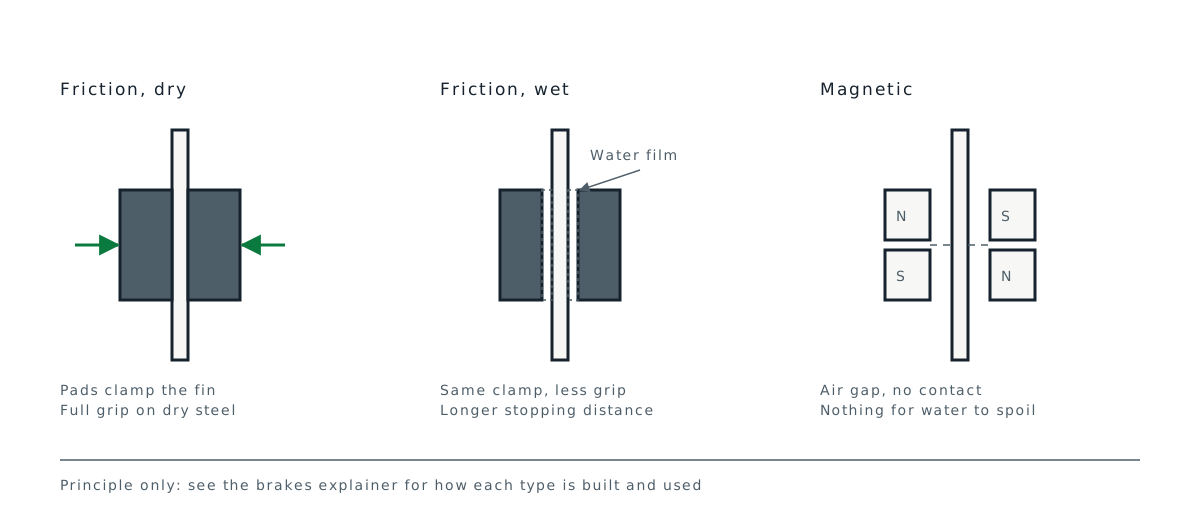
This is also why the closures look arbitrary. A ride whose brakes are magnetic, which slow the fin through induced currents with no contact at all, has far less to fear from a wet fin than one that relies on friction pads. Enthusiast reports consistently describe parks pulling trains from service, or closing rides altogether, when wet stations make trains overshoot their stopping points, which is precisely the failure the block system depends on not happening: a train that stops late is a train sitting where the next one expects empty track.
There are softer reasons as well. Wet track can change how a train rolls, which matters on a ride that runs on a tight energy margin, and the sensors and cabling that tell the controller where every train is have to be sealed against water. And, frankly, at coaster speeds rain stings.
Lightning: a tall steel structure with people on it
Lightning follows different logic again, because the hazard isn’t the ride’s machinery; it’s the ride’s shape. A big steel coaster is a tall, conductive structure, and the people on a lift hill are at the worst place on it.
The UK Theme Park Spy team, writing in March 2026, describes the usual pattern: monitoring begins when lightning is within about 10 miles (16 km), some tall rides may suspend operation within about 8 miles (13 km), and most outdoor rides close within about 5 miles (8 km). Rides typically can’t reopen until 30 minutes have passed since the last strike inside the radius, and another strike resets the clock. Those distances vary from park to park, so treat Fig. 3 as a typical pattern rather than a rule.
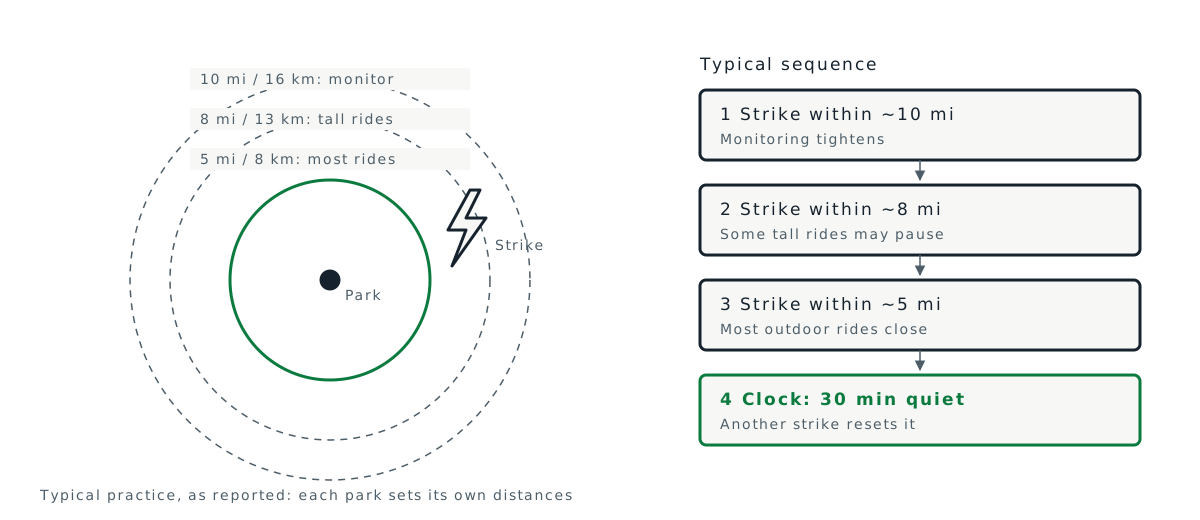
Notice the order of events, too. As the same source describes it, current cycles complete, trains return to their stations, queues close and guests are directed indoors. Nobody wants a train held at the top of a lift hill while a storm approaches, so the system aims to get every train back to the platform before the rule bites.
Lightning is also why indoor attractions usually stay open (and how indoor coasters are engineered is a story of its own). The shape of the problem is a tall exposed structure, and a dark ride in a shed doesn’t have it.
Why a closed ride doesn’t reopen the moment the weather does
The sky clearing is the start of the recovery, not the end of it. Before a ride reopens after a weather stop, parks work through much the same routine as the start of any day, as covered in the inspection guide: an unloaded train circuits the track, then a loaded one, and the sensors and brakes are checked for correct operation. Wet track and wet fins need to dry or be dried, and the controller needs to see the conditions it requires.
That recovery time is a real cost to the park, because a stopped ride is also lost capacity: every cycle skipped is guests not carried, and the queue that built up has to be worked off afterwards.
Where you’ll find it
Weather policy is public in outline if not in detail. Alton Towers’ website says severe conditions such as heavy rain, hail, lightning and high winds can result in ride closures, and recommends checking ride status on its app for live updates. It doesn’t publish the limits themselves, which is common: the numbers belong to each ride’s manual.
The opposite case is the enclosed coaster. Space Mountain at Walt Disney World’s Magic Kingdom, an indoor Arrow Development and WED Enterprises coaster that opened on 15 January 1975, sits inside a building (Wikipedia lists the track at 65 ft / 19.8 m high and 27 mph / 43.5 km/h top speed). Rain on the roof is simply not a variable for it, though it can be closed for other reasons, as can any ride.
The Dispatch verdict
What’s clever here is how unglamorous it is. A ride doesn’t need anyone to judge whether the weather looks nasty; a sensor reports a number, the controller compares it with a limit written down before the ride was built, and the decision follows. The human judgement is in the margins: lightning rules, rain on friction-braked rides, what a dripping station does to a train’s stopping point.
So the next closure that looks pointlessly cautious is probably the system doing exactly what it was built to do. Whether a park communicates it well is another matter, and on that front plenty of them could do rather better than a sign saying “weather”.
Further reading: how brakes stop a train, wet or dry, how block systems keep trains apart, how safety inspections work, and how wheels keep trains locked to the track.