
Copenhagen’s oldest park hasn’t built a new coaster since 2004. This August it opens the largest themed development in its history — and the coaster at the centre of it is the same one.
What happened
Tivoli Gardens has unveiled Hikari — Japanese for “light” — a Japanese-inspired district the park describes as the largest single themed development in its 183-year history, built on the site of its former Asia-inspired quarter after a two-year closure and rebuild. Tivoli has confirmed an opening in late summer 2026, with a media preview on 12 August; an exact public opening date hasn’t been announced.
Hikari’s centrepiece isn’t a new ride. It’s Dæmonen (“The Demon”), the B&M floorless coaster that has run the same layout since 2004, now completely re-dressed: new structure around it, new visual identity, and the track re-presented as an elevated line threading through a Japanese streetscape rather than a stand-alone thrill ride sitting in its own plot.
Two genuinely new attractions join it. Typhoon’s Eye is a rotating drum ride from Italian manufacturer SBF Visa Group, in which the floor falls away and riders are pinned to the wall. Hotel Hikari is a walkthrough funhouse from fellow Italian firm Gosetto, entered through what looks like an ordinary hotel lift and built around a vortex tunnel, a tilted room and an infinity-mirror maze. Alongside them: five street-food outlets developed with Danish restaurateurs, two shops, and an artwork by Takashi Murakami.
The detail
| Spec | Figure |
|---|---|
| District footprint | 2,000+ m² (21,500+ sq ft) |
| Investment | “Several hundred million” Danish kroner (park figure; exact sum undisclosed) |
| Build period | Two-year closure of the former Asia area |
| Anchor ride | Dæmonen — B&M Floorless Coaster |
| Opened | 16 April 2004, replacing the family coaster Slangen |
| Original cost | DKK 75 million (roughly €10 million at the time) |
| Height | 28 m (92 ft) |
| Drop | 20 m (66 ft) |
| Length | 564 m (1,850 ft) |
| Top speed | 77 km/h (48 mph) |
| Inversions | 3 — vertical loop, Immelmann, zero-gravity roll |
| Maximum force | 4 g |
| Trains | 2 × 6 cars, 4 abreast — 24 riders per train |
| Stated capacity | 1,200 riders per hour |
| Ride time | 1 min 46 sec |
| Minimum height | 132 cm (4 ft 4 in) |
Every one of those coaster figures is unchanged from 2004. This is a re-skin, not a re-track, and Tivoli isn’t claiming otherwise — the park’s own material is explicit that Dæmonen’s layout stays exactly as built, with the transformation confined to what surrounds it.
The coaster Tivoli decided to keep
Dæmonen arrived in 2004 as a solution to a problem Tivoli has had for most of its existence: it wanted a serious thrill ride and had almost nowhere to put one. B&M’s answer was one of the most compact machines the firm has ever delivered — 564 m of track folded into a plot most parks would consider a car park, with the layout stacked vertically rather than spread out.
It is also, in model terms, an early example of a genuinely clever idea. The Floorless Coaster — B&M’s product name, not a description someone invented afterwards — was developed between 1995 and 1996 and debuted as Medusa at Six Flags Great Adventure in April 1999. Only around a dozen have been built from scratch worldwide, plus three conversions of older B&M stand-up coasters. Dæmonen is one of a small club.
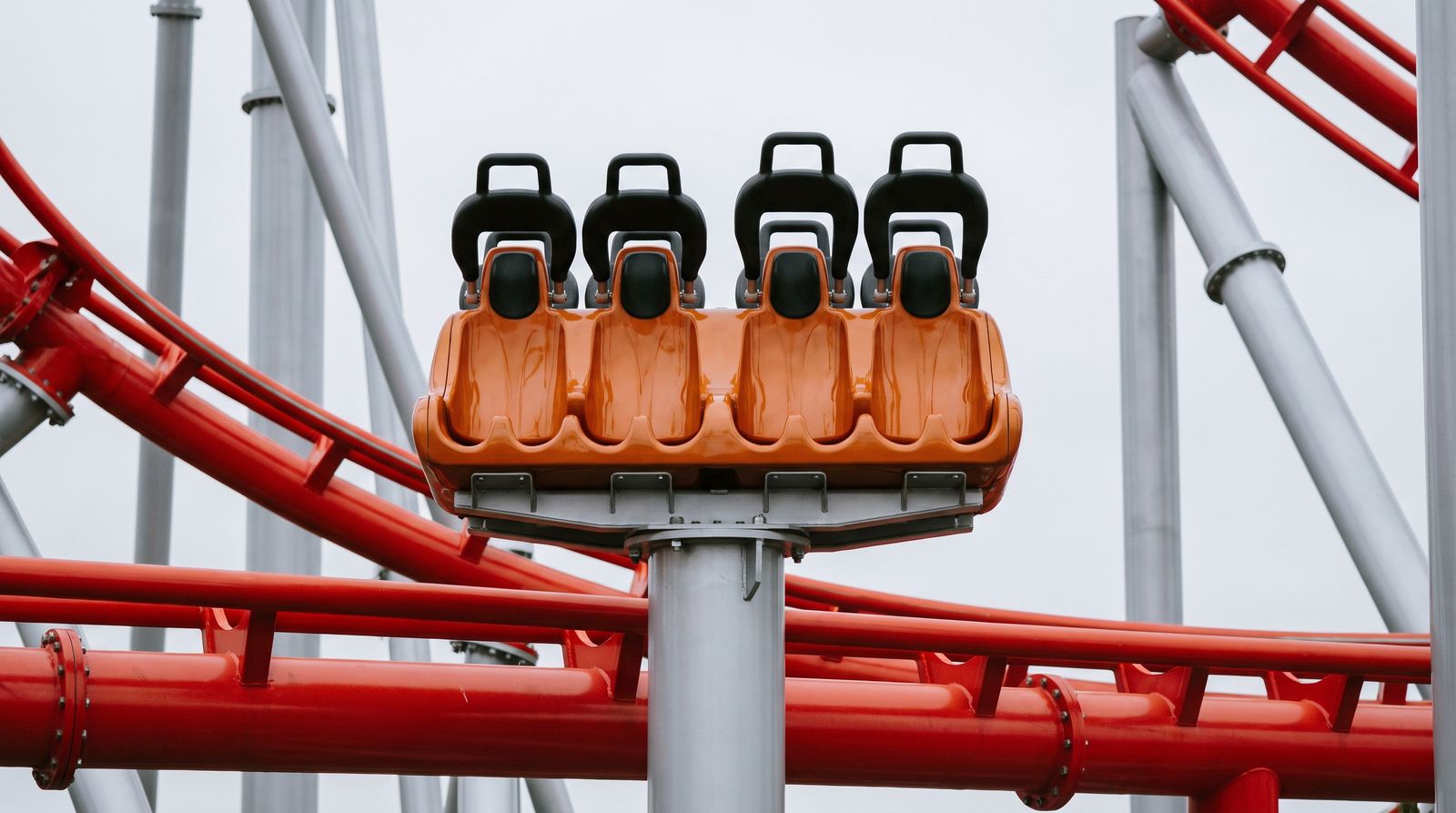
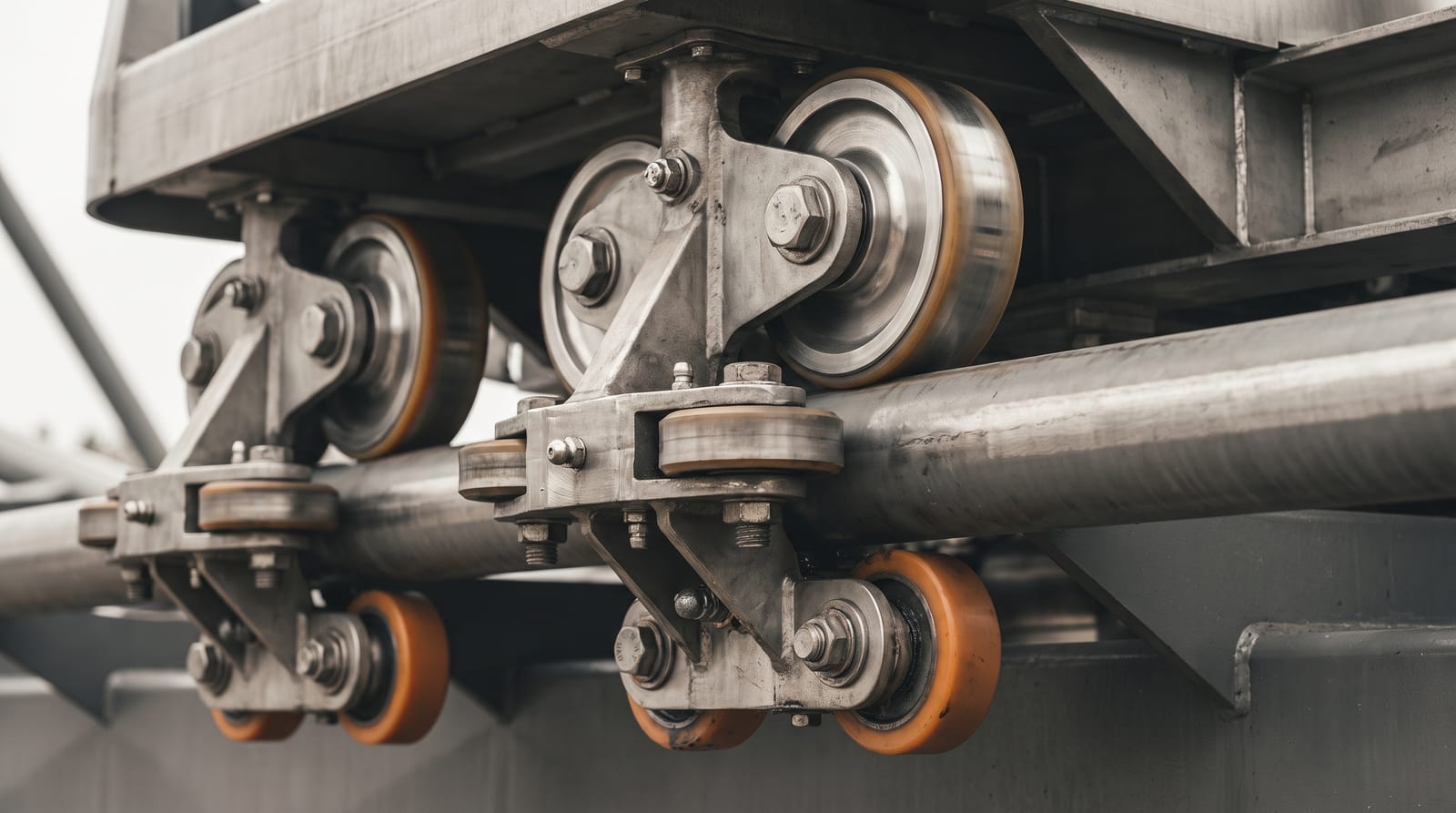
The trick is where the seats sit. On a conventional sit-down coaster, the car is a box: chassis, floor pan, footwell, and you inside it. A floorless car deletes the box. The seats are raised on a pedestal above the running rails, so the wheel assemblies and the box spine pass beneath your legs and there is nothing at all under your feet.
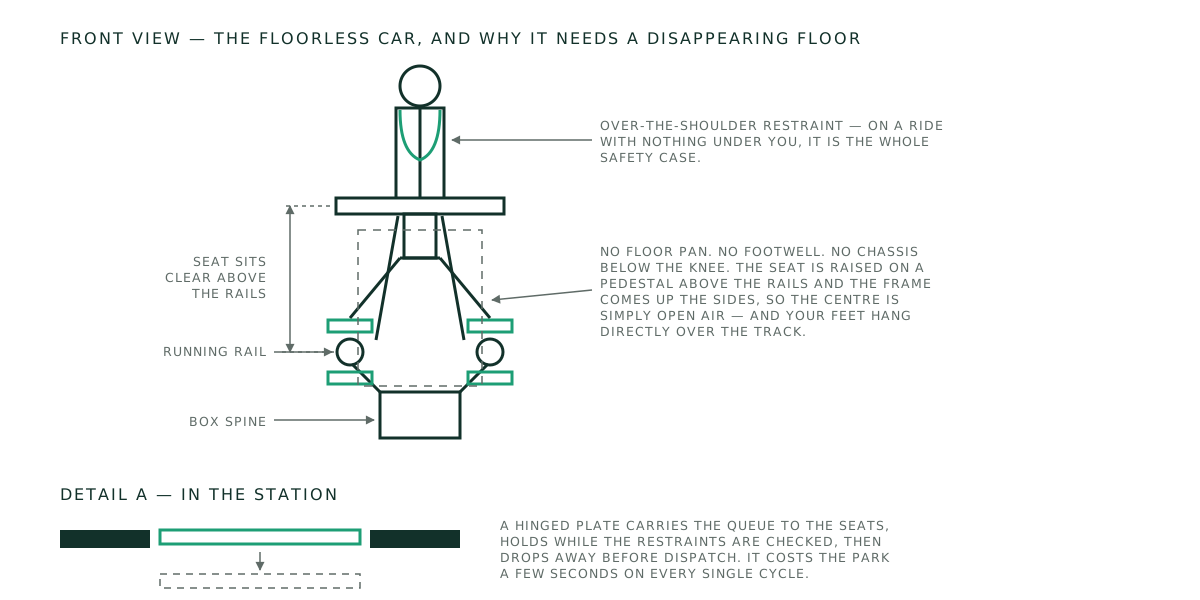
Which creates an obvious operational problem: you cannot board a train that has no floor. The solution is a hinged plate in the station that carries the queue to the seats, holds while the restraints are checked, and then drops away before dispatch. It is the ride’s signature moment and it costs the park a few seconds on every cycle — part of why the stated 1,200 riders per hour is modest by modern standards for a two-train coaster.
Dæmonen has also been rethemed before, in software. In April 2017 Tivoli fitted it with headsets from the German firm VR Coaster and ran it as Scandinavia’s first virtual-reality coaster, replacing the view of Copenhagen with a flight through ancient China. The hardware sat still; the story changed. Hikari is the same instinct, executed in steel, timber and 60 tonnes of roof tile.
Why a retheme is harder than it sounds
“Just repaint it” is the assumption, and it is wrong. A running coaster is not a backdrop you can build against — it is a machine with a defined volume of air it owns, and that volume is not negotiable.
That volume is the clearance envelope: the swept path of the train plus a margin for the riders’ limbs, for the flex of the structure under load, and for the possibility of a train stopping anywhere on the circuit and needing to be walked off. Nothing may enter it. Not a lantern, not a roof overhang, not a maturing tree.
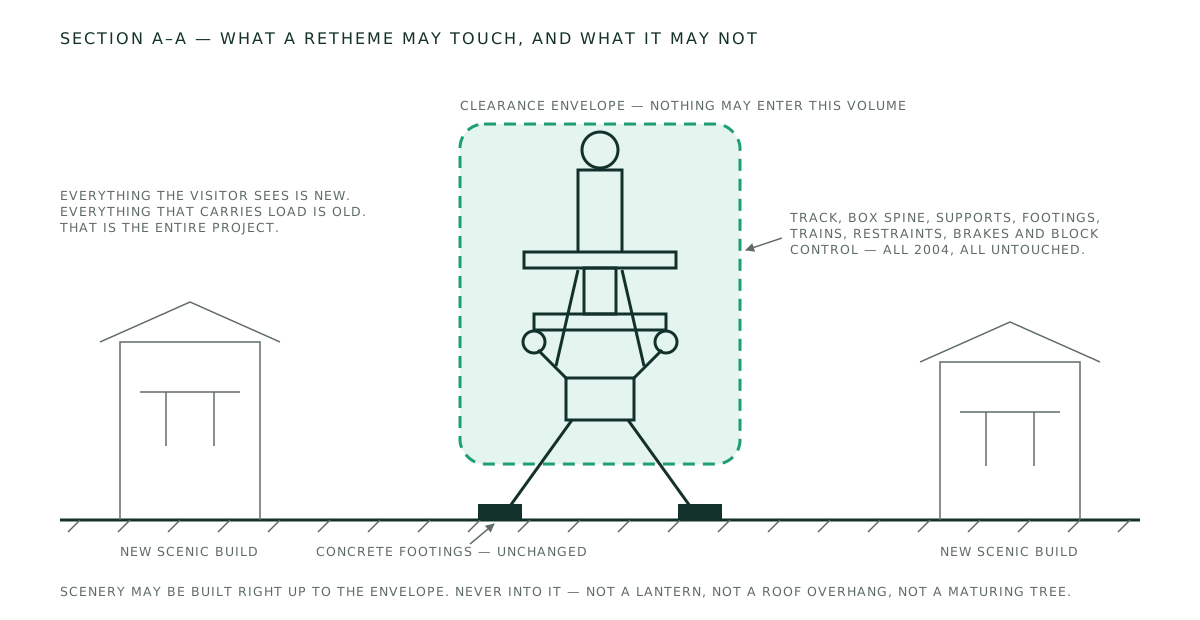
So the work divides cleanly. On one side of the line: track geometry, box spine, supports, footings, trains, restraints, brakes and the block-control system — all 2004, all untouched, all still subject to the same inspection regime they were on the day they opened. On the other: cladding, buildings, planting, lighting, sound, signage and the walking routes between them, all of which have to be designed around a fixed steel object rather than the other way round.
A themed land normally decides where the ride goes. Here the ride had already decided, twenty-two years ago, and everything else had to negotiate with it.
Two constraints in particular shape what you’ll actually see. Evacuation access means the catwalks along the track have to stay reachable, which quietly dictates where a roofline can and cannot go. And maintenance access means the whole structure still needs to be reachable for inspection every night, so the pretty new buildings have to open up, come apart, or leave gaps that the scenography then has to disguise. Any competent themed-land designer will tell you that hiding the maintenance door is the job.
Tivoli’s stated approach to the theming itself is worth noting because it is unusually disciplined: not a reconstruction of Japan, but Japanese architectural and urban-design principles reinterpreted through the park’s own theatrical language. The park convened an advisory board of five Danish and Japanese specialists — architecture, literature, travel — who reviewed everything from signage to colour palette. Reclaimed Japanese doors, windows and objects have been worked into the buildings, and roughly 60 tonnes of traditional roof tiles were shipped from the Japanese makers Tsuruya and Eishirou Kawara. That is a materially more expensive way to do it than a paint scheme and a few plastic torii, and it is the part of this project most likely to age well.
Typhoon’s Eye is a 1949 ride, and that is a compliment
Strip the name and the theming off Typhoon’s Eye and you have a Rotor — a ride type patented by the German engineer Ernst Hoffmeister in 1948 and first demonstrated at Oktoberfest in 1949.
The mechanism is beautifully spare. A large upright drum spins at around 33 revolutions per minute. The wall pushes each rider inward — that inward push is the only force doing the turning, and it runs to nearly 3 g. Friction between rider and wall then quietly does the other job: holding your weight. Once the drum is at speed, the floor retracts, and nothing whatsoever happens, because the friction was already carrying you.
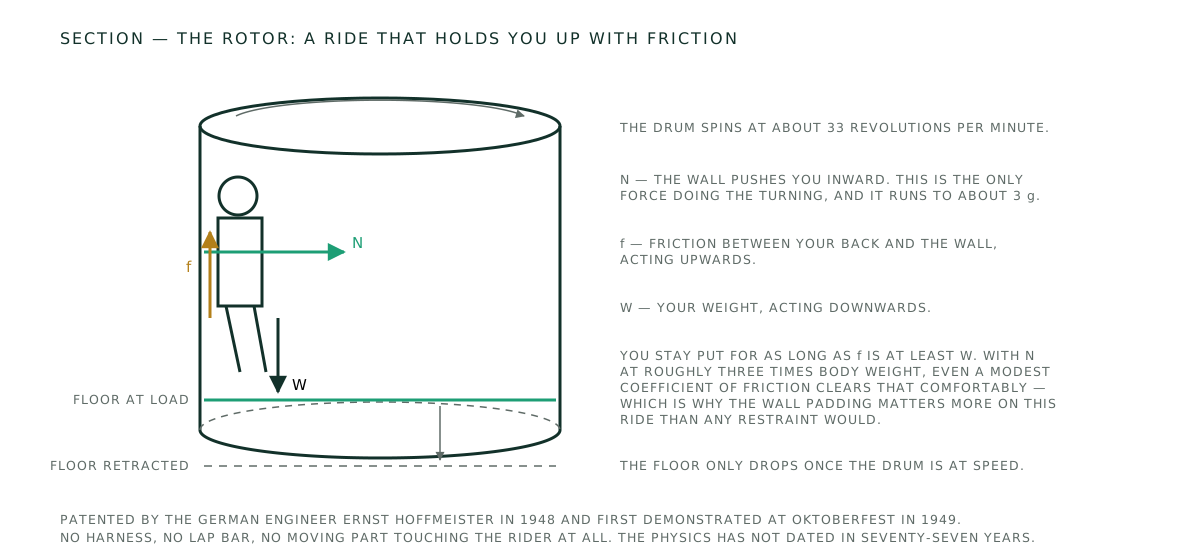
There is no restraint. There are no moving parts touching the rider at all. In an industry that has spent thirty years adding hydraulics, sensors and redundancy to every seat, a ride whose entire safety case rests on wall friction and a well-understood force balance is a genuine curiosity — and it has survived seventy-seven years because the physics does not date.
SBF Visa Group, who are building it, are the sort of firm this site thinks deserves more coverage: an Italian manufacturer running seven plants across the Padua and Rovigo provinces, supplying the family rides and mid-tier thrill machines that fill parks worldwide while the headlines go to the coaster builders. Gosetto, supplying Hotel Hikari, occupies an even quieter niche — walkthrough funhouses and dark-ride scenery, a category most parks abandoned decades ago.
The walkthrough comeback
Hotel Hikari is the least glamorous item in the announcement and possibly the shrewdest. Walkthrough attractions have a set of properties that a land-constrained northern-European park should find irresistible.
They are cheap per square metre compared with anything on rails. They have no dispatch cycle, so throughput scales with how quickly you let people in rather than with train count. They are entirely indoors, which matters enormously in a city where the season is short and the weather is Danish. And they suit families with a range of heights, which a 132 cm coaster and a 3 g drum ride emphatically do not.
Put plainly: the two new rides are there to catch everyone Dæmonen turns away.
The 2,000 m² problem
Here is the number that explains the whole project. Tivoli sits on a fixed footprint of roughly 80,000 m² (8.3 hectares) in central Copenhagen, hemmed in by the city on every side. Hikari covers 2,000 m². The largest themed development in the park’s history is two and a half per cent of the park.
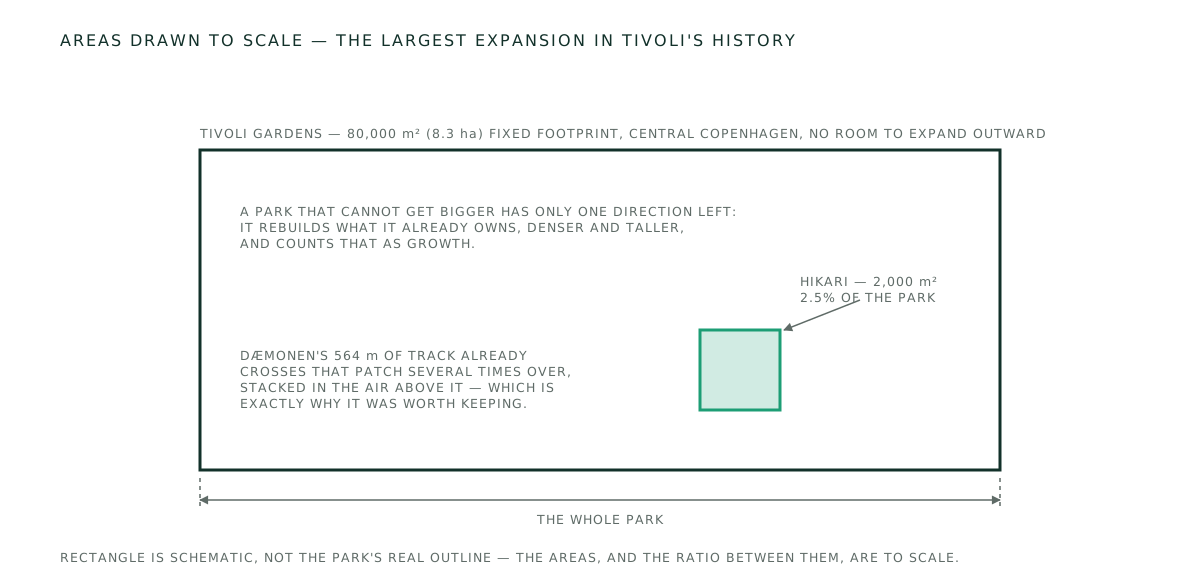
That is not a criticism, it is the operating condition. A park with no room to expand outward has exactly two moves: build upward, or rebuild what it already has to a higher standard. Tivoli has spent two decades doing both, and Hikari is the most expensive version of the second.
The money frames it further. Tivoli A/S — a listed company on Nasdaq Copenhagen, so its numbers are public — took 4,304,000 visitors in 2025, up 1% on 2024, on record revenue of DKK 1.345 billion and a pre-tax profit of about DKK 156 million. Against that, “several hundred million kroner” of capital expenditure on 2,000 m² is not a rounding error. It is well over a year’s profit committed to one district.
What it actually means
Re-theming a running coaster instead of replacing it is a well-worn move in this industry, usually as a cheap repaint when an old ride needs a new story. What makes Hikari worth a second look is the scale of the exception: Tivoli isn’t dressing up a tired flat ride, it’s wrapping its single largest thrill asset in 2,000 m² of new architecture, imported roof tile and Murakami, and calling the result its biggest expansion ever. That only works because Dæmonen was worth keeping in the first place.
Which is the real B&M story here. Twenty-two years is a long time for a coaster to still be the ride a park chooses to build a headline attraction around rather than quietly retire. B&M’s box-spine track and conservative design margins are the industry’s byword for reliability, and Dæmonen retaining its factory-spec height, speed and inversion count without a single number needing revision after more than two decades of dispatches is that reputation made concrete. Tivoli didn’t need to ask whether the hardware could still carry the investment. It clearly could.
There’s a hard cost logic underneath the theming story too. A new coaster of comparable scale would be a multi-year capital project — Dæmonen itself cost DKK 75 million in 2004 money, and that was for a compact ride on a cleared site with no city-centre logistics premium and no two-year closure of the surrounding area. Re-theming a structurally sound one lets Tivoli spend its budget on architecture, a funhouse and a flat ride instead, while still getting a headline coaster on the poster.
And there’s a pattern worth watching across Europe. Tivoli is not alone in discovering that the cheapest new attraction is the one you already own — the same instinct drives RMC’s hybrid conversions, Vekoma’s retrofit programmes, and every park that has quietly re-themed a 1990s ride rather than scrapped it. Expect more of it, particularly at older urban parks with heritage constraints and no spare land. The alternative model — a regional park betting its year on one genuinely new ride — needs space Tivoli hasn’t had since about 1900.
The Dispatch verdict
A smart piece of capital allocation dressed as a theming story, and unusually honest about it. Nobody should mistake a re-clad Dæmonen for a new coaster — the stats table above hasn’t moved an inch since 2004, and if you’ve ridden it, you have ridden this. But the surrounding work looks like the expensive kind rather than the quick kind, the two new attractions are aimed squarely at the audience the coaster excludes, and building a district’s identity around proof that a 22-year-old B&M still earns its keep is a better story than most “new for 2026” press releases manage.
The thing to watch on 12 August isn’t the coaster. It’s whether the buildings hold up close, and where they hid the maintenance doors.
Further reading: our guide to the coaster manufacturers, including B&M, how modern restraint systems like Dæmonen’s actually work, why Tivoli’s 1914 Rutschebanen still carries a brakeman, what a press preview does and doesn’t tell you, and another 2026 European park betting big on a single new attraction.