
Every queue you’ve ever stood in was a maths problem wearing theming. The park knows the numbers precisely — they’re designed, measured and managed all day — and once you know them too, queues stop being mysterious injustices and become something better: predictable.
The short answer: a ride’s capacity is riders per vehicle multiplied by vehicles dispatched per hour — nothing else. A 24-seat train leaving every 90 seconds moves 960 people an hour, whatever the ride’s top speed. Your wait is simply the number of people ahead of you divided by that rate. Everything parks do about queues — more trains, faster loading, single-rider lines, priority passes — is an attack on one of those two numbers.
The strange, useful corollary: a coaster’s speed appears nowhere in the equation. Capacity lives in the station.
The only equation that matters
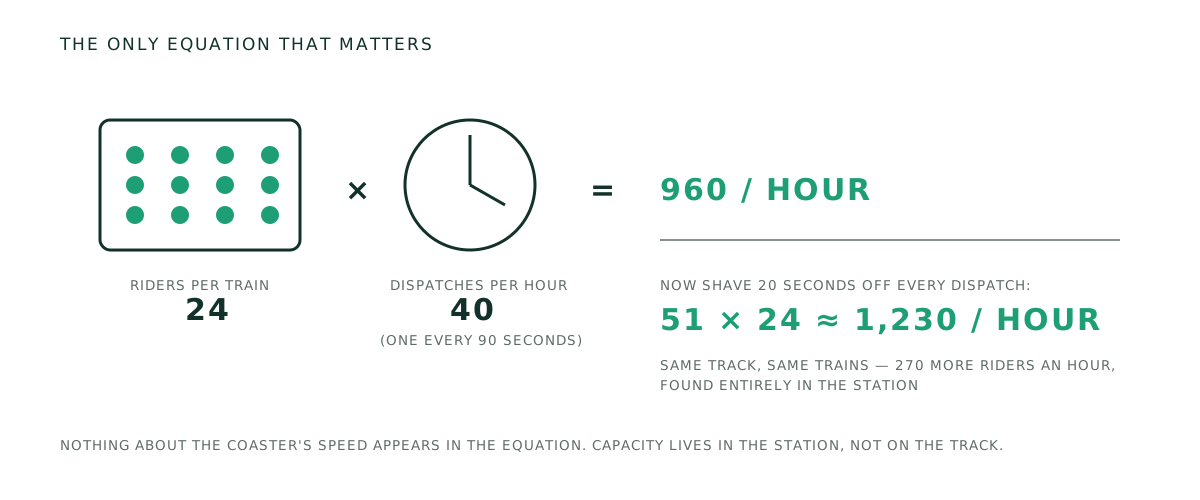
Play with the numbers and you see why operators obsess over seconds. At a 90-second dispatch interval, our 24-seat train delivers 960 riders an hour; tighten to 70 seconds and it’s roughly 1,230 — a 28% capacity increase with no new hardware, found entirely in how fast the crew can unload, load, check restraints and clear the block ahead. This is why a sharp station crew is genuinely thrilling to watch, and why Phantasialand’s Taron squeezes around 1,200 riders an hour through four trains and two launches: the machinery and the humans are both running at pace.
More trains help only as far as the layout allows — a train added without a block section to put it in just stacks on the brakes. Trains, blocks and dispatch speed rise and fall together; that’s the design conversation happening years before the queue exists.
The brochure number versus the car park number
Manufacturers quote theoretical capacity: every seat filled, every dispatch on time, for a full hour. Reality taxes it.
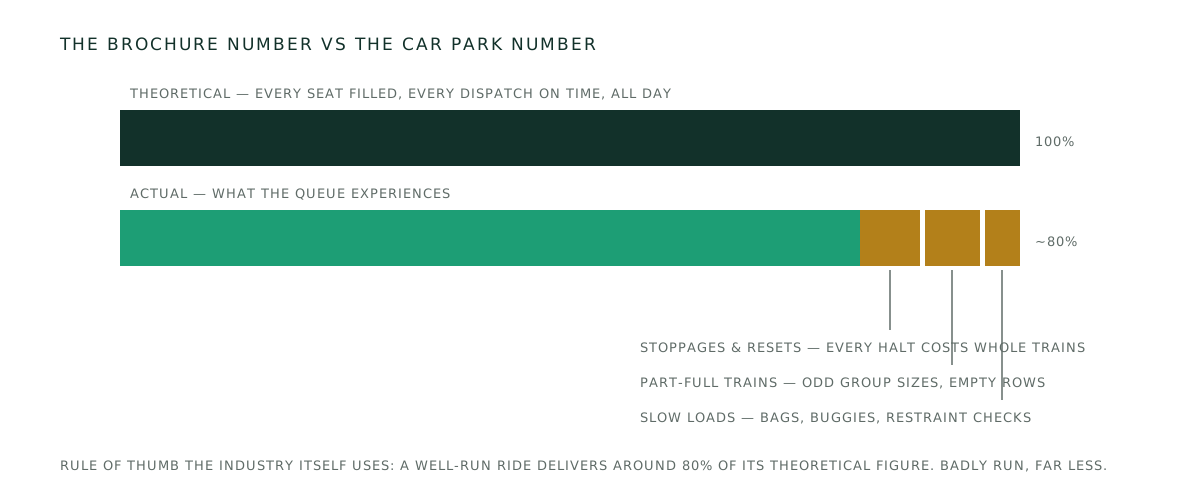
The gap has three main causes. Stoppages — a guest’s dropped phone, a sensor fault, a rehearsal-grade hiccup — cost whole trains at a time. Part-full trains leak seats constantly (odd-sized groups, single riders in pairs of seats — the entire justification for single-rider queues, which exist to caulk empty seats, not to reward the friendless). And loading varies with humanity itself: bags, buggies, restraint rechecks, that one row that didn’t hear the spiel. A well-run operation lands near 80% of theoretical; a sloppy one, far below — and the queue feels every percentage point.
The masters of the genre are worth naming. The continuous-loading Omnimover — Disney’s endlessly rotating chain of vehicles, loading from a moving walkway with no dispatch interval at all — is the capacity king: the Haunted Mansion’s system is rated around 3,200 riders an hour theoretical, and even its real-world figure of roughly 2,500 embarrasses most coasters. Europa-Park’s Geisterschloss runs the same trick at about 2,050. When a designer really needs to eat a crowd, they don’t build a faster ride; they build one that never stops boarding.
Why the queue is long anyway
Now invert the equation, because that’s what the posted wait time is:
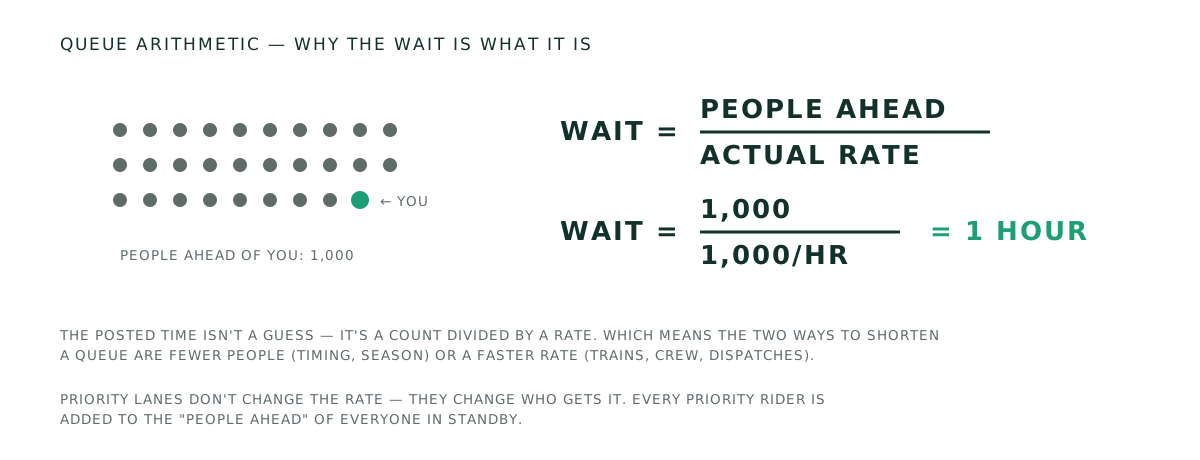
This little formula explains most queue phenomena people attribute to dark magic. Why does the line barely move sometimes? The rate dropped — a stoppage upstream, and the queue’s clock stops with it. Why did the posted time jump while you stood still? Priority lanes don’t add capacity; they allocate it — every priority rider joins the invisible “people ahead” of standby, stretching the same rate across more claimants. And why does a short-looking queue for a small ride outlast a monster queue for a headliner? Because a 400-person line at 300 riders an hour is longer, in the only unit that matters, than 1,200 people at 1,500 an hour.
Using the maths on the ground
Turn the equation into strategy and it earns its keep. Ride low-capacity attractions first — the flat rides, the single-vehicle oddities, anything with one train — because their queues grow fastest and shrink slowest; the people-eaters can absorb an afternoon crowd. Treat posted times as counts-divided-by-rates, not moods: a big posted number on an Omnimover moves constantly and often overdelivers, while a modest number on a one-train coaster can curdle the moment anything stops. Use single-rider lines for what they are — the operator paying you in time to fill their empty seats. And if you see a crew stacking trains on the final brakes every cycle, adjust your expectations: the hardware’s fine, but the rate is running below spec.
The same arithmetic shows up in odd corners of ride design, too — Toverland’s new rider-controlled “swinging bobsled” has a programmed minimum speed for exactly this reason: without one, a cautious rider on the brake lever the whole way round would strangle the dispatch rate for everyone behind them.
The Dispatch verdict
Ride capacity is the least romantic subject in park design and the one that most determines whether your day is any good. The equation is almost insultingly simple — seats times dispatches, people over rate — but everything hangs off it: why stations are built the way they are, why parks drill their crews like pit teams, why the Omnimover refuses to die, and why the queue is long.
It’s long because the maths says so. The consolation is that now you can do the maths too — ideally while walking briskly towards the single-rider entrance.
Further reading: the block systems that set how many trains can run, and why a ride in technical rehearsal runs below its numbers.