
It might be the most famous sound in any theme park: the slow, deliberate clack… clack… clack of a roller coaster climbing its lift hill. Film-makers use it as shorthand for dread. Riders hear it as a countdown. And almost nobody in the queue knows what’s actually making it.
The short answer: each clack is a hinged steel catch under the train — the anti-rollback dog — dropping over the next tooth of a ratchet strip that runs up the lift hill. If the lift chain ever broke, the dog would jam into the nearest tooth and stop the train dead within a few centimetres. The scariest sound at the fair is the safety system, announcing itself several times a second.
That’s the two-sentence version. The full story involves a hinged piece of steel that has barely changed since 1910, a man with more than a hundred coaster patents to his name, and the surprisingly interesting reasons some modern lift hills say nothing at all.
The ratchet on the way up
Flip a coaster train over — parks do this in the maintenance bay every winter — and among the wheels you’ll find one or more heavy, hinged steel catches: the anti-rollback dogs. They hang down under their own weight, which matters, because it means they need no power, no springs and no instructions to do their job.
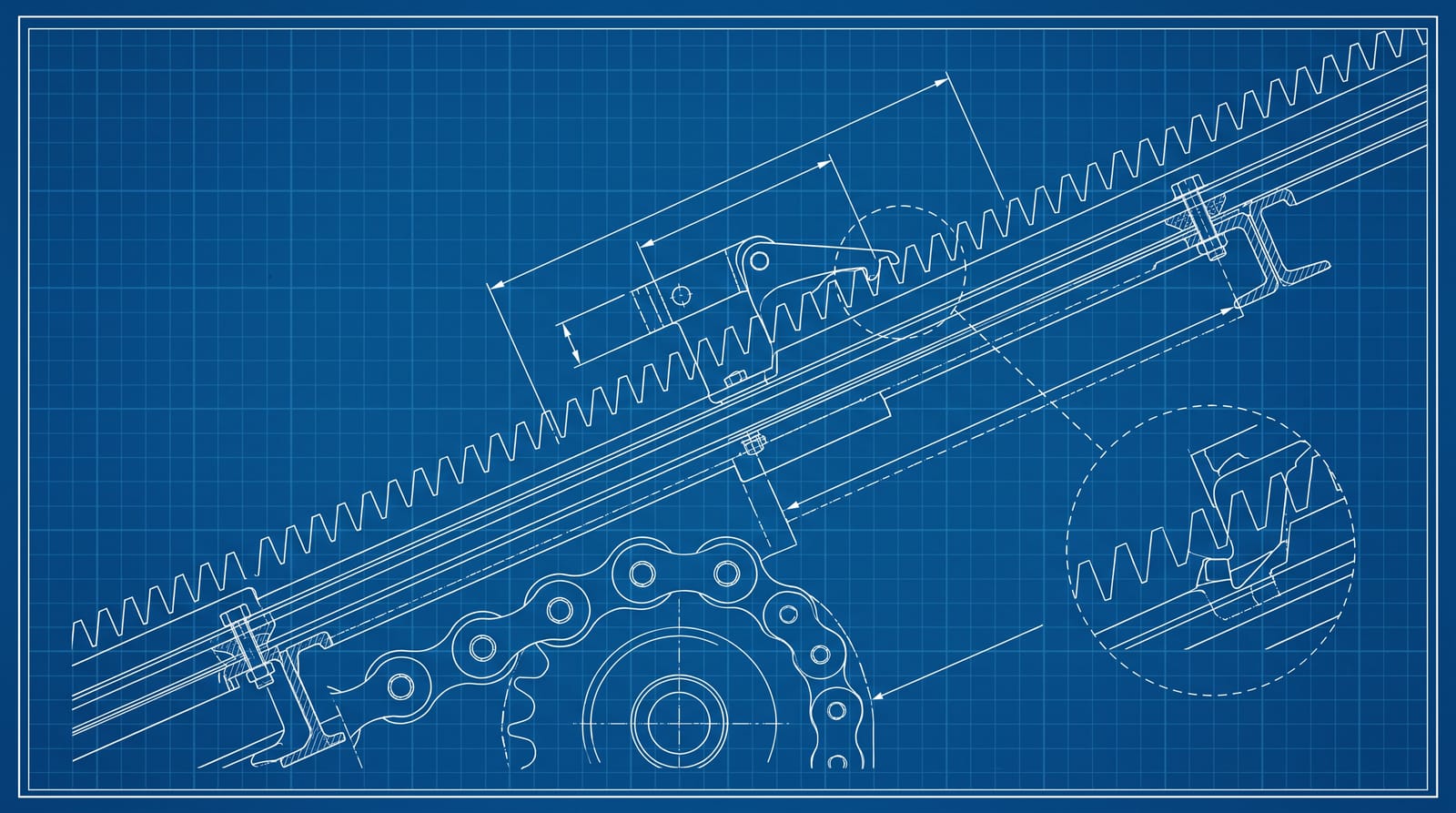
Running up the centre of the lift hill is their other half: a long strip of steel teeth, shaped like a saw blade, called the ratchet rack. The teeth lean uphill. As the chain hauls the train up, each dog drags over the sloped back of one tooth after another, lifting and dropping, lifting and dropping. Every drop is one clack.
Then comes the day the mechanism exists for. If the train ever starts moving backwards — a snapped chain, a failed drive — the dog doesn’t slide over the teeth any more. It slams into the vertical face of the nearest one and wedges there, and the train stops. Total distance lost: one tooth’s spacing.
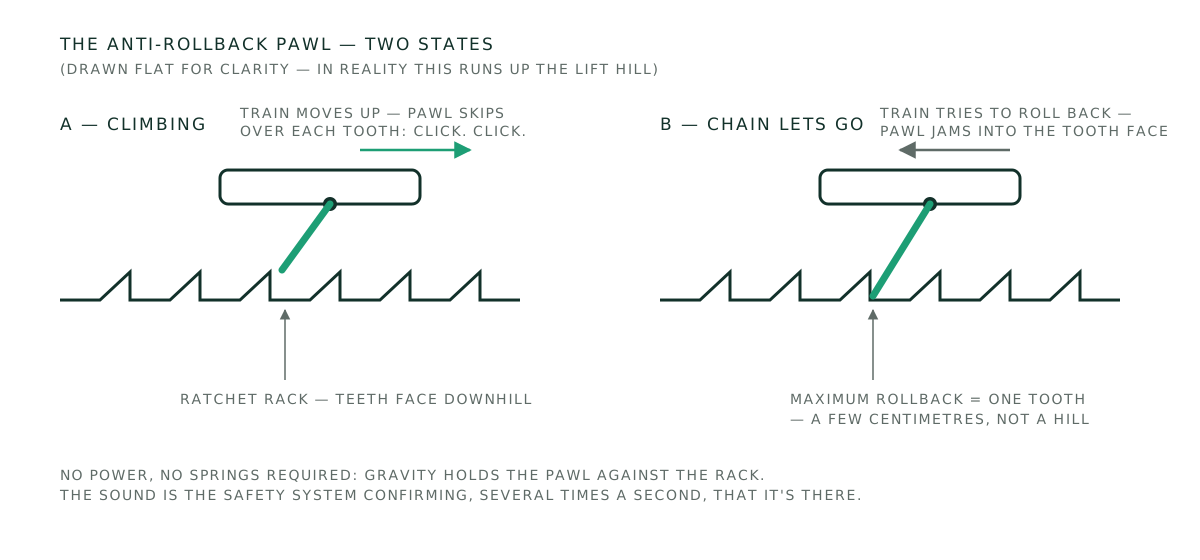
Notice what’s not in that mechanism: no sensor, no computer, no compressed air. Gravity holds the dog against the rack, and geometry does the rest. It belongs to the same family of thinking as the fail-safe block brakes elsewhere on the ride — the system’s failure mode is the safe state — except this one is so simple it can’t meaningfully fail at all.
Two dogs, two jobs
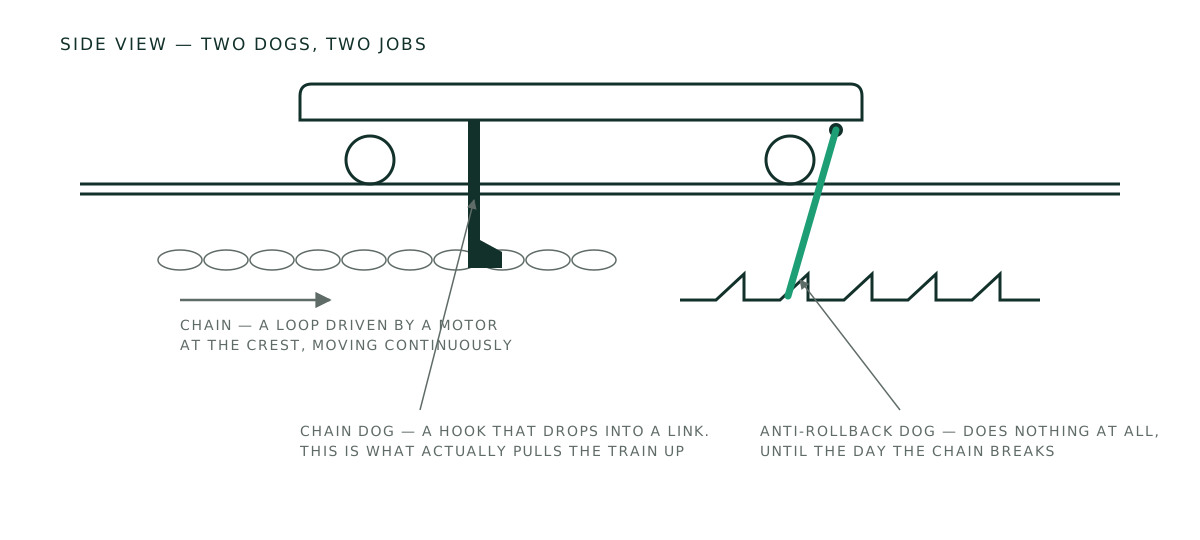
The anti-rollback dog often gets confused with its neighbour, because most lift hills carry a pair of similar-looking catches doing entirely different work.
The chain dog is the one earning its keep. It’s a hook on the train’s underside that drops into a link of the lift chain — the enormous loop of steel, driven by a motor at the crest, that grinds continuously up the hill like the world’s least hurried escalator. Chain dog in, train goes up. At the top, the chain dips away from the track, the dog slips free, and gravity takes over.
The anti-rollback dog, meanwhile, does absolutely nothing. It drags along its rack, clicking away, contributing not one newton to the climb — a passenger with one job, which it will perform perhaps never in the ride’s entire operating life. Engineering is full of components like this, and the mark of a well-run park is that they’re maintained as carefully as the parts that work every day.
One click of insurance
The spacing of the ratchet teeth sets the entire safety case: a train can never roll back further than one tooth. On most lifts that’s a matter of centimetres — a jolt, not a journey.
This is also why the anti-rollback rack makes the lift hill work as a block section. As covered in our block systems explainer, every section of a multi-train coaster must be able to stop a train and hold it. On the lift, “stop” is easy — stop the chain — but “hold” is the ratchet’s gift: a train parked mid-lift simply sits on its dogs, held by teeth and gravity, indefinitely and for free. When a coaster halts on the lift and the ride reopens twenty minutes later, that’s the machinery you were sitting on.
The man who invented the clack
The sound is older than almost everything else in the park. The safety chain dog was patented in 1910 by John A. Miller, a prolific American engineer who started under coaster pioneer LaMarcus Thompson at nineteen and went on to hold more than a hundred patents in ride technology — enough that historians call him the Thomas Edison of the roller coaster.
Miller’s 1910 ratchet solved the era’s most alarming failure: chain breaks on the climb, train runs away backwards through a station full of people. His fix was so complete that the industry has spent the century since merely refining the materials. And he wasn’t finished — his 1919 underfriction wheel patent, the wheels that grip the underside of the rail, is the invention that lets coasters loop, bank and leave the ground at all. Every airtime hill you’ve ever floated over is Miller’s paperwork in action.
There’s something quietly wonderful about the fact that the sound of coaster anticipation — used in a hundred film trailers — is really the sound of Edwardian-era health and safety.
Why some lift hills say nothing
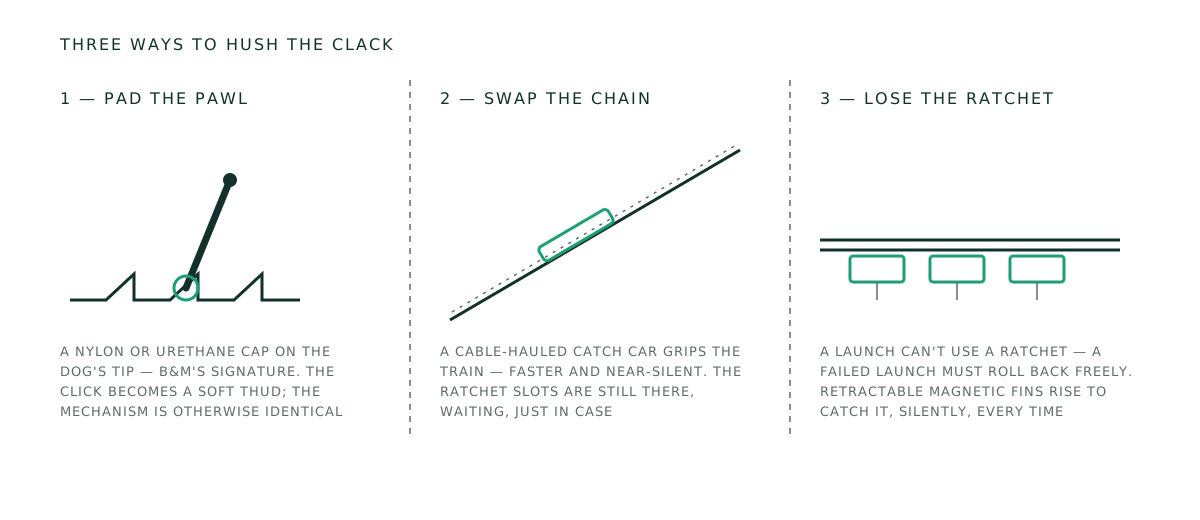
Ride a modern B&M — a Silver Star, a Nemesis — and the climb is nearly silent: a low mechanical hum and a soft, rubbery thud-thud instead of the clatter. The ratchet hasn’t gone anywhere. B&M cap their anti-rollback dogs with nylon, so the steel-on-steel click becomes a padded knock. Parks with close neighbours and long operating hours appreciate a coaster that doesn’t announce every single climb to the entire postcode.
Cable lifts go further. Millennium Force at Cedar Point — the first coaster built with one — swaps the chain for a catch car: a winched carriage that grips the train and hauls it up a 45-degree hill 94 m (310 ft) tall at speeds a chain can’t match. Smoother, faster, far quieter — and still not trusted alone: each train carries six anti-rollback dogs, and the lift carries the slots for them to fall into. The ratchet remains the deal Miller struck with gravity, whoever does the pulling.
Launch coasters are the genuinely interesting exception, because a launch can’t have a ratchet. If the launch doesn’t give the train enough speed to clear the top — a rollback, which famously happens now and then on giant accelerators like Cedar Point’s (now retired) Top Thrill Dragster — the train must be free to roll backwards down the launch track. A ratchet would turn a routine rollback into a derailment. So the launch track carries retractable magnetic brake fins instead: they drop flat to let the train fire, then rise behind it, ready to catch a returning train silently and without touching it.
Where you’ll hear it
The full orchestral experience lives where the mechanism is oldest. Blackpool Pleasure Beach’s Big Dipper, clattering up its lift since 1923, sounds today almost exactly as it did when the ratchet was cutting-edge technology — as honest a piece of industrial heritage as Britain still runs daily. Classic steel coasters from the 1970s–90s (the great Arrow and Vekoma loopers) keep the sharp metallic version. B&M’s rides give you the muffled thud; a cable lift like Millennium Force offers only a whirr and the wind; and a launch coaster skips the overture entirely, which is rather the point of a launch.
The Dispatch verdict
The clickety-clack is that rare thing: a beloved piece of theme park atmosphere that is also, literally, the sound of not dying. A hinged lump of steel with no power supply, patented before the First World War, still riding up every lift hill on Earth because nobody has invented anything more trustworthy than a tooth and gravity.
Some sounds get designed by imagineers. The best one just fell out of the engineering — and the industry has been wise enough never to fix it.
Further reading: How roller coaster block systems work — and why trains never collide.