
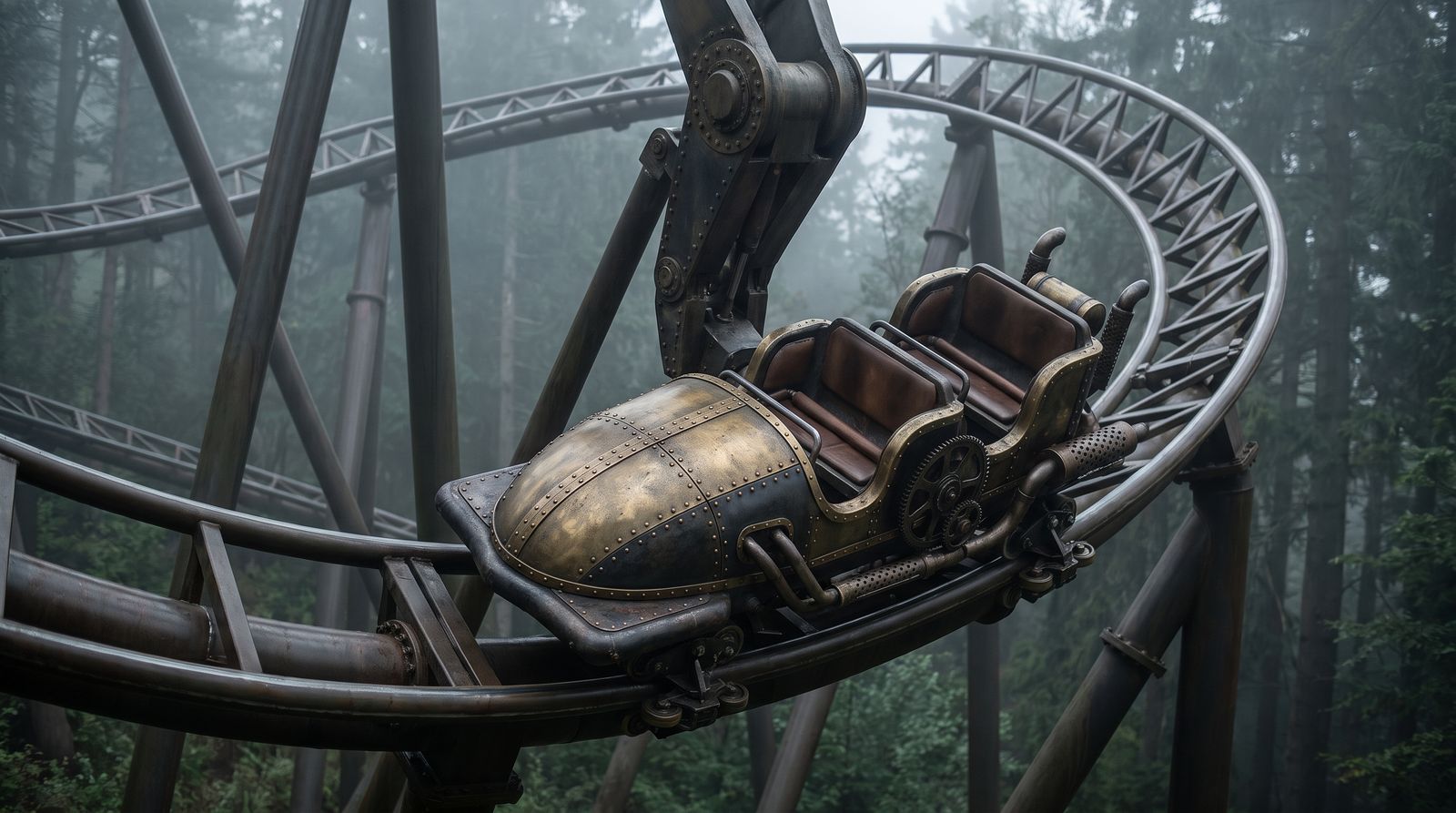
A bobsled ride that steers itself onto a roller coaster’s rails, built by a manufacturer best known for vehicles that need no rails at all: Toverland’s next attraction is a small ride with an unusually specific engineering story attached.
What happened
The Dutch park in Sevenum, Limburg, has confirmed it is retiring Maximus’ Blitz Bahn, its long-running bobsled ride, and replacing it with a new attraction developed in partnership with ETF Ride Systems, the trackless-ride specialist based twenty-odd kilometres away in Nederweert. Maximus’ Blitz Bahn closed for the last time on 17 May, and the park says its successor — still unnamed, provisionally referred to as a “swinging bobsled” — will open during the 2026/27 winter season, once construction in the Wunderwald themed area is finished.
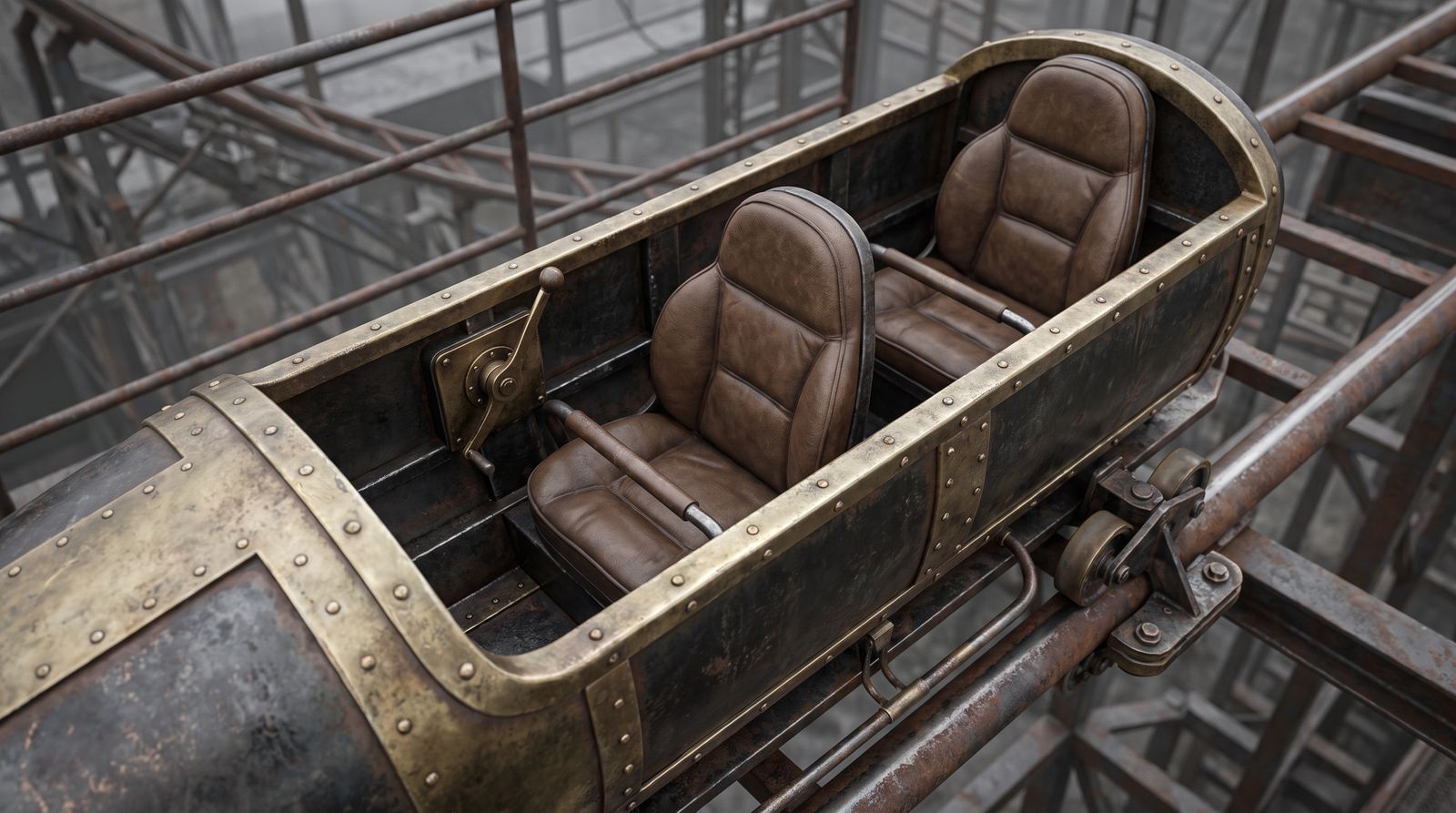
The detail that separates this from a routine ride swap is the hardware. Classic bobsled and alpine-coaster rides run vehicles through curved concrete or steel troughs, with riders braking but not steering. Toverland’s new ride keeps the rider-operated speed lever guests will recognise from the old attraction, but mounts it on a conventional steel coaster track instead — with banked corners that tilt the vehicle inward through the turns, and points along the circuit where the sled swings outward on the rail, the angle and force of the swing governed by how fast you’re going.
The detail
| Spec | Detail |
|---|---|
| Manufacturer | ETF Ride Systems (Nederweert, Netherlands) |
| Replaces | Maximus’ Blitz Bahn (closed 17 May 2026) |
| Location | Wunderwald themed area |
| Vehicle | Two-seat sled, inline seating |
| Speed control | Rider-operated lever, with a programmed minimum speed |
| Track | Steel coaster rail, banked corners, speed-linked swinging sections |
| Opening | Winter 2026/27 (exact date tbc) |
No height, top speed or track length has been published, and none appears in any of the trade coverage we could find — so, in line with this site’s policy, those numbers are simply left out rather than guessed at. ETF and Toverland describe the ride as a bespoke, one-off design, not an existing product pulled from a catalogue.
What it actually means
Start with the claim doing the rounds: several outlets are calling this a “world first.” Treat that carefully, because it usually means “first we could find,” not “first, verified.” What’s true is narrower and more interesting: alpine bobsled rides (Wiegand, Zamperla and others build plenty) hand riders a speed lever inside a trough; pendulum and swing rides (Intamin’s gyro swings, Gerstlauer’s Sky Fly) put riders on a rail that swings on its own schedule, not the rider’s. Nobody in either camp appears to have combined the two — lever-controlled speed feeding a track-mounted swing — into one system before. That’s a genuine, specific gap, and it’s the kind of claim that survives scrutiny because it’s narrow enough to check.
Then there’s the minimum speed, the one number the park has actually confirmed, and it’s the most telling detail in the whole announcement. Rider-controlled bobsled rides have a famous throughput problem: give the timid guest a brake lever and they will hold it down for the entire circuit, stacking the sled behind them and gutting the ride’s dispatch rate. A programmed floor on how slow you’re allowed to go is a direct fix for that — proof the “interactive” element is real, but bounded by an operations team that still has to hit an hourly number.
The manufacturer choice makes sense once you look at what ETF actually builds. Its day job is trackless dark ride vehicles — battery-powered cars that navigate by dead reckoning and floor markers under a central choreography system, the technology behind Efteling’s own Symbolica a few miles down the road. That’s a company whose core skill is precise, safety-bounded motion control in a confined envelope, not track-based coaster engineering as such. Building a banked steel circuit with a rider-adjustable speed governor and a swing behaviour keyed to velocity is a genuine stretch into new territory for them, not an incremental product update — which is presumably why the whole thing is being built from scratch rather than off an existing ETF platform.
There’s a smaller, tidier story sitting underneath the engineering one: this is a Limburg park commissioning a Limburg manufacturer, both a short drive apart, to build something that exists nowhere else. It’s the same regional-industry pattern this site keeps finding once you stop only looking at the big five manufacturers — mid-sized parks and nearby specialist builders solving a specific problem together, the way a family park in Saxony did with Mack Rides this summer, rather than buying whatever’s already in a brochure.
The Dispatch verdict
This won’t be anyone’s headline coaster — it’s a family-friendly replacement ride in a themed forest, not a record-chaser. But it’s a properly novel piece of ride engineering from a manufacturer stepping outside its specialism, with a capacity fix baked into the control system rather than bolted on afterwards. Worth a look when it opens this winter, and worth watching whether ETF brings the format to a second park once the bugs are out.
Further reading: how theme parks calculate ride capacity, how trackless dark ride systems work, and our guide to the roller coaster manufacturers.