
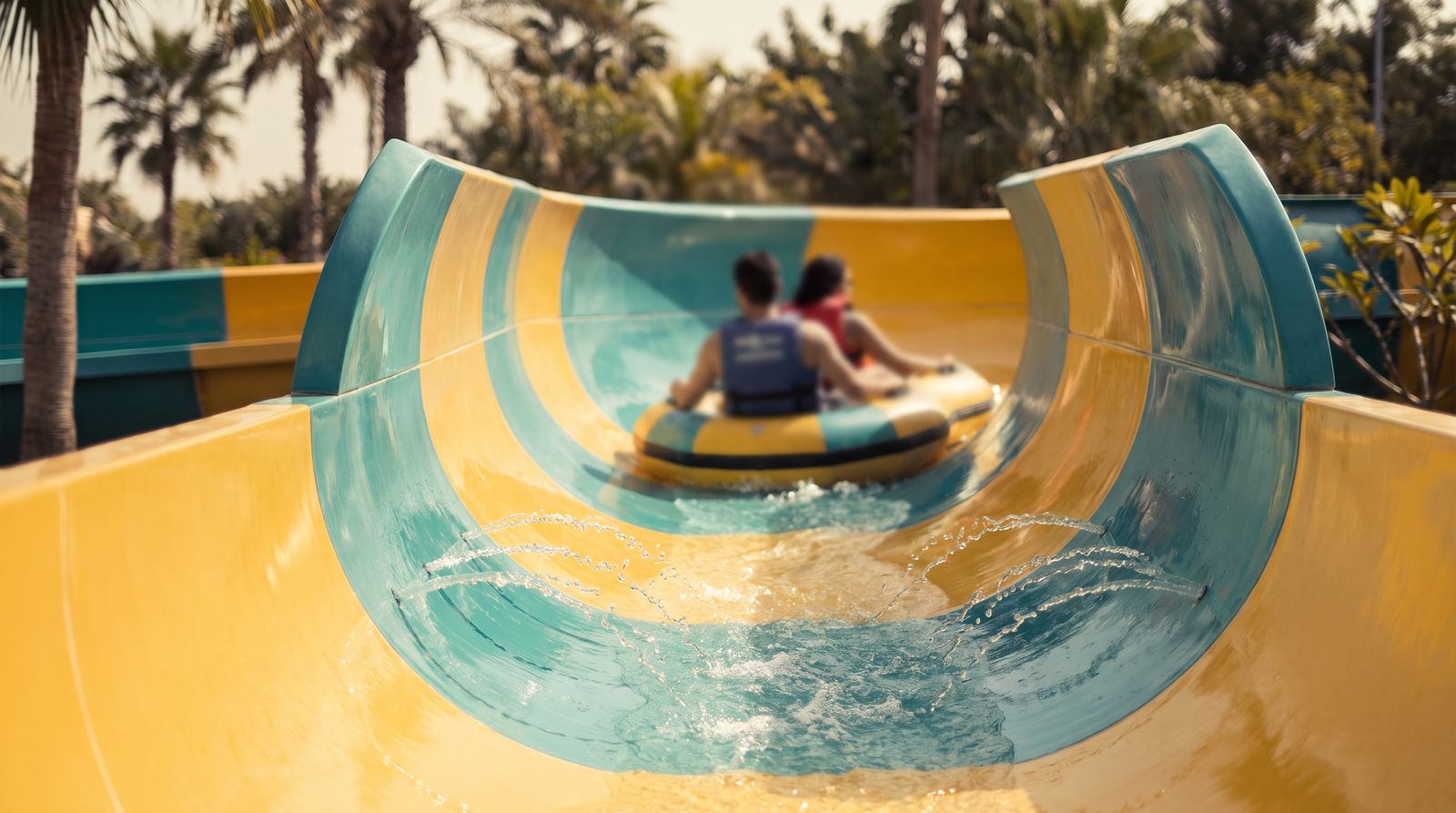
A water coaster normally needs a chain lift to get its boat uphill. ProSlide’s does it with a row of pumps and a lot of water, and Brazil is about to get its first two-lane version.
What happened
ProSlide, the Canadian water-ride manufacturer, announced that it will build a Dueling RocketBLAST at Hot Beach Olímpia, in the state of São Paulo, Brazil. Trade title Blooloop reported the deal on 26 October 2026, calling it Brazil’s first dueling water coaster. It is due in 2027 and anchors what the park says is its largest expansion to date.
ProSlide’s description is that the ride has two side-by-side tracks, each built on its FlyingSAUCER 20 and HIVE 20 technologies, with uphill propulsion, sweeping curves and “surprising transitions” before a high-speed finish. The fibreglass is finished in a colour scheme inspired by Brazilian culture. Phil Hayles, ProSlide’s senior vice president of business development, called it “a race unlike anything Brazil has seen before”.
The detail
ProSlide has not published a length, height or top speed, and neither has the park, so we are not going to guess them. Brazilian press coverage, which we could only partly read, adds a few figures that the manufacturer’s release does not. Treat them as reported rather than confirmed.
| Detail | Source | |
|---|---|---|
| Ride | Dueling RocketBLAST water coaster, two lanes | ProSlide, via Blooloop |
| Boats | Two riders per boat | Local press |
| Capacity | Up to 720 riders an hour | Local press |
| Expansion | More than 2,000 m² (21,500 sq ft), plus a new pool with a swim-up bar | Local press |
| Opening | 2027, no date set | Park, via local press |
If the 720 figure holds, that is a ride built to feed a busy resort rather than to be a one-off showpiece. It is also an estimate for the whole expansion in at least one report, so it should not be read as a precise throughput.
What it actually means
Start with how a water coaster gets uphill. Mack’s Serpent’s Curse at Paultons Park uses a steel track and a conventional chain lift, the same machinery described in our guide to lift hills. ProSlide’s BLAST system has no chain. The company describes it as “jet propulsion technology”: water is fired along the flume so that it pushes the boat up the incline. The principle is related to the uphill kick on a log flume, but sustained over a whole climb rather than a small hump.
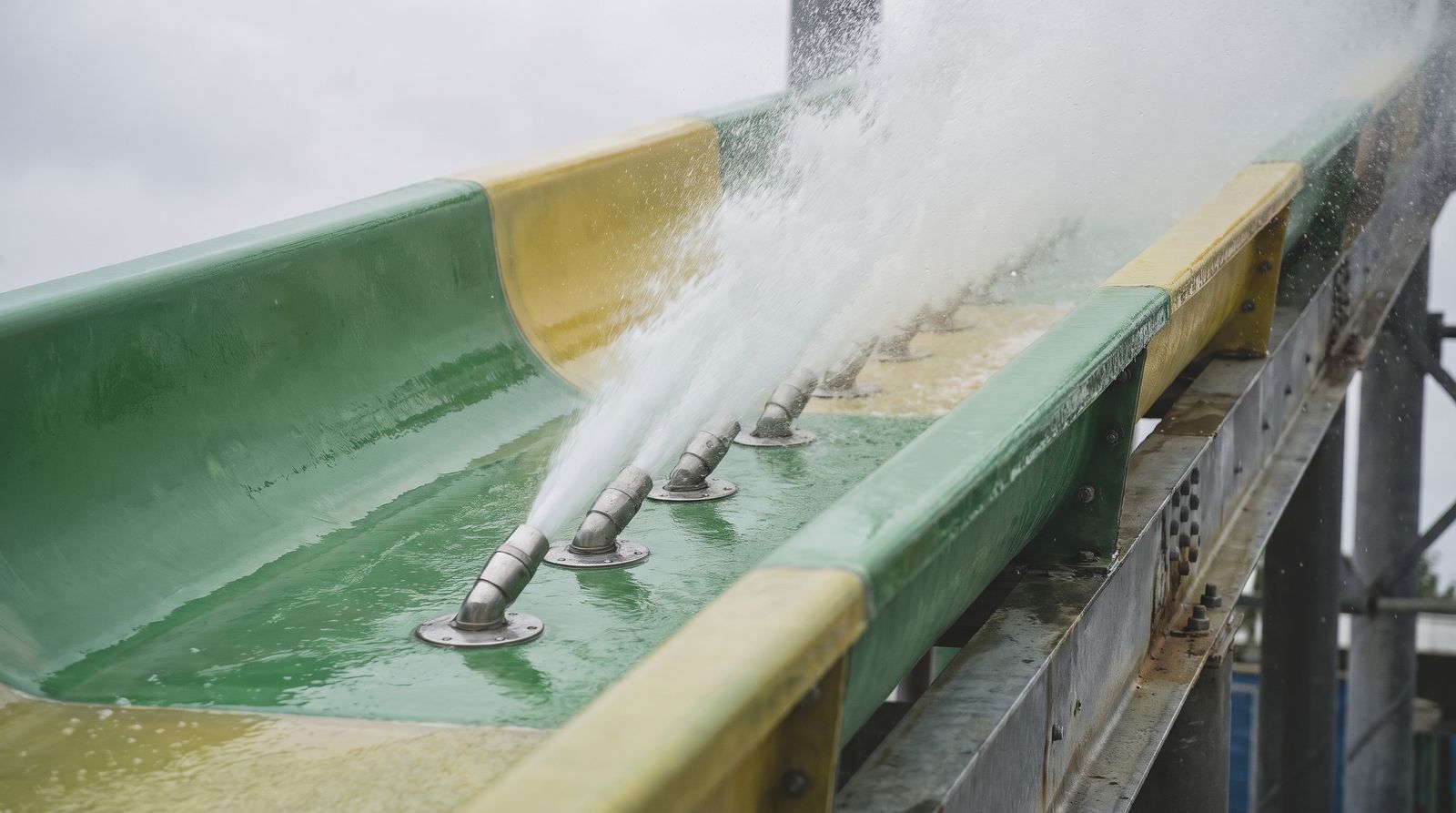
The trade-off is worth understanding. A chain lift is cheap to run and slow. A jet-driven climb is quicker and, in principle, lets the designer put uphill sections where the layout wants them rather than where a lift structure fits. The cost is pumps, which draw power and need maintenance, and a ride that depends on water pressure behaving the same on a hot Saturday as on a quiet Tuesday. That is our inference from how the system works, not a figure from ProSlide.
Now the “first”. The claim is narrow and, as far as we can tell, correct: first dueling water coaster in Brazil. It is not Brazil’s first water coaster, and local reports say it is not even Olímpia’s first. It is also nowhere near the world’s first. ProSlide itself announced the world’s first dueling water coaster, at Splashway in Texas, on 8 August 2019, and it has since built more. The format is proven, which is rather the point.
Dueling means two lanes run together and the boats race. ProSlide says its Splashway ride used open, low walls between lanes so riders could see and hear the opposition. That is cheap theatre, and it sells repeat rides, because you will want a rematch.
The Dispatch verdict
A sensible purchase from a manufacturer that has done this before, by a park that has clearly decided water rides are the product. The one thing missing is numbers, so judge the ride when ProSlide or Hot Beach publish a length and a height. Until then it is a proven format arriving somewhere new.
Further reading: Paultons Park’s Mack water coaster, how log flumes and river rapids work, how launch coasters work and our guide to the manufacturers.