
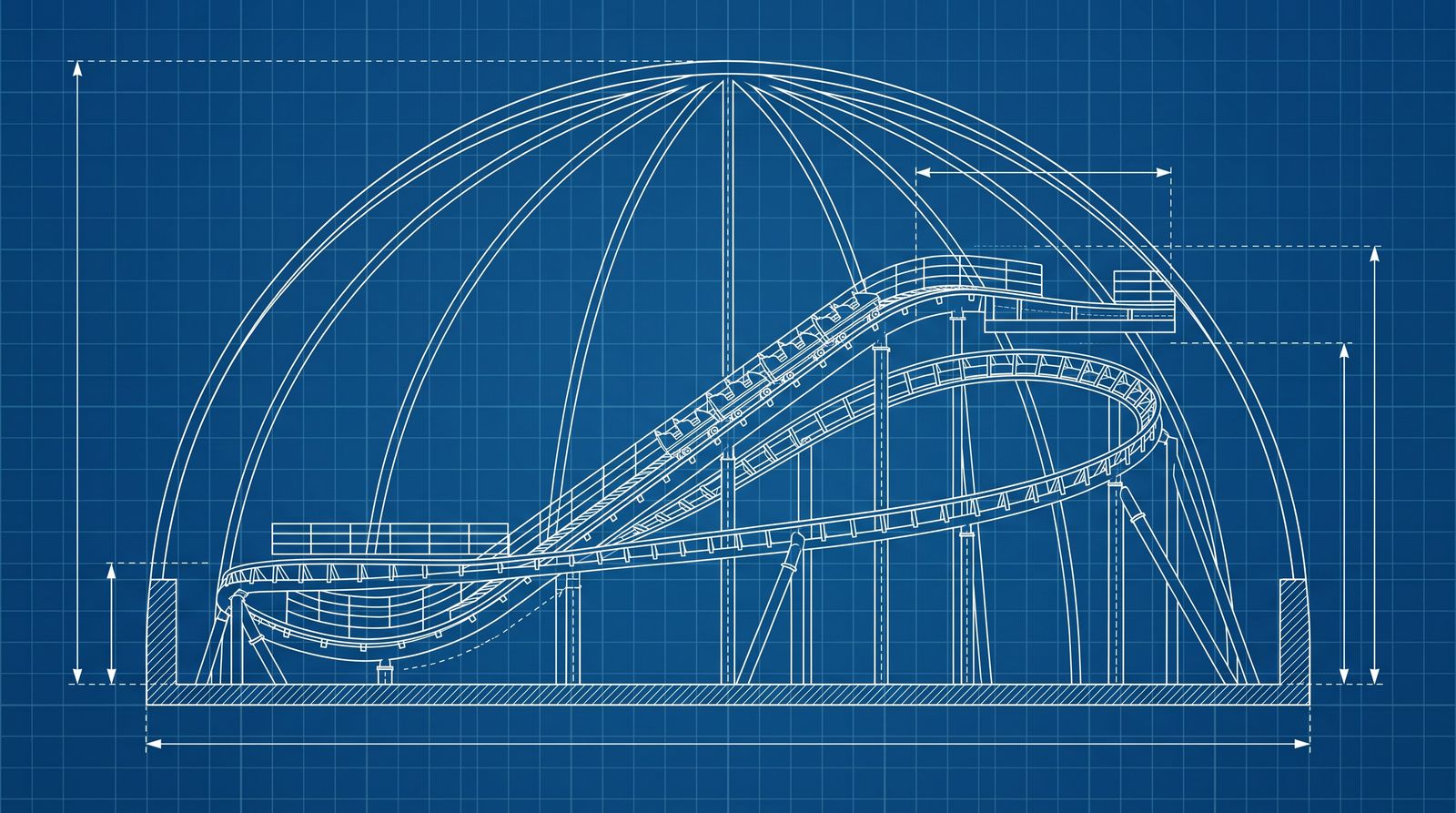
You are standing in a queue in daylight, looking at a plain windowless building. Ninety seconds later you are being fired through total blackness at what feels like sixty miles an hour, and the question forms on its own: how does a roller coaster fit inside that, and what happens if something goes wrong in the dark?
The short answer: an indoor roller coaster is an ordinary coaster that has been designed around its building, not just dropped into one. The shell supplies the darkness and keeps the weather out, which in turn forces compact layouts (often with motorised launches in place of tall lift hills) and a fire and evacuation system that can turn a blacked-out show into a lit building in seconds.
Everything that follows is the engineering behind those two sentences, and most of it is the building’s doing rather than the track’s.
Why put a coaster in a box at all
There are three reasons, and they don’t carry equal weight.
The first is theming. A building can control everything a rider sees. A coaster in a field is a structure you look at from the car park; a coaster in a building can be a mine, a spacecraft or a tomb, because nothing in the real world is visible to spoil it. This is the reason most indoor coasters exist.
The second is darkness as a ride element. Take away the horizon and the rider loses every visual clue about speed, height and where the next turn is. Disneyland’s Space Mountain, which opened on 27 May 1977 according to Wikipedia, is the textbook case: its RCDB entry lists a top speed of 32 mph (51 km/h), which in daylight would pass for a modest family coaster. In the dark it is something else.
The third is weather and season. A ride under a roof doesn’t close for rain, and it isn’t subject to the wind and lightning limits that shut outdoor rides. In Florida, where Space Mountain at the Magic Kingdom has run since 15 January 1975, a summer thunderstorm is hardly rare. The building keeps the queue moving.
There’s also a fourth, less romantic reason: sometimes the building is simply already there. Revenge of the Mummy at Universal Orlando, which opened on 21 May 2004, went into a six-storey, 62,000 square foot building that had previously housed the Kongfrontation ride, according to Wikipedia. The ride is partly a new use for an expensive shell.
The building is part of the machine
On an outdoor coaster the track and the supports are the whole structure. Indoors, the building has to do three jobs at once: carry its own roof loads, hold the ride’s supports and keep a precise envelope around the moving train.
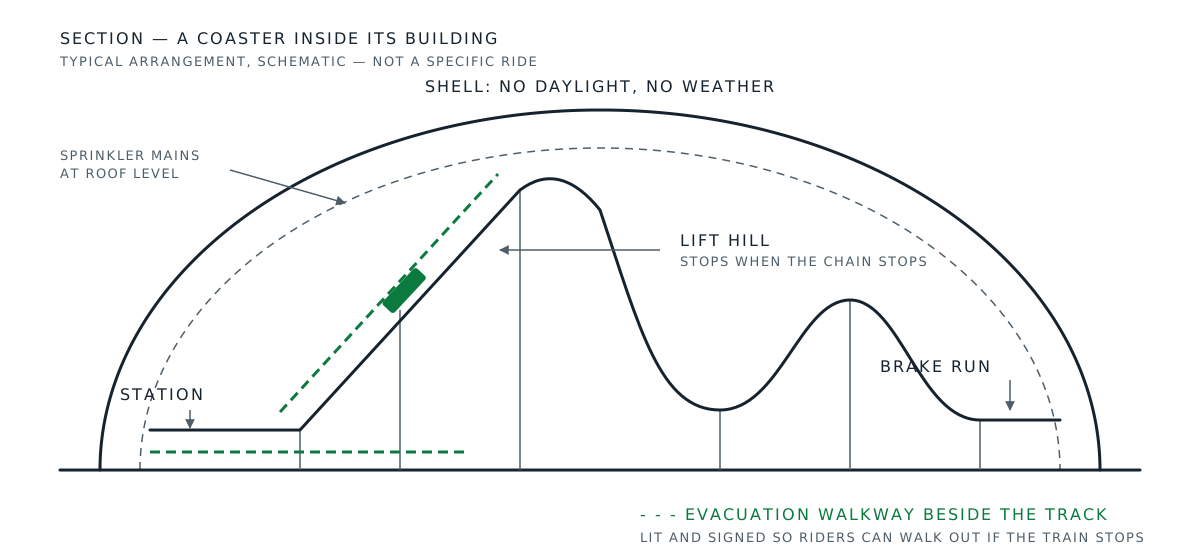
The size of the envelope is the constraint that shapes everything. The Magic Kingdom’s Space Mountain sits inside a hollow cone about 300 ft (91 m) across, per Wikipedia, and carries two tracks of roughly 3,190 ft (970 m) each, according to RCDB. Europa-Park’s Eurosat, which opened in 1989 and is built by Mack Rides, lives inside a silver geodesic sphere and runs on roughly 900 m (2,950 ft) of track, though sources differ by a few metres on the exact length.
Both are the same trick in two shapes. A dome or cone is an efficient way to enclose a very large volume, and a coaster is mostly empty space between track and walls, so a big hollow shell suits it.
Where space is tight in a different way, the answer can be to dig downwards. Wikipedia says part of the Revenge of the Mummy building was excavated several feet deep for the climactic drop. That’s a neat bit of arithmetic: you can’t make the roof taller without rebuilding the building, but you can make the floor lower and gain the same drop.
Why launches replaced the lift hill
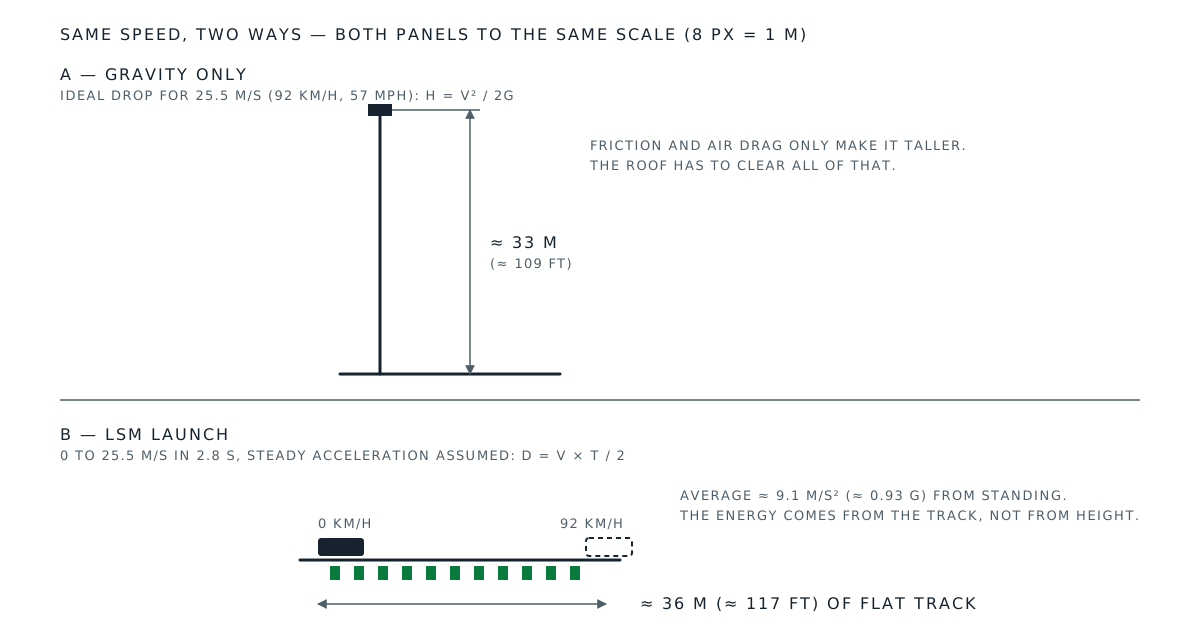
This is the engineering consequence most visitors never spot. A lift hill is a tall, slow, space-hungry thing. It turns height into speed, and height is exactly what a roof limits.
The numbers show why. To reach 92 km/h (57 mph), 25.5 m/s, using gravity alone you need a drop of about 33 m (109 ft), from the physics of v squared over two g, and that’s before friction and air drag, which make the real figure taller. Now compare Rock ‘n’ Roller Coaster at Disney’s Hollywood Studios. It’s an indoor Vekoma coaster that opened on 29 July 1999, according to Wikipedia. Its RCDB entry lists a height of about 80 ft (24 m) but a top speed of 57 mph (92 km/h), reached from a standing start in 2.8 seconds.
That is not a gravity result. A 24 m structure cannot deliver a 33 m drop. The speed comes from an LSM, a linear synchronous motor, which pushes the train along a flat launch track using magnetic fields rather than height. If you assume steady acceleration (a simplification, since real launches are shaped), 2.8 seconds to 25.5 m/s is an average of about 9.1 m/s², or roughly 0.93 g, over about 36 m (117 ft) of track. That is a short straight stretch in the base of a building, not a hill that needs a tower.
The same logic runs through Revenge of the Mummy, which uses linear induction motors rather than LSMs and launches the train three times in a ride of about three minutes. RCDB lists a top speed of 40 mph (64 km/h) on 2,200 ft (670 m) of track, in a ride just 44.4 ft (13.5 m) tall, which is what you get when motors, not hills, supply the energy. Wikipedia adds that the track includes five switches, and that one launch follows a 180-degree turn of the train in a room.
Not every indoor coaster does this. Space Mountain is gravity-driven apart from its chain lift, and Bill Watkins, who designed the Disneyland version, is credited with its tubular steel track design. Both routes work; they just spend different resources.
A tall hill needs a tall building. A launch needs a long floor, and floors are cheaper than roofs.
Darkness is a design tool, and a hazard
Darkness makes the ride feel faster than it is. With no horizon, no fixed objects and no sense of how far away the walls are, your brain has nothing to measure speed against, and every change of direction feels sharper. The Magic Kingdom’s Space Mountain is listed at 27 mph (43 km/h) and a duration of 2 minutes 35 seconds by RCDB. In daylight that would be a modest family coaster.
It has a practical downside. Everyone in the building, riders and maintenance crews alike, now depends on lighting that isn’t the lighting the guests see.
Indoor rides therefore run in two lighting modes. In show mode the effects, music and darkness are on. In work mode the building is lit like a warehouse, so crews can see the track, the supports and the train. Wikipedia’s Space Mountain page notes that work lights turn on during technical problems, which is exactly the principle: the dark is a presentation layer, and it can be switched off.
Strip the darkness away and what’s left is an ordinary coaster. That isn’t a criticism. Hiding ordinary engineering well is the whole job.
Fire, smoke and getting out
Here the box becomes a liability. A windowless building full of electrical equipment, lighting rigs and theming materials is a hazard in its own right, and it holds several hundred people who can’t see where the exits are.
Fire codes treat such buildings as a special case. In the United States, local adoptions of the model fire codes class them as “special amusement buildings”, and the requirements published by municipal fire authorities that we reviewed are consistent: sprinklers throughout; automatic illumination of the exit route when a detector or the sprinklers trigger; confusing sounds and effects stopped; and a voice alarm that tells people to proceed to the nearest exit. One published code specifies at least 1 footcandle (about 11 lux) of light on the walking surface. Singapore’s fire authority sets its own requirements for indoor amusement rides, including non-combustible materials. The details vary by jurisdiction, and a ride’s own certification, covered in our piece on how coasters are inspected, has to satisfy local rules as well as the manufacturer’s.
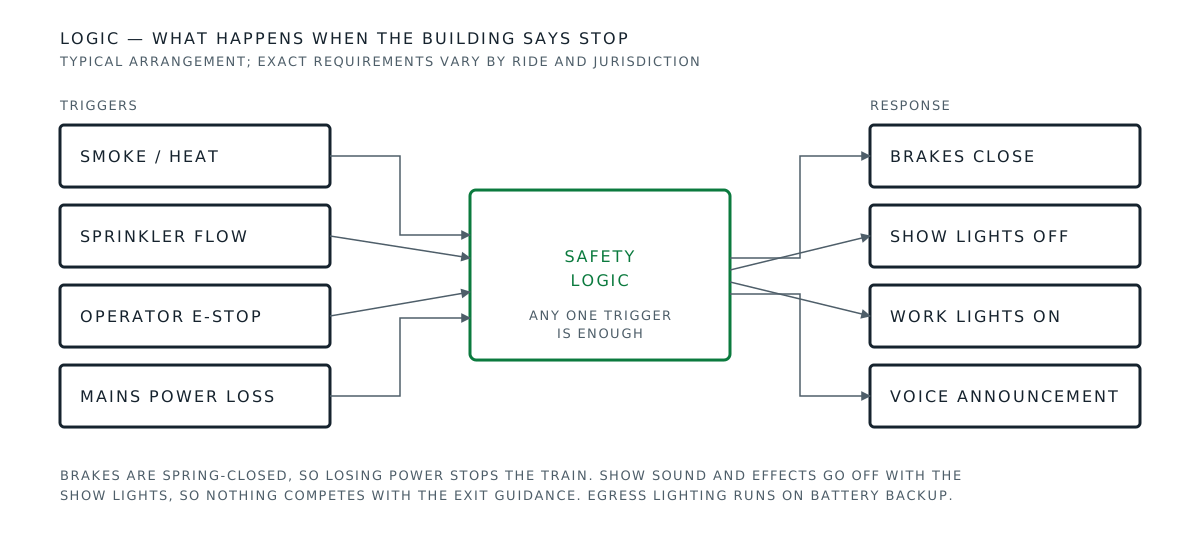
Then there is the ride itself. A coaster in a stoppage is the same as any other: the brakes are designed to close when power is lost, as we explain in the block system article, so a failure leaves trains held rather than free. What’s different indoors is what happens next. Riders on a stopped train in a dark building need a lit, signed way to walk out. That is why indoor tracks have evacuation walkways beside them, lit separately from the show, and why the work lights are wired so that they come on automatically rather than waiting for a person to find a switch.
None of this is glamorous, and almost none of it is visible to a guest. It is, however, the bulk of what separates an indoor coaster from an outdoor one in a regulator’s eyes.
Where you’ll find it
| Ride | Park | Opened | What to notice |
|---|---|---|---|
| Space Mountain | Magic Kingdom, Walt Disney World, USA | 1975 | Twin tracks of about 3,190 ft (970 m), 27 mph (43 km/h) and a duration of 2:35, per RCDB. A gravity coaster with a chain lift, in a hollow cone. |
| Space Mountain | Disneyland, USA | 1977 | 3,459 ft (1,054 m) at 32 mph (51 km/h), per RCDB. New track was fitted in a 2005 refurbishment. |
| Rock ‘n’ Roller Coaster | Disney’s Hollywood Studios, Walt Disney World, USA | 1999 | A Vekoma LSM coaster: 57 mph (92 km/h) in 2.8 seconds, about 80 ft (24 m) tall, three inversions, per RCDB. Now themed to The Muppets, per RCDB. |
| Revenge of the Mummy | Universal Studios Florida, Universal Orlando, USA | 2004 | Premier Rides, linear induction motor launches, 40 mph (64 km/h), 2,200 ft (670 m), a turntable and track switches. |
| Eurosat – CanCan Coaster | Europa-Park, Germany | 1989 | A Mack Rides coaster in a geodesic sphere. Rebuilt in 2017–18 with new track and trains and reopened as CanCan Coaster. |
The Rock ‘n’ Roller Coaster entry carries a footnote worth knowing. RCDB notes that its layout is nearly identical to Xpress: Platform 13, an outdoor Vekoma coaster at Walibi Holland, with only the unload station different. It’s a useful reminder that an indoor coaster isn’t a different animal from an outdoor one, only a better-dressed one with more plumbing.
The Dispatch verdict
The clever part of an indoor coaster is how little of it you can see. The track is routine engineering; the real work is in the choices around it: a launch chosen because a roof is lower than a lift hill, a big hollow shell chosen to enclose the layout efficiently, a lighting system chosen so the same building can be a spaceship at 10.00 and a lit corridor at 10.01.
If you ride one this week, the thing to look for is the moment the show stops. Parks rarely draw attention to it, but a well-run indoor ride switches from fiction to procedure in seconds, and that is the best evidence that the engineering underneath is sound.
Further reading: how launch coasters get from 0 to 92 km/h without a hill, how chain lifts, cable lifts and elevator lifts work, why rides close in bad weather, and why indoor rides mostly dodge it, and how coasters are inspected and certified.