
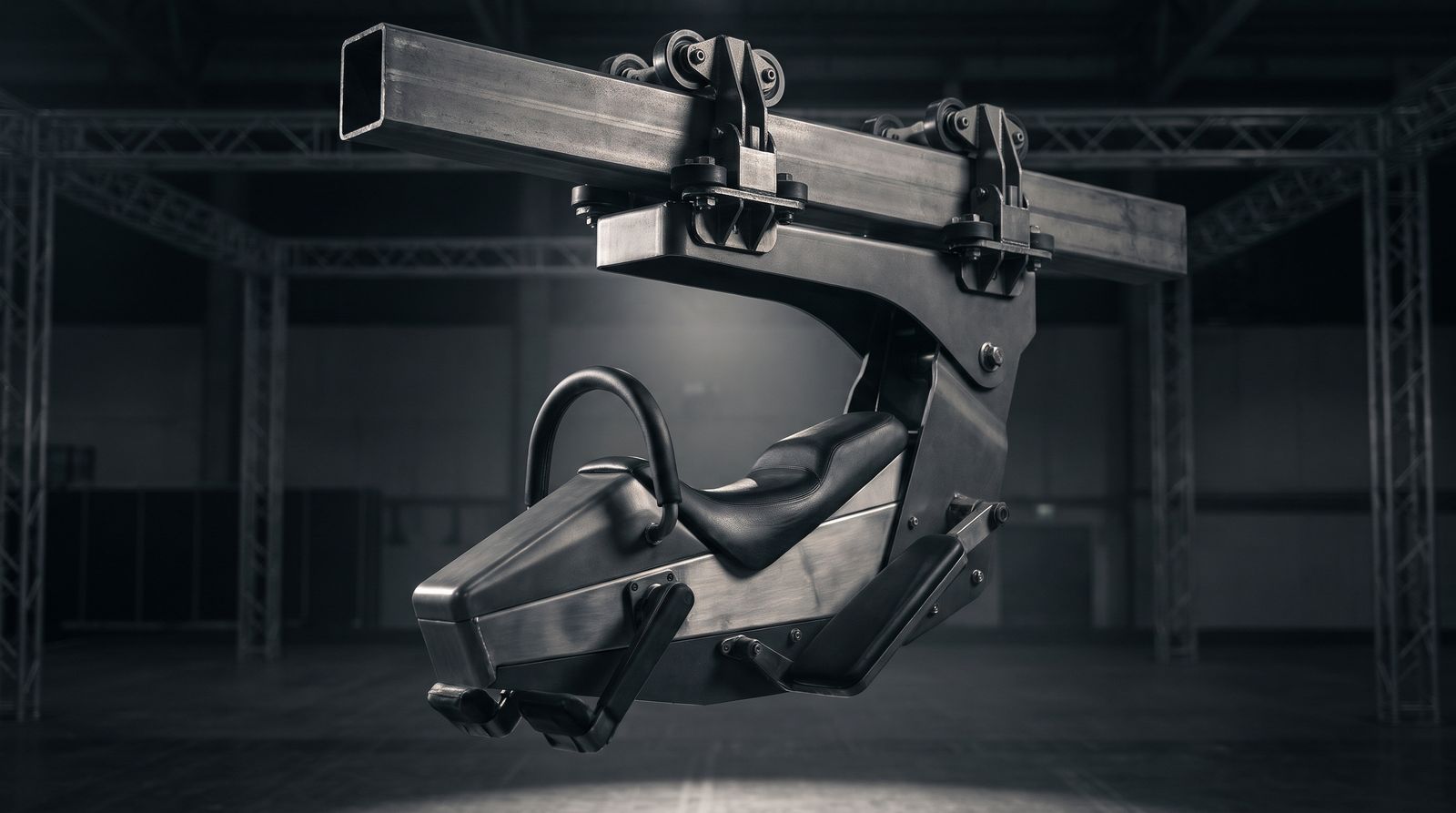
Vekoma’s newest type of coaster now exists as real hardware rather than renderings. On the opening day of IAAPA Expo 2026 in Orlando, 17 November, the Dutch manufacturer and Six Flags Magic Mountain unveiled the first Thrill Glider train. Riders sit astride it and lean forward beneath the track. It is the same type of ride Efteling has ordered for Missie Luminar.
What happened
Six Flags Magic Mountain announced Thrill Glider in September for a 2027 opening, on the former Golden Bear Theatre site in Valencia, California. Trade title Amusement Today reported that the coaster “officially went vertical” (the first track and supports standing on site) a few days before the show. At the Expo, Six Flags and Vekoma presented a sample car, which the park calls a “hovercycle-style” train, along with its onboard lighting and audio.
The park describes the ride as a mix of flying, motorbike and suspended coasters. Riders lean forward in a seat hanging below the rail, with no track in view beneath them. Six Flags says they board from the rear of the station, which it describes as an accessibility measure. The minimum height is 48 in (122 cm).
The more useful detail came from Vekoma itself. Speaking to Dutch enthusiast site Looopings at the show, Vekoma’s Stefan Holtman described how the rider is held. A bar comes down against the rider’s back, and a retractable lever pins the legs. Holtman said the layout is similar to Vekoma’s Booster Bike at Toverland but leaves more room to get on. He also said Vekoma added extra dampers for ride comfort, and that each car carries speakers and a subwoofer.
The detail
| Six Flags Magic Mountain | Efteling (Missie Luminar) | |
|---|---|---|
| Opening | 2027 | 2029 |
| Top speed | 80 km/h (50 mph) | about 80 km/h (50 mph) |
| Height | 32.6 m (107 ft) | not announced |
| Length | 1,030 m (3,380 ft), per the park | not announced |
| Inversions | five, per the park | not announced |
| Seats per train | 16 (RCDB) | 18 (Looopings) |
| Investment | not disclosed | €50 million |
Six Flags’ own figures for length and inversions don’t match RCDB’s. RCDB currently lists 1,090 m (3,576 ft) and four inversions. We’ve used the park’s numbers and labelled them, and they may change before opening. The two databases agree on the height and the speed.
What it actually means
The most important thing Vekoma said at the show wasn’t about the theming. Holtman told Looopings that the ride’s forces top out around 3.5 g, and he gave the reason: in a forward-leaning seat, a stronger force would push the rider’s head too far down.
That is the main engineering limit on this ride type. On a normal sit-down coaster, positive g (the force that presses you into the seat at the bottom of a dip) runs straight down the spine. The seat back and the headrest carry it. Lean the rider forward and the same force works across the body. Now the neck has to hold up a head that sticks out in front of the shoulders. Flying coasters have the same problem, which is why their big loops are designed so carefully. A restraint can only do so much. The back bar holds you onto the seat, but it does nothing to stop your head nodding forward.
The numbers support this. Holtman said the launch system can reach 120–130 km/h (75–81 mph). Both customers have chosen about 80 km/h (50 mph). That isn’t Magic Mountain or Efteling being timid. If the forces have to stay low, extra speed brings little benefit, so the ride depends on other things: multiple launches, what the park calls 12 airtime moments, and track that passes close to the ground and the scenery. Coming from a manufacturer that spent the 1990s known for rough rides, the extra dampers are a sensible addition.
Some of this is familiar to Vekoma. The company showed its first motorbike coaster concept at IAAPA in 2003. It became Booster Bike at Toverland in 2004, and Vekoma built a custom version, Velocity, at Flamingo Land in North Yorkshire the following year. RCDB lists Booster Bike’s trains as eight two-seat cars, 16 riders in all, which is the same layout RCDB gives for Magic Mountain’s Thrill Glider. If RCDB is right that Magic Mountain runs a single 16-seat train, hourly capacity will be modest. A single train can’t be dispatched again until it returns to the station, so the queue moves only as fast as one ride cycle. Efteling’s longer 18-seat train hints that the Dutch version may be set up differently. Neither park has said how many trains it will run.
That leaves the record claims. Six Flags says Thrill Glider will set six world records. Every one of them, from “longest Thrillglider” to “most inversions on a Thrillglider”, is in a category that has only one member. It is the first Thrill Glider, so it will also be the tallest, fastest and longest until another is built. As we noted when Efteling began clearing the Missie Luminar site, Efteling has avoided “world’s first” claims, and Magic Mountain’s 2027 date would make Efteling’s 2029 ride the second at best.
The Dispatch verdict
The sample car shows that Vekoma has thought hard about how the human body behaves in this position. The fairly low 3.5 g ceiling and the matching 80 km/h top speeds come from that physics, not from timid customers. Whether the ride works will depend on how the track uses those limits, and nobody can judge that until the Magic Mountain coaster runs in 2027.
Further reading: Efteling’s Missie Luminar site clearance and what we knew in September, how roller coaster restraints actually work, how LSM and hydraulic launches work, how theme parks calculate ride capacity, and our guide to the roller coaster manufacturers.