
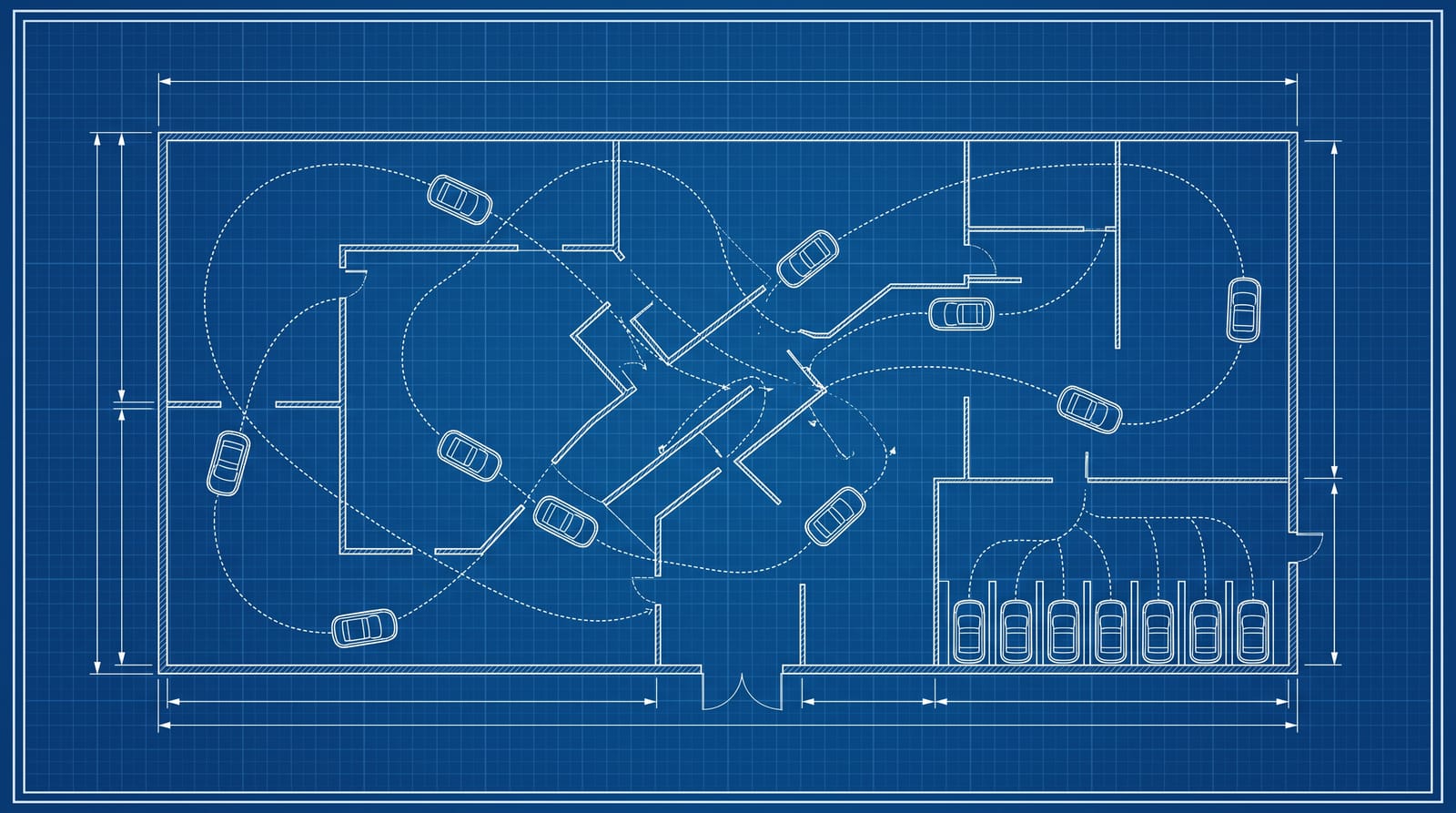
Somewhere in the middle of a modern dark ride, your vehicle does something quietly impossible. It drifts sideways, pirouettes, waltzes around another car full of strangers, and parks itself in front of the scene the story needs next — and when you glance down, there’s no rail. There’s nothing. You are in a room with several free-roaming vehicles and none of them ever touch.
The short answer: a trackless dark ride vehicle is a battery-powered robot. It steers itself along an invisible, pre-programmed path, tracking its own position by counting wheel rotations and correcting against reference markers in the floor, while a central control system choreographs every vehicle in the building — where each one goes, when it pauses, and how close it’s allowed to get to the others.
No rail, no wire, no driver. Just arithmetic, radio, and a great deal of rehearsal.
What the rail used to do
A classic dark ride’s rail did three jobs at once: it steered the vehicle, powered it (usually via a bus bar alongside), and guaranteed spacing — vehicles on one rail are in single file forever, like beads on a string. Reliable, cheap, and creatively rigid: every guest visits every scene in the same order, at the same speed, from the same angle, for the life of the attraction.
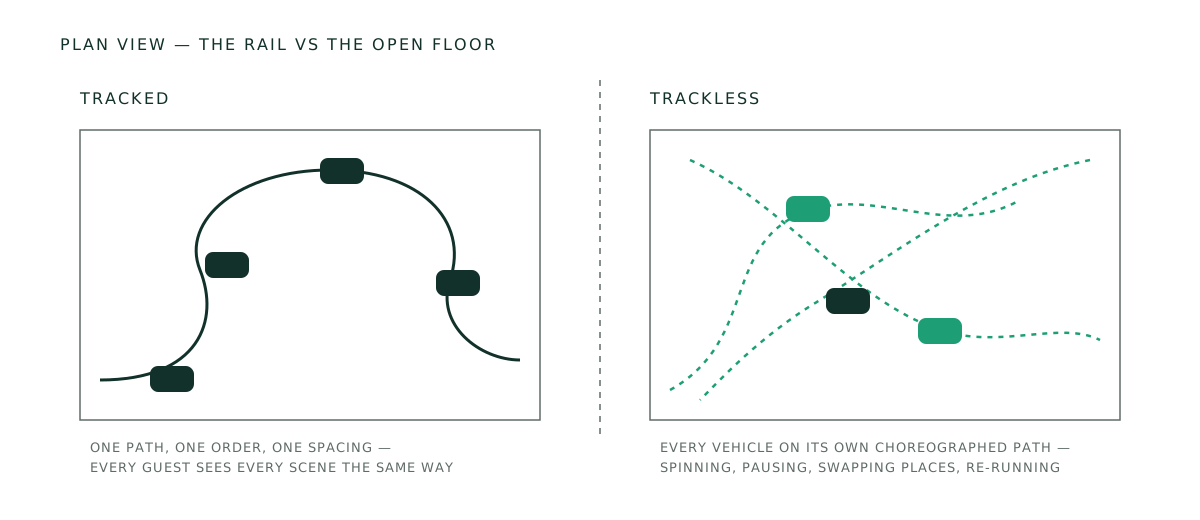
Going trackless means rebuilding all three jobs in software and batteries. Steering becomes navigation; power becomes onboard batteries (topped up by charging in the station or at show stops); and spacing — the safety-critical one — becomes a digital block system, with the same rule as any coaster: two vehicles are never permitted in the same protected zone at once. The rule survives; only the hardware enforcing it changed.
How a vehicle knows where it is
There’s no GPS indoors, so the vehicle navigates the way a careful hiker does: dead reckoning, corrected by landmarks.
Dead reckoning: encoders on the wheels count every rotation and steering angle, so the vehicle continuously computes where it thinks it is. Over a long run, tiny errors accumulate — carpets of drift, in navigation terms. So the floor holds reference markers — transponders or tags at known positions — and each time the vehicle passes one, it snaps its estimate back to truth. Between the two, position is known to centimetres, continuously, without a single visible piece of guidance.
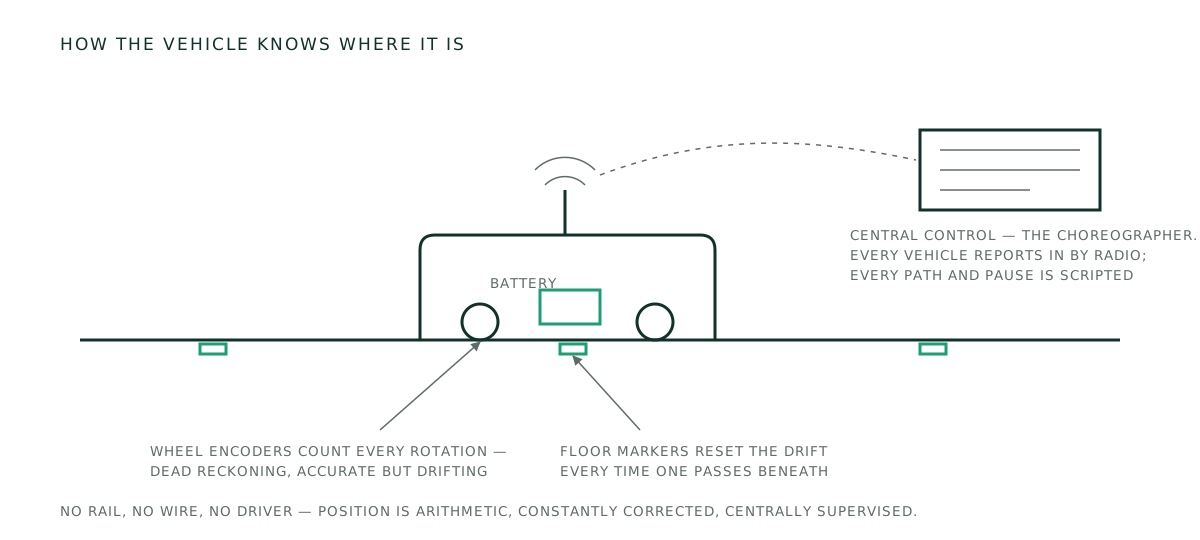
Above the vehicles sits the central control system — less a traffic cop than a choreographer. Every vehicle reports position by radio; control compares everything against the scripted show, nudges timing, holds a vehicle here, releases one there. The paths aren’t improvised (a themed ride is a performance, not a robotics demo) — they’re authored, rehearsed and stored, down to the second and the centimetre.
The pioneer was Pooh’s Hunny Hunt at Tokyo Disneyland, which opened in 2000 and swapped the older buried-wire guidance idea for sensor-based positioning — the template refined by everything since, from Hong Kong Disneyland’s Mystic Manor (2013) to Disneyland Paris’s Ratatouille (2014) and Star Wars: Rise of the Resistance (2019).
Why parks pay for this
The creative unlock is obvious the first time you ride one: scenes can be staged rather than passed. Vehicles dance in pairs, split down different corridors, spin to face the action, or back away from a threat — the ride vehicle becomes an actor.
The quieter reason is arithmetic. Watch the choreography chart:
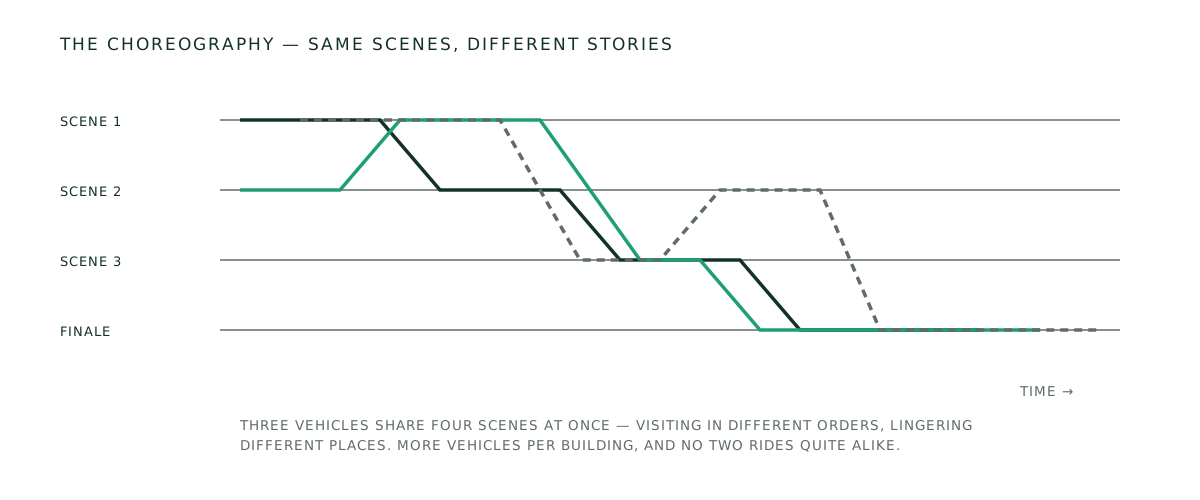
Because vehicles don’t queue on one rail, a trackless building can hold more of them at once, visiting scenes in parallel and in different orders. That’s capacity — the currency every park actually trades in — plus built-in re-rideability, since your second lap can genuinely differ from your first. When a ride costs this much per square metre of showbuilding, extracting two benefits from one system is what gets finance to sign.
The Dutch angle
Here’s the bit English-language coverage routinely misses: much of the world’s trackless hardware isn’t built by the theme park giants but bought in — and one of the leading suppliers is ETF Ride Systems of Nederweert, in the Netherlands, whose “Mystic Mover” platform carries guests through dark rides worldwide. The showcase closest to this site’s heart is Symbolica at Efteling (2017), where ETF’s vehicles glide through the Palace of Fantasy on three different scripted routes — a Dutch supplier, in a Dutch park, running some of the smoothest trackless choreography anywhere, twenty minutes from where the hardware was made.
It’s a tidy illustration of how this industry actually works: the magic gets the press, the machinery comes from an industrial estate in Limburg. That same estate is now trying its hand outside dark rides entirely — ETF’s next project, a track-mounted “swinging bobsled” for Toverland, a few miles up the road.
The catch
Trackless rides are harder to run than they look. Batteries need managing all day; navigation needs its markers and its radio spectrum clean; and when one vehicle faults, control has to re-choreograph the whole floor around it — or stop the show. Operators will tell you a trackless system’s uptime is earned nightly, in the maintenance bay, one vehicle at a time. The rail, for all its rigidity, never needed charging.
That’s the trade, and parks keep making it, because the alternative is scenes that can only ever be driven past in single file.
The Dispatch verdict
Trackless is what happens when a century-old ride format meets warehouse robotics and both come out better. The engineering isn’t exotic — encoders, markers, batteries, radio — but the discipline is: a good trackless ride is a stage show performed by a dozen robots, every four minutes, all day, with no understudy. When the choreography lands, it’s the closest thing the industry has to genuine sleight of hand — the trick where the trackwork disappears, and the story is all that’s left.
Further reading: the block-system logic that still governs vehicle spacing, rail or no rail.